





 Portuguese
  English
  Spanish
  6 min of reading
  1 comment


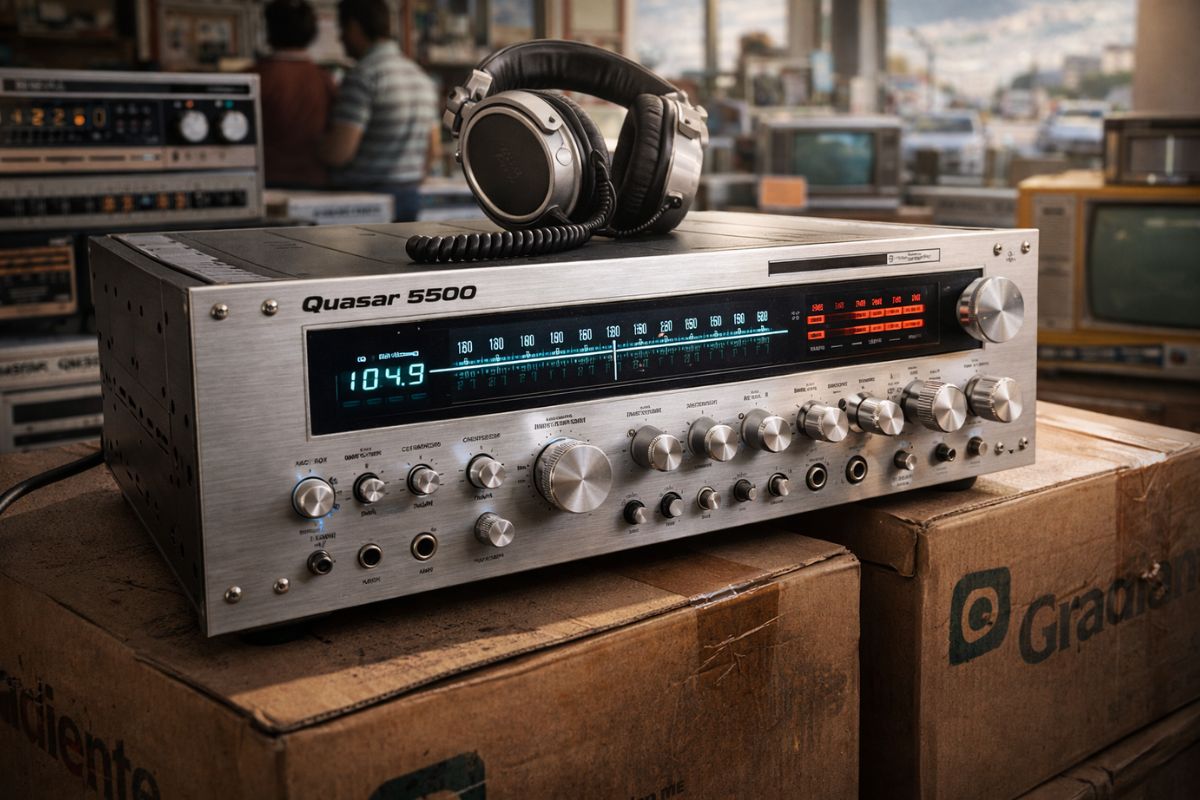


The Quasar 5500 Became a Legend as an Anodized Aluminum Amplifier with Studio Sound, but Lost Ground in the Brazilian Market Despite Its Cult Aura.
The Quasar 5500 became a legend because it did not take the easier path during a time when national audio was dominated by larger brands, more flexible industrial strategies, and products designed to compete on a large scale. While the market sought adaptation, cost reduction, and standardization, Quasar chose to exaggerate in construction, finishing, and the personality of its design.
This choice turned the amplifier into a rare symbol of national engineering. The Quasar 5500 became a legend not only for its sound but for the entire work, with an anodized aluminum chassis, firm controls, an almost industrial assembly proposal, and an evident refusal to accept solutions that seemed like concessions to the market.
An Amplifier Born to Challenge Its Own Sector
In the late 1970s, the Brazilian audio sector was strong, with large companies occupying display cases, shelves, and the consumer imagination.
-
Scientists have finally discovered where the plastic that disappeared from the oceans went, and the answer is frightening: it fragmented into such tiny particles that they became invisible and now there are 27 million tons of nanoplastic just in the North Atlantic.

-
The Artemis II mission will take the Orion capsule back to the vicinity of the Moon with four astronauts, a private bathroom with a curtain, a system adapted for men and women, and a level of comfort that highlights how the Apollo era operated at the rawest limits of space exploration.

-
Giant structures on the seabed precisely control oil and reveal how high-tech underwater valves work.

-
China has just tested a giant drone the size of a fighter jet with a wingspan of 25 meters that carries 6 tons, flies for 12 hours, and the most frightening part: it can launch entire swarms of smaller drones directly from the air.


However, Quasar decided to take a different path. Instead of repeating already accepted formulas, the brand built its own identity, based on technical independence and a very strict vision of quality.
In this context, the Quasar 5500 emerged as the ultimate symbol of this stance. It was not designed to be discreet, lightweight, or consensual.
It was conceived to convey solidity, visual impact, and the feeling that the owner was facing an unusual machine. This is precisely why the equipment became a reference among vintage audio enthusiasts.
Why the Quasar 5500 Became a Legend in Construction
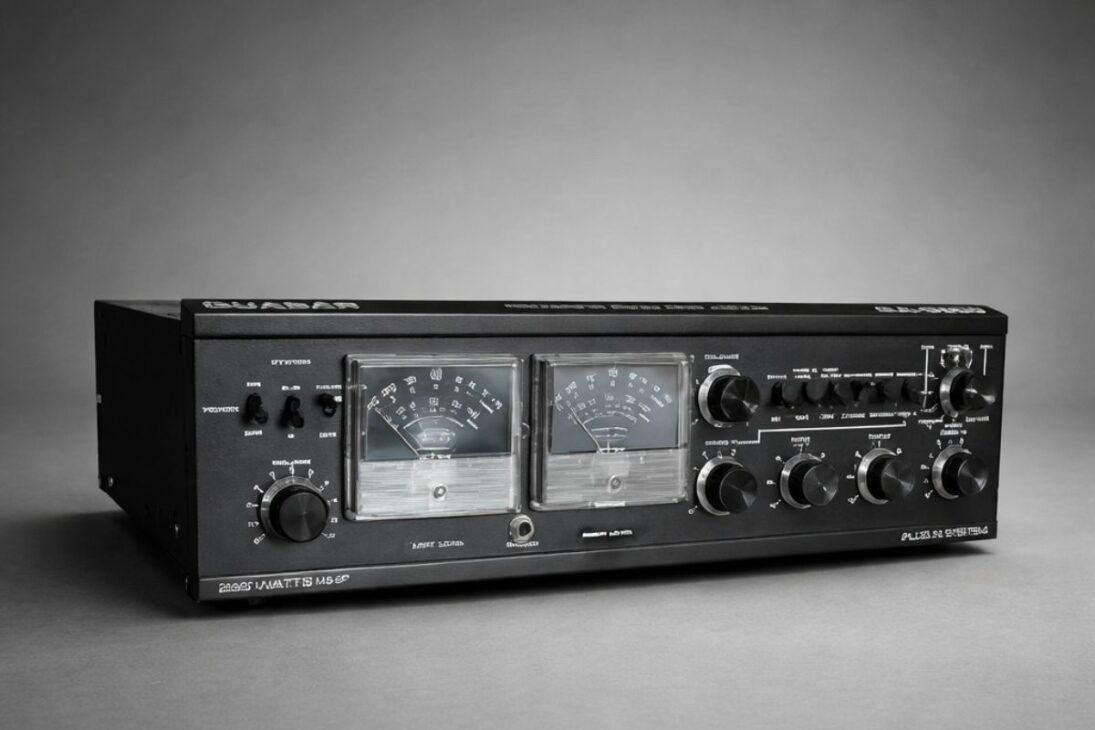
The fame of the device begins with its physical aspects. The thick anodized aluminum front panel, firm switches, and large controls gave the ensemble a presence well above average.
The Quasar 5500 did not try to appear delicate or modern in the conventional sense. It embraced an almost brutalist, heavy, and direct aesthetic.
This type of construction helped to solidify the aura surrounding the model. The Quasar 5500 became a legend because it seemed built to last far longer than normal, without visible economies in the main finish.
The tactile sensation of the controls and the robustness of the cabinet reinforced the idea that the device was in another category within the national market.
More Than an Amplifier, a Mixing Center
Another point that sets the model apart is its functional proposal. The equipment was not sold merely as an amplifier but as a machine capable of taking on a mixing role, bringing domestic use closer to resources more related to the professional world.
According to the submitted material, the brand highlighted this dual function as a major differentiator. There was a decibel-to-watt reading circuit, a filter for cleaning noise, and an operating proposal that interested even those who worked with audio transitions and blends.
This helped to transform the Quasar 5500 into the centerpiece of parties, nightclubs, and more ambitious systems.
The Black Aluminum Tower That Became an Object of Desire
The Quasar 5500 also made sense within a larger set. It could be stacked with other modules from the line, forming a visually imposing tower marked by dark finishing, anodized aluminum, and a strong aesthetic identity.
A graphic equalizer, measuring instrument, and tuner completed the proposal. However, the brand did not manufacture the tape deck that would fully complete the system.
The refusal to import Asian mechanisms simply to apply its own name shows the degree of rigidity of the company.
This coherence helped to preserve the brand’s image but also limited its ability to compete with more flexibility.
The Interior Showed Genius, but the Rivets Became a Problem


Inside, the design was seen as sophisticated. The separate and pluggable boards, fitted into sockets with gold-plated contacts, indicated a technical care that impressed.
In theory, this facilitated electronic maintenance work and showed advanced thinking for the period.
The problem began before reaching the boards. The company’s obsession with closing the chassis turned internal access into a mechanical nightmare. The brand used industrial rivets to prevent simple opening.
Thus, the technician had to destroy this sealing to enter the device, and the subsequent closing already altered the original appearance. It was an extreme solution, consistent with the brand’s philosophy but not friendly for common repairs.
The Studio Sound Contradicted the Idea of Aggressiveness
Over time, part of the fame of the Quasar 5500 was simplistically reduced to an aggressive sound. But the presented material points to another reading.
The manuals and the technical proposal indicate a device aimed at fidelity in the audible range, with low distortion and a gain margin planned for tolerance, not saturation.
This places the model in a curious position. It had a rugged appearance, heavy construction, and intimidating presence, but the intended signature seemed to aim for cleanliness and neutrality.
The Quasar 5500 became a legend also because of this fascinating contradiction between form and result, as its tank-like visual coexisted with the promise of more controlled and precise audio.
The Price Showed It Was a Product for the Few
The submitted material cites that in May 1981, the amplifier cost 44,900 cruzeiros, a very high amount for the consumption standards of the time.
The device was not just a technical desire but also a good restricted to an audience willing to invest heavily in sound.
This reinforces the symbolic place that the model occupied. It was not a popular product and never tried to be. The Quasar 5500 positioned itself as high-level equipment in a market that was already experiencing fierce competition for scale, price, and distribution.
The Refusal to Go to Manaus Came at a High Price
The same conviction that made the brand admired also helped to weaken it commercially. When the Free Trade Zone of Manaus began offering significant tax advantages, more established rivals benefited from this movement and gained competitive edge.
Quasar, on the other hand, remained faithful to its production base and its own manufacturing logic. This decision, combined with the company’s rigidity on several points, made the competition increasingly unequal.
The Quasar 5500 became a legend for its engineering, but the company ultimately lost ground in terms of costs, scale, and tax adaptation.
The Market Won Where Engineering Did Not Yield
The fall of Quasar does not appear, in the material, as a result of a lack of quality. On the contrary. What is seen is the image of a brand that insisted on an almost inflexible product vision and paid dearly for it when the market demanded more pragmatic responses.
In the end, the company could not compete equally with those who better capitalized on the industrial and tax advantages of the period.
It was a commercial defeat, not a denial of the technical strength that the brand sought to build. In 1986, according to the material, Quasar declared bankruptcy, ending a journey that still inspires respect today.
Why the Legend Remains Alive
Today, finding a preserved example of the Quasar 5500 means much more than finding an old electronic device. It means locating a piece that encapsulates an entire philosophy of design, finishing, and industrial posture.
Details like intact rivets, the integrity of the chassis, and the originality of the ensemble weigh heavily in the perception of value among collectors.
For this reason, the Quasar 5500 became a legend over time, even after the company was defeated by the market.
The anodized aluminum, excessive construction, rigid design, and sound surrounded by technical aura transformed the device into a relic from a time when part of the national industry still believed that doing better could be more important than doing cheaper.
A Commercial Defeat That Turned into Symbolic Victory
The story of the Quasar 5500 summarizes a powerful contrast. On one side, a company that refused shortcuts, insisted on its own identity, and took engineering to an almost obstinate level. On the other, a market that rewarded industrial efficiency, tax benefits, and strategic adaptation.
In the end, the brand fell, but the equipment remained. The Quasar 5500 became a legend precisely because it survived as a symbol of what the market could not preserve, an idea of national product that is radical, authorial, and built to command respect from the very first touch.
And for you, which vintage national device truly became a legend and still deserves to be remembered today?









Fuja de empresas executivos gerentes criadores que sejam intolerantes rígidos e inflexíveis é a falência na certa.