





 English
  Francês
  Alemão
  Italiano
  Japonês
  Norueguês
  Portuguese
  Spanish
  4 min of reading
  0 comments


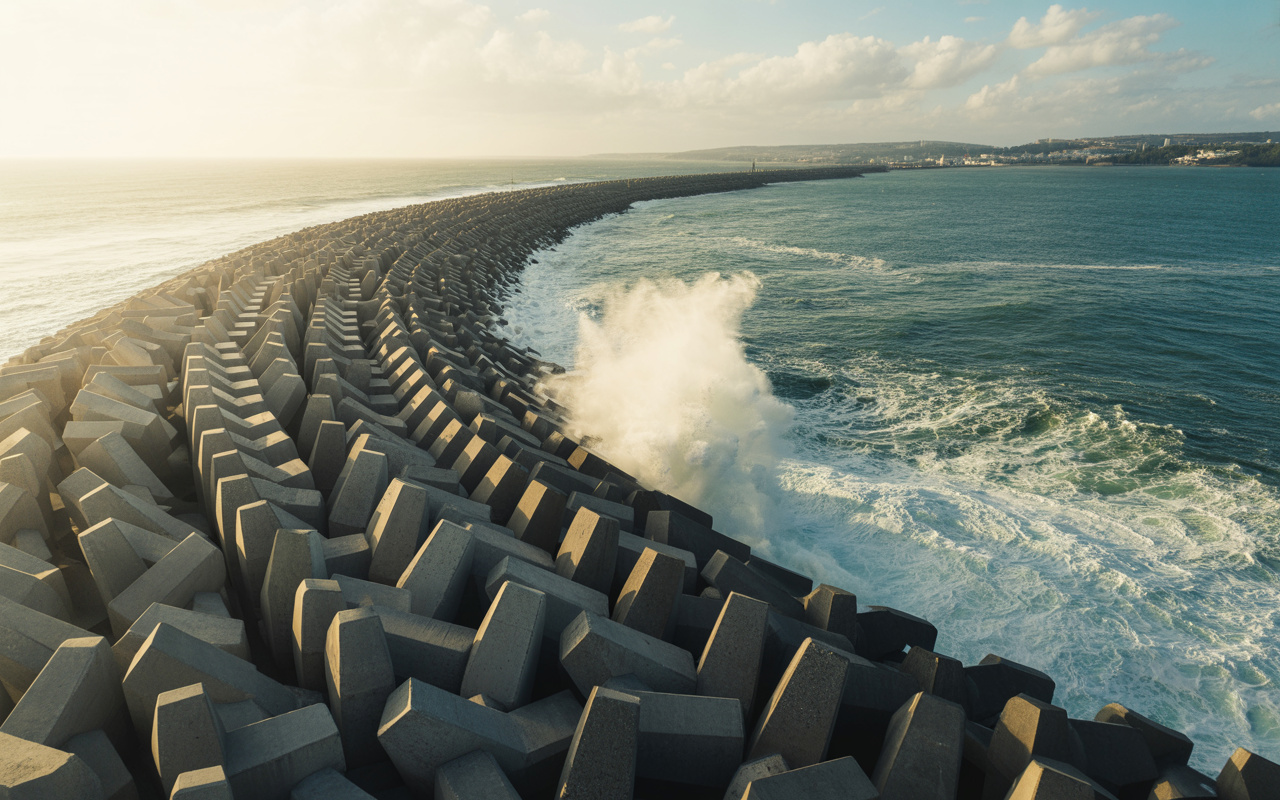
The Breakwater of the Port of Sines Uses Artificial Concrete Blocks Weighing Up to 90 Tons to Withstand Extreme Atlantic Waves in One of Europe’s Most Demanding Coastal Works.
According to technical studies from European coastal engineering, PIANC reports, and documentation associated with the development of the Port of Sines, the breakwater in Sines is not just an ordinary port structure. It was designed to operate in open Atlantic waters, without natural protection, directly facing one of the most energetic wave regimes in Western Europe.
Unlike ports sheltered by bays or estuaries, Sines is exposed to long waves, persistent ocean swell, and severe winter storms, which imposed construction solutions typical of extreme engineering projects.
A Breakwater Designed for Deep Waters and Maximum Wave Energy
The main breakwater of the Port of Sines was built in deep waters, a condition that eliminates the possibility of shallow structures and requires the use of massive slopes and heavy armor. In storm scenarios, the Atlantic in this region can generate significant waves exceeding 10 meters, with long periods and enormous destructive capacity.
-
Private ports increased by 14.1% in January 2026 and lead port activity with 66% of the cargo, driven by oil, agribusiness, and exports.
-
Government Releases R$ 5.1 Billion to Modernize Ports and Generate Over 5,000 Direct Jobs in Brazil
-
Merchant Marine Fund Approves R$ 5.1 Billion for Port Projects Aiming to Accelerate Port Modernization, Expand Logistics Infrastructure, and Generate Over 5,000 Jobs in Brazil
-
Giant of World Trade: Largest Port in Latin America Is in Brazil, Covers 7.8 Million Sq. Meters on São Paulo Coast, Accounts for 25% of All Exports, and Now May Undergo Historical Expansion That Triples Its Area and Changes the Future of National Logistics


To deal with this environment, engineers adopted a classic heavy coastal engineering concept: dissipate energy through mass, rather than structural delicacy.
Artificial Blocks Weighing Up to 90 Tons as Primary Armor
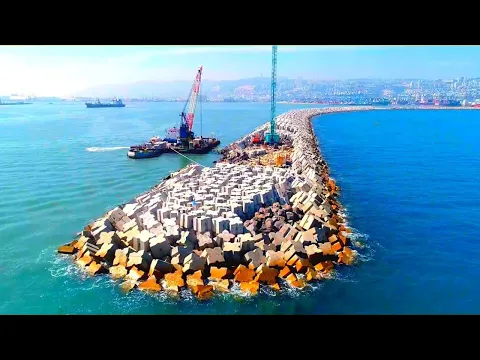
The most impressive element of the work is the use of high-density artificial concrete blocks, of the Antifer type and equivalent massive variations, with individual weights between 70 and 90 tons. Each block functions as an independent energy dissipation unit, absorbing the direct impact of waves and reducing the erosion of the breakwater core.
These blocks are not stacked in a regular manner. They are cast and strategically positioned on the outer slope, creating an irregular geometry that breaks the coherence of the waves and reduces the reflected force.
From a construction perspective, this means dealing with:
- pieces larger than mining trucks,
- positioning tolerances in an unstable marine environment,
- and lifting and launching operations in extremely limited weather windows.
Concrete as a Strategic Material in Ocean Environments
The use of high-strength concrete, instead of natural rock, was not an aesthetic choice. In Sines, concrete allowed for:
- strict control of weight and geometry,
- mass production of standardized units,
- greater structural predictability under repetitive wave impact.
Each block is, in practice, a structural mass designed to fail slowly, absorbing energy over decades without compromising the breakwater core.
Construction in Open Sea: Logistics and Constant Risk
The execution of the breakwater required continuous operations in open sea, where ocean conditions dictate the pace of work. Unlike land construction sites, the work depended on:
- large barges,
- maritime cranes capable of handling dozens of tons in motion,
- and constant monitoring of wave, wind, and current conditions.
Each block launched represented a high-risk operation, where positioning errors could mean loss of the element, damage to equipment, or local slope instability.
A Breakwater That Became an International Study Subject
The breakwater in Sines has become an international reference not only for its scale but because partial failures and subsequent reinforcements have generated a vast array of academic and technical studies. Hydraulic engineers analyzed the behavior of the blocks under extreme events, refining stability models for similar structures worldwide.
This transformed Sines into a real laboratory of coastal engineering, contributing to standards, design methods, and safety criteria used today in major ocean ports.
When Weight Becomes the Main Engineering Tool
At the breakwater of the Port of Sines, there are no sophisticated visible systems, complex sensors, or “elegant” solutions. The structural logic is straightforward and brutal: sufficient mass to stay in place when the ocean tries to uproot everything.
Blocks weighing up to 90 tons, cast in open sea, represent an approach that accepts direct confrontation with nature, rather than trying to circumvent it.
An Invisible but Vital Work
To those observing the port from a distance, the breakwater appears as just a solid line on the horizon. But beneath the surface lies a colossal structure, made up of millions of tons of materials, whose sole purpose is to ensure that ships, terminals, and pipelines operate safely in one of Europe’s most hostile marine environments.
This is the kind of work that rarely becomes a postcard, but without it, no modern port infrastructure would survive in open sea.
Coastal Engineering Taken to the Physical Limit
The breakwater of Sines is a clear example of how, in certain contexts, engineering needs to abandon refined solutions and rely on weight, volume, and redundancy. Concrete blocks weighing dozens of tons are not an exaggeration — they are the only viable response when the Atlantic decides to test the limits of concrete and steel.
In this sense, Sines is not just a port. It is a practical demonstration of how far heavy engineering needs to go to keep human structures standing against the continuous force of the ocean.









Seja o primeiro a reagir!