





 Portuguese
  English
  Spanish
  4 min of reading
  3 comments


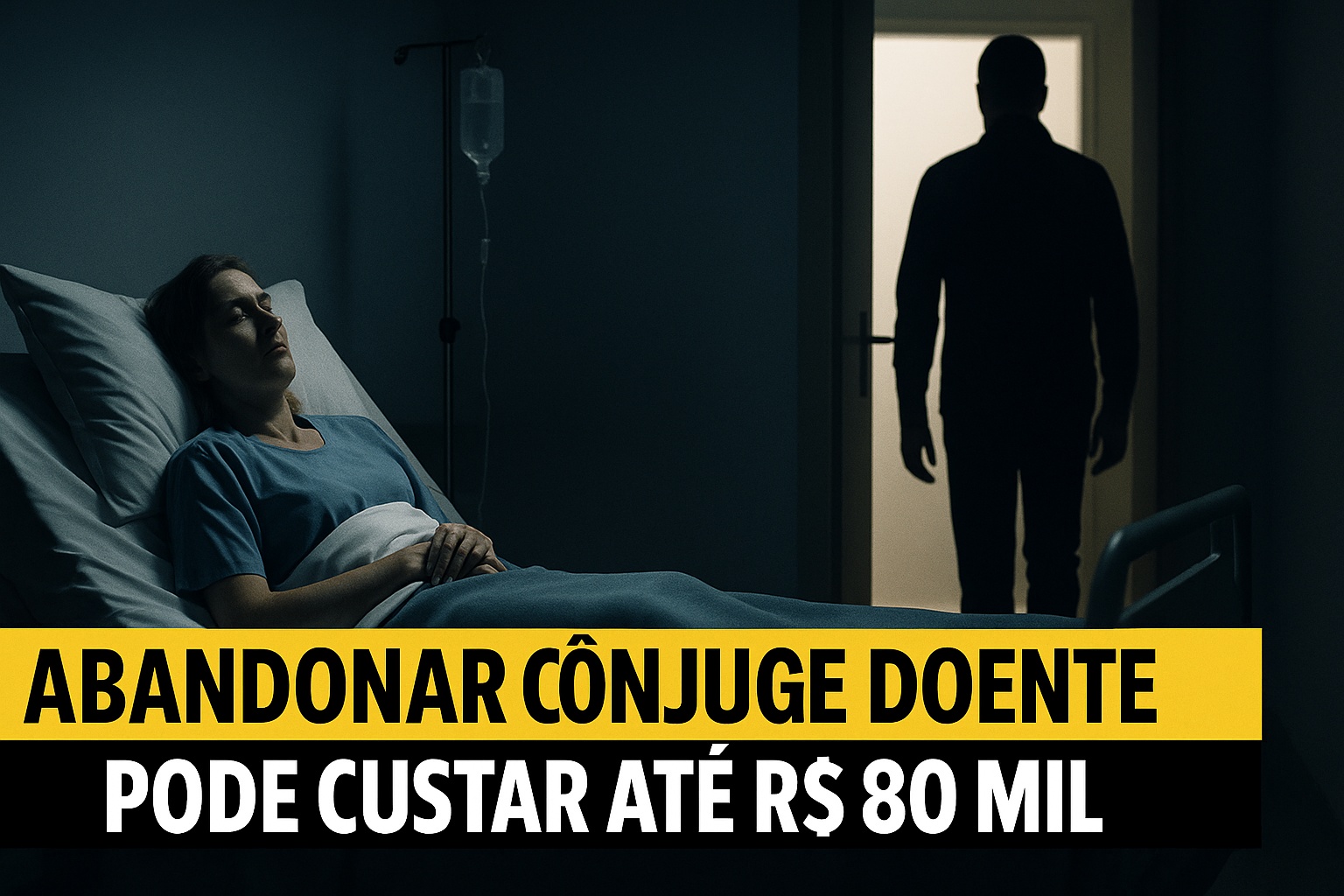


Courts Decide: Abandonment of Ill Spouse in Severe Treatment Leads to Compensation for Moral Damages that Can Reach R$ 80 Thousand.
Marriage and stable unions in Brazil are not just emotional bonds, but also legal relationships governed by mutual duties and responsibilities. Among these duties, mutual support in difficult times, especially in situations of illness, is one of the pillars provided for in the Civil Code. Breaking this obligation can lead to severe consequences. In recent years, court decisions in various instances have begun to recognize that the abandonment of a spouse during severe illness treatment constitutes compensable moral damage. In recent cases, courts have set compensations that reached R$ 80 thousand, demonstrating that Justice considers this type of conduct a serious violation of human dignity.
The Duty of Care and Solidarity in Marriage
Article 1,566 of the Civil Code clearly establishes the duties of spouses: mutual fidelity, living together in the marital home, mutual assistance, support, guardianship and education of children, and mutual respect and consideration.


Among these duties, mutual assistance takes center stage in cases of illness. This means that, in the face of severe treatment — such as cancer, degenerative diseases, or illnesses that require constant monitoring — the healthy spouse must support the other, whether emotionally, financially, or logistically.
-
The noise law will no longer be in effect at 10 PM starting in June with a new rule valid during the 2026 World Cup.

-
The Chamber opens a debate on driver’s licenses at 16 years old as part of a reform that includes around 270 proposals to change the Brazilian Traffic Code and may redesign rules for licensing, enforcement, and circulation in the country.

-
The new Civil Code could revolutionize marriages in Brazil with “express divorce” and changes that could exclude spouses from inheritance.

-
Banco do Brasil sues famous influencer for million-dollar debt and intensifies debate on delinquency, risks of seizure, and direct impact on Gkay’s credibility.


When this support is deliberately denied, with physical and emotional abandonment, the act begins to constitute a contractual and existential violation, paving the way for judicial compensation.
Jurisprudence: When Courts Recognize Abandonment as an Unlawful Act
In different state courts, there are decisions that consolidate this understanding:
- The Sao Paulo Court of Justice (TJ-SP) has already ordered a former husband to pay R$ 50 thousand in compensation to an ex-wife who was abandoned shortly after being diagnosed with cancer. The court found that the conduct constituted moral and psychological abandonment, worsening the woman’s suffering.
- In another case, the Rio Grande do Sul Court of Justice (TJ-RS) upheld a sentence that required a man to compensate his ex-partner with R$ 80 thousand, after she proved she was left without support during treatment for a degenerative disease.
- There are also precedents in the Superior Court of Justice (STJ) reinforcing the idea that violations of marital duties can lead to compensation for moral damages, especially in situations of extreme vulnerability.
These rulings consolidate an essential point: abandonment during illness is not seen merely as an emotional failure, but as a civil wrong with patrimonial repercussions.
Moral Damages in Family Relationships: An Evolution in Brazilian Law
Historically, Brazilian Justice was resistant to convict spouses for emotional abandonment. The rationale was that feelings could not be the subject of financial reparation.
However, starting in the 2000s, with the evolution of civil liability theory, courts began to consider that the breach of marital duties — when it causes measurable and proven suffering — can indeed generate an obligation for compensation.
The most well-known advancement was in emotional abandonment between parents and children, with STJ decisions establishing compensations in cases of complete lack of care. This reasoning is now extending to marital relationships, especially when the breach of duty occurs in situations of extreme fragility, such as severe illness.
When Abandonment Generates the Right to Compensation
Not every end of a relationship generates compensation. The Justice system makes it clear that the mere termination of a marriage or stable union does not constitute a wrongdoing.
Compensation is only applicable when there is:
- Proof of severe illness of the abandoned spouse;
- Proof of material and moral abandonment, with absence of financial, emotional, or logistical support;
- Causal link between the abandonment and the worsening of suffering;
- Willful or negligent behavior of the spouse who abandons.
When these elements are present, courts have understood that the act generates not only emotional pain but also a risk of worsening the clinical condition — which characterizes compensable moral damage.
Values Set by Justice: Up to R$ 80 Thousand
The amounts of compensations vary depending on the case, but courts have set significant amounts. In recent decisions:
- R$ 30 thousand to R$ 50 thousand in cases of abandonment during illnesses with the possibility of recovery;
- R$ 80 thousand in more serious situations, especially when the abandonment coincided with terminal or degenerative diagnoses.
Judges justify that, in these contexts, the compensation is not a “price for love”, but a compensation for the increased suffering and for the breach of legal marital duties.
Social Impacts of the Decision
This new legal understanding has repercussions beyond the specific case. It reinforces a clear message: family relationships are not just emotional bonds, but also social contracts with real legal duties.
The recognition of moral damage in these cases also serves as a warning for situations of silent abandonment, in which sick people are left to fend for themselves in hospitals or nursing homes. The judicial decision paves the way for greater accountability.
Marriage, Illness, and Legal Responsibility
The main message of the recent decisions is simple: marriage is not disposable. Abandoning a spouse in the midst of severe illness treatment is not just a gesture of insensitivity, but an unlawful act with serious legal consequences.
Case law makes it clear that human dignity and family solidarity take precedence over the right to simply “turn one’s back” in times of crisis.
For society, this represents a landmark in protecting the family and the most vulnerable, reinforcing that Brazilian Justice does not tolerate strategies for evading responsibility in extreme situations.










É o mínimo sabem que dinheiro nenhum vai pagar o abandono,mas uma vez juntos deve ser para os momentos felizes mas tbm para os percausos que a vida pode oferecer.
Vocês são formidáveis, são as nossas vozes. Se é este firmamento que é feito na hora que casamos que assim seja,na alegria e na tristeza e na doença então é exatamente nesta Hora que tem que fazer valer o compromisso firmado. Mas infelizmente não é assim que acontece o vem o (abandono).
Parabéns vocês são as nossas vozes,infelizmente é exatamente assim que acontece o(abandono).Ainda bem que temos uma justiça formidável e honesta para fazer valer e reconhecer esses deveres. que na hora mais difícil temos que ter alguém para nós apoiar,porque quando casamos é este firmamento que é feito na alegria na tristeza e na doença,entao que assim seja.