





 Portuguese
  English
  Spanish
  5 min of reading
  1 comment


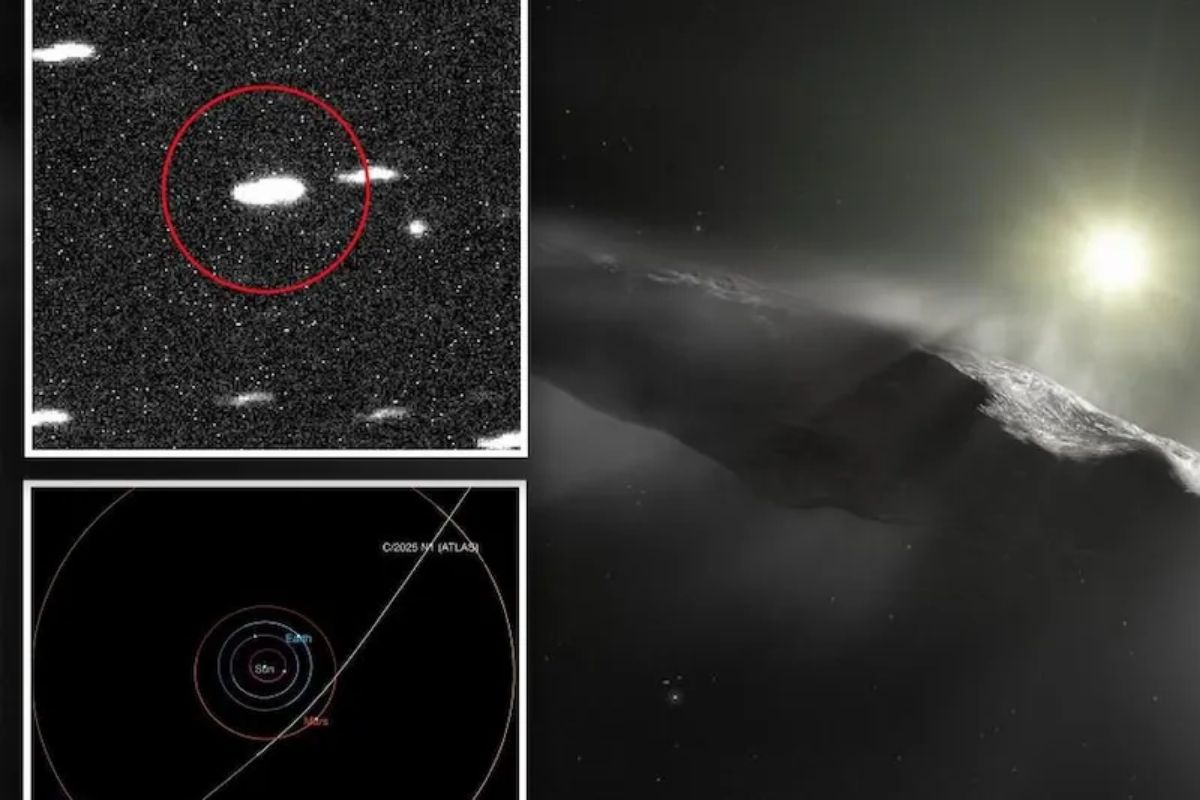


Even With Conspiracy Theories About Comet 3I/ATLAS Circulating Online, The Astronomer From The National Observatory Clarifies That The Interstellar Body Does Not Pose A Threat To Earth And Does Not Have An Artificial Origin.
The comet 3I/ATLAS has reignited popular fascination with interstellar visitors and, along with it, a wave of misinformation. With each new image released, speculation about supposed anomalies and even the hypothesis that it could be an alien spacecraft multiplies. According to astronomer Jorge Márcio Carvano from the National Observatory, there is no evidence of risk or intelligent interference. It is a natural body passing through the Solar System on a one-time journey.
Behind the scenes in the scientific community, 3I/ATLAS is seen as a rare opportunity for study. It is only the third interstellar body ever identified, with composition and trajectory that help understand how planetary systems form around other stars. Attention, Carvano explains, should be directed to science, not to theories that distort preliminary observations to generate online engagement.
Comet 3I/ATLAS Is An Outside Visitor To The Solar System
Discovered in July 2025 by the ATLAS project of the University of Hawaii, comet 3I/ATLAS does not pose any real threat to Earth.
-
The longest public work in history began in Antiquity, spanned empires, was attempted by Nero, and was only completed 2,500 years later, turning the Corinth Canal into one of the most incredible stories of world engineering.

-
The USA invaded Brazil to create a city: founded after the war, the municipality of 250,000 inhabitants is the safest in São Paulo.

-
With a length of 399.9 meters and a capacity for over 24,346 containers, the MSC Irina becomes the largest ship in the world and revolutionizes global maritime transport.

-
With nearly 6,000 square meters and an investment of $100 million, the building that seems to move in Las Vegas has a reflective stainless steel façade, creates optical illusions, and has become a symbol of creativity worldwide.


Its closest approach will be about 270 million kilometers, a distance greater than that which separates the planet from Mars.
Measurements confirmed that its orbit is open, meaning it is not bound to the Sun and will continue on its way back to interstellar space.
“This is a body that came from outside the Solar System and will not return,” Carvano affirms.
The name “3I” indicates exactly that, the third interstellar object detected, and the term “ATLAS” refers to the detection system that discovered it.
The Physics Of Comets And The Misleading Brightness
Comets are blocks of ice, dust, and volatile compounds.
As they approach the Sun, they undergo intense heating, and their ices sublimate, changing directly from solid to gas.
This process creates jets and luminous tails that reflect sunlight and often lead to misinterpretations about anomalous behaviors.
The comet 3I/ATLAS exhibits exactly these characteristics.
Nothing indicates a metallic or artificial structure. “The emissions of gas and dust are typical and already observed in comets of the Solar System,” explains the researcher.
The brightness, therefore, is a natural phenomenon resulting from the interaction between radiation and particles released from the surface.
The Myth Of The Suspicious Trajectory
Among the most popular claims is that the comet would have a calculated route to cross Earth’s orbit.
Carvano dismantles this idea based on orbital mechanics. The orientation of the trajectory depends on the origin of the body, not on any intention.
While some interstellar objects have highly inclined orbits, 3I/ATLAS crosses the plane of the ecliptic at a shallower angle, which is purely geometric coincidence.
“There is no maneuver or control involved,” emphasizes the astronomer.
Nevertheless, unreviewed articles have suggested otherwise, being sensationally replicated by websites and profiles on social media.
Why The Size Caused Confusion
Initial size estimates led to the belief that comet 3I/ATLAS would be too large.
This happened because astronomers, upon observing the brightness, initially classified it as an asteroid and ignored the contribution of the coma, the dust cloud that surrounds it.
With refined data, the current estimate indicates a radius between 200 meters and 3 kilometers, within the range of known comets.
The initial interpretation, taken out of context, gave rise to exaggerated headlines that associated the size with the possibility of artificial origin.
The So-Called Anomalies Explained
Another recurring narrative deals with jets directed towards the Sun, as if they were signs of propulsion.
Carvano explains that the jets depend on the rotation, composition, and thermal orientation of the nucleus, and they can emerge in any direction, including solar direction.
The phenomenon is well documented in comets within the Solar System.
Even the observed chemical differences are expected, as the body formed in another stellar system, under distinct conditions.
“What would be surprising is if it were identical to our comets,” says the researcher.
The Role Of NASA And International Cooperation
The silence from NASA, pointed out by some as a sign of concealment, has a simple explanation. The agency is not responsible for commenting on all astronomical events.
Its telescopes and missions generate public data and collaborate with researchers worldwide, but most comet observations are conducted by independent observatories and universities.
The ATLAS project, which discovered the comet, is operated by the University of Hawaii with partial funding from NASA, without any direct relation to a supposed secrecy protocol.
“NASA does not hold a monopoly on astronomical observations,” Carvano reinforces.
Cooperation And Planetary Defense
The recent campaign by the International Asteroid Warning Network (IAWN) aimed only to refine measurements of comet 3I/ATLAS, monitoring the jets and small variations in trajectory following its closest approach to the Sun.
None of these deviations pose a risk. These actions are part of standardized planetary defense protocols, aimed at research and training, not emergencies.
The collected data will be crucial for understanding the sublimation and composition of interstellar objects, essential knowledge for future interplanetary probe missions.
Carvano acknowledges that public interest is positive but warns of the impact of scientific misinformation.
Preliminary articles and automated posts turn technical results into fictional stories. “We live in a time where every second of attention is contested by people and robots,” the astronomer observes.
For him, the current challenge of astronomy is to communicate the truth clearly and in context before digital noise transforms legitimate discoveries into conspiracy narratives.
Do You Think Science Should React Faster To Viral Theories That Distort Astronomical Discoveries?








Querem acreditar que seja uma nave que vem de milhões de quilômetros no espaço, anos luz fa Terra, mas seria mais sensato se perguntar prá que, pois a informação que coletasse levara milhares de anos luz para chegar à base da tal nave, que sabe-se lá se ainda existe, e depois levaria outros milhares de anos para os comandos voltarem até aqui, obde dabe-se lá se ainda aqui nos encontraremos!