





 Portuguese
  English
  Spanish
  8 min of reading
  0 comments


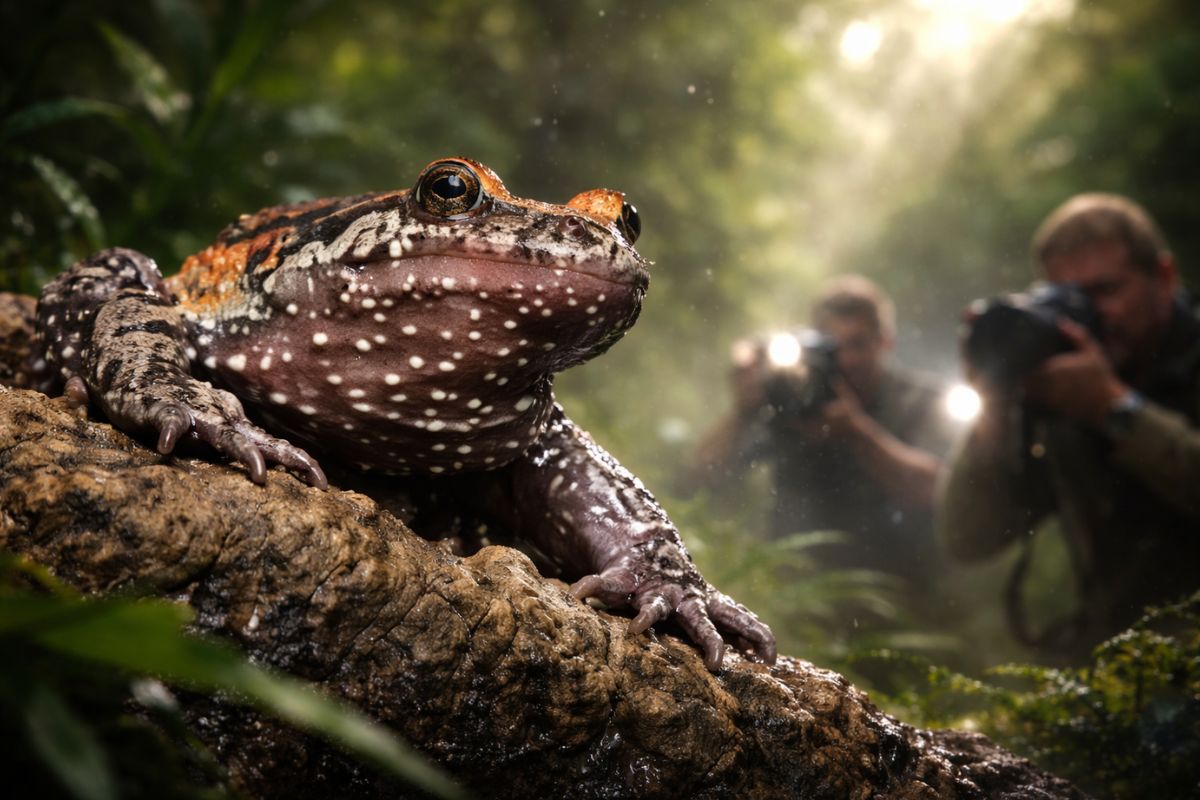
The Rediscovery of a Frog Considered Extinct for More Than Fifty Years in Israel Occurred in a Nature Reserve in the North of the Country, According to the Parks and Nature Authority. The Image Released in 2011 Confirmed Its Reappearance and Reopened Scientific Investigations About Its Survival.
The reappearance of a Frog That Had Not Been Seen for More Than Fifty Years in a nature reserve in northern Israel surprised the country’s Parks and Nature Authorities and reignited the debate about extremely rare species that disappear from scientific records but manage to persist hidden in nature for decades.
The image released in 2011 showed a specimen of the painted frog of Palestine, identified as Discoglossus nigriventer, photographed within the reserve. The new record returned the species to the center of attention, raising immediate questions about how many individuals still exist, where they hide, and what conditions allowed for their survival.
The Frog That Returned from Disappearance and the Immediate Impact of the Record

The reappearance of the Frog was officially communicated by Israel’s Parks and Nature Authorities following the confirmation of the animal in a natural reserve in the north of the country. The most decisive element was the released photograph, as it not only reinforces the sighting but also creates a concrete visual milestone after decades of absence.
-
In a flooded well, archaeologists found a 1,700-year-old Roman egg that still contains clear and yolk intact inside the very thin shell.

-
Something is happening around the Earth: Inside the huge explosion of fireballs in 2026

-
A hot air bubble coming from Argentina expands over Brazil, causing thermometers to exceed 38 degrees with a thermal sensation of 40 degrees in late March, affecting 6 states at once.

-
The radish leaf that almost everyone throws away has more polyphenols, flavonoids, and fiber than the consumed root, and a 2025 study showed that the leaf contains compounds that protect the intestine, combat inflammation, and may inhibit the growth of cancer cells.


According to Omri Gal, a representative of the Parks Authority, the Frog had not been seen in the region for at least five decades.
This gap in records explains why the species came to be treated as extinct, since, without observations confirmed for so long, disappearance becomes the dominant hypothesis for specialists and environmental authorities.
There is still little consolidated public information about the rediscovered Frog, making the case even more intriguing.
When a species returns after such a long period without records, every detail observed about the animal and its environment gains scientific value, from location, behavior, soil conditions, and surroundings to the activity pattern outside of water.
Identity of the Species and the Name That Has Returned: Painted Frog of Palestine

The photographed specimen was identified as the painted frog of Palestine, with the scientific name Discoglossus nigriventer.
The resurgence of this name carries special weight because it embodies the idea of extreme rarity and a history of scarce records, helping to explain why the species was able to remain hidden from human observation for decades.
The prolonged absence signifies not only a lack of effort but also the possibility of discreet habits and a very restricted occupation of habitat.
For a Frog considered rare, any alteration in the environment can further reduce the chances of encounter, making the animal practically invisible to conventional monitoring.
The Historical Rarity: A Frog Described as Elusive Even Before the “Extinction”
Even before being declared extinct in 1996, the Frog was already considered an elusive creature, difficult to observe and record.
This characteristic of “disappearing” from human sight plays a central role in the narrative of its reappearance, as it suggests that the species did not need to be numerous to survive, only well hidden and in minimal habitat conditions.
The Frog has a belly with black and white spots, a striking feature. Still, not even such a recognizable body pattern ensured frequent sightings.
The contrast between a strong visual mark and the low number of records reinforces the hypothesis that behavior and the microenvironment of concealment are determining factors.
Additionally, it is mentioned that only three adults have been seen to date, which reveals the degree of scarcity and reinforces why any new photograph becomes a major environmental and scientific event.
The Episode of the 1940s and the Suspicions of Cannibalism
A historical detail stands out: in the 1940s, a specimen of the painted frog of Palestine reportedly ate another specimen, leading specialists to believe the animal practices cannibalism.
This type of report, even without a long series of observations, tends to gain traction precisely because there are few records available.
In interpretative terms, this data reinforces how little is understood about the Frog. When a species is rarely observed, any unusual recorded behavior can influence scientific understanding for decades, until new observations confirm or contest the hypothesis.
The Connection with the Hula Painted Frog and the “Living Fossil” That Changed Science
Within the submitted material, there is also a complementary axis that amplifies the story’s impact: the Hula painted frog, in Israel, described as rediscovered after having been considered extinct, and subsequently reclassified as a “living fossil.”
The Hula painted frog was last seen in the 1950s and was rediscovered in 2011 by a park ranger, lurking in a marshy area with low vegetation.
This information is crucial because it creates a pattern of rediscovery associated with wetland areas and marshy habitats that survived in fragments, despite human interventions.
After the rediscovery, tests revealed that the frog belongs to a group of amphibians that is believed to have been extinct for 15,000 years.
The study was published in the journal Nature Communications.
This layer of scientific evidence changes the scale of the subject, as it is not just about “a species reappeared,” but an evolutionary lineage that seemed to have disappeared and suddenly emerges alive in a contemporary environment.
The Drained Hula Valley and the Explanation for the Frog’s Disappearance
The material describes a central point to understand how a Frog can disappear from the map: the Hula Valley was drained in the 1950s, and its marshy habitat was destroyed.
When a wet ecosystem is removed, species that depend on mud, low vegetation, and micro-shelters lose the basic conditions for survival or become confined to small habitat islands.
Scientists, confronted with the drainage and the lack of sightings, concluded that the species had disappeared forever.
This line of reasoning is common in conservation: destroyed habitat combined with decades without records often points to local or total extinction.
However, an alternative hypothesis: scientists believe that the frogs may have remained hidden in areas of the marshy habitat that still existed.
In other words, even after a major environmental transformation, there may have been pockets of conditions adequate enough to maintain a residual population.
How Researchers Located the Frog and Why the Search is So Difficult
Professor Sarig Gafny from the Ruppin Academic Center describes an important aspect: the specimens were found on land, out of the water.
This detail changes the logic of the search, as many people would expect a Frog to be found primarily in the water.
The search requires crawling through dense vegetation, traversing thorny wild blackberries, and then digging through decomposing debris.
These obstacles help explain why a species can remain out of sight for so long, even in monitored areas, since the animal’s micro-location is not obvious, and the effort is physically challenging and unattractive.
This level of operational detail also illustrates why the reappearance of a Frog after decades is not necessarily a “miracle,” but can be the result of specific conditions and a combination of biological persistence with practical barriers to fieldwork.
From Discoglossus Classification to the Latonia Group: The Taxonomic Turn
The frog had been classified as a member of the amphibian group Discoglossus, but genetic testing and CT scans indicated that it belongs to the Latonia group. This reclassification is a milestone as it alters the entire evolutionary interpretation of the species.
Latonia frogs were common throughout Europe for millions of years, but all except for the Hula painted frog went extinct about 15,000 years ago.
The direct consequence is one: no one would have had the chance to see a living Latonia in Europe, and the only way to know it was through fossils.
Professor Gafny’s statement summarizes the significance of this finding: upon analyzing the characteristics of the current Hula painted frogs, it becomes evident that they correspond to the fossils of Latonia and not those of Discoglossus. Thus, the species has come to be treated as a “living fossil.”
Resilience, Risk, and the Urgency of Ensuring the Future of the Frog
Researchers stated that the frog is a remarkably resilient species, but highlighted that it is vital to ensure its future survival. This phrase is important as it avoids the misreading that “if it has survived this long, it does not need protection.” Surviving hidden does not mean being safe.
The very history of the drained habitat shows that the species may be one step away from disappearing again if the remaining conditions are degraded, fragmented, or altered.
The Proposal to Flood Parts of the Hula Valley to Create Habitat
The material states that researchers believe that flooding parts of the Hula Valley would help provide a habitat where the species could thrive.
This indicates an environmental restoration approach as a direct conservation tool, reversing the historical logic that destroyed the marshland.
The idea of partial flooding suggests recreating suitable wet areas with vegetation and shelter conditions, allowing the Frog to have space to expand its presence and reduce dependence on isolated pockets.
Why the Reappearance of a Frog Moves Science and the Public So Much
When a Frog disappears from records for decades, it becomes a symbol of loss. When it returns, it becomes a symbol of hope.
The impact is not only emotional but scientific: the rediscovery allows for the study of the anatomy, behavior, and ecological needs of an animal that, until then, was known from few records and, in some cases, from fossils and ancient descriptions.
At the same time, the reappearance puts pressure on environmental authorities, as a new record usually requires measures of protection, monitoring, and restrictions on impacts in the surroundings, even when there is still little information available.
The story also serves as a reminder that “extinct” often means “not found,” especially when the species is discreet, lives in hard-to-access environments, and depends on microhabitats that may persist hidden amidst altered landscapes.
Currently, in 2026, the species is classified as Critically Endangered
Living Fossil: Genetic research conducted after its rediscovery revealed that it is the only surviving member of a genus of amphibians (Latonia) that was believed to have disappeared millions of years ago, being considered a “living fossil.”
Habitat: It lives exclusively in the Hula Nature Reserve in northern Israel. Environmental restoration efforts and ongoing monitoring are carried out by the Israel Nature and Parks Authority to ensure its survival.








-

-

-

-

4 pessoas reagiram a isso.