





 Portuguese
  English
  Spanish
  4 min of reading
  0 comments


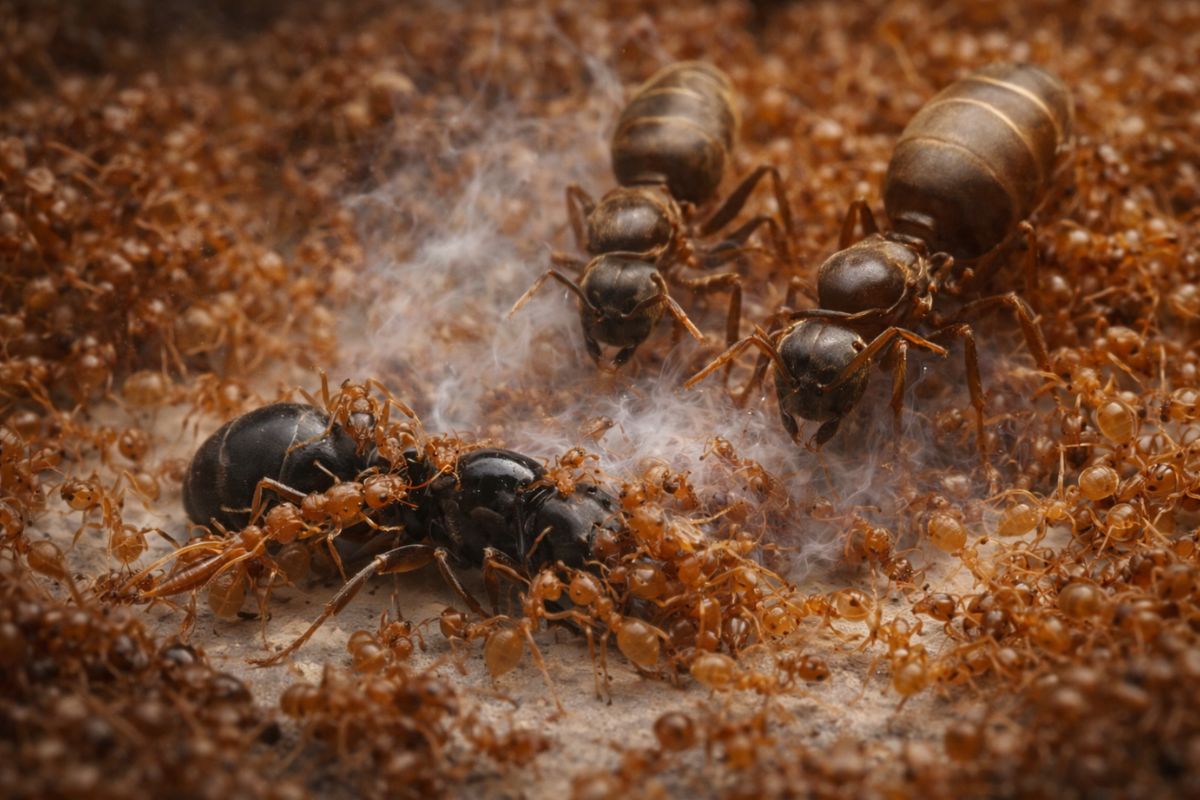
In An Article In Current Biology, Researchers From Kyushu University Show How A Parasite Queen Enters The Ant Nest, Acquires The Host’s Scent, And Uses Sprays Of Formic Acid To Incite Workers To Kill The Matriarch. Later, She Is Accepted, Lays Eggs, And Dominates The Colony In Two Species Of Lasius.
An ant nest can become a scene of extreme competition when a parasitic queen invades a host colony and, instead of fighting directly, manipulates the workers to execute their own mother. The recorded strategy involves chemical camouflage and an indirect attack that turns the matriarch into a “threat” within the nest.
The sequence was described by researchers from the Kyushu University in an article published in Current Biology and includes a disturbing detail: the attack happens through a chemical trigger, with sprays that make the workers redirect their aggression towards the legitimate queen, culminating in matricide, the murder of a mother by her offspring.
How The Parasite Queen Manages To Enter The Ant Nest Without Being Destroyed

Direct infiltration into the ant nest would likely fail because the workers recognize an intruder and would attack her immediately.
-
While the world looks at oil, the war with Iran is already disrupting helium supply from Qatar, affecting car and iPhone chips, threatening AI expansion, and putting pressure on aluminum packaging at the highest value in four years.

-
Global warming will expose a treasure hidden under the ice of Antarctica and may spark an international dispute over gold and valuable minerals.

-
A street vendor from Praia Grande built a robot made of scrap from scooters and washing machines that pulls his popcorn cart on the beach, emits sounds, and interacts with customers, becoming an attraction on the coast of São Paulo.

-
The specifications of the Xiaomi 18 Pro Max have been leaked, and the highlight is a dual 200 MP camera with a new 22-nanometer technology that promises to consume less energy and capture details in shadows and bright areas using LOFIC HDR.


To circumvent this barrier, the team described a process called host odor pre-acquisition.
The parasitic queen was housed with some host workers and cocoons. After just one night, she acquired the specific scent of the host colony, creating an essential chemical camouflage to bypass the initial defenses of the nest and advance to the living area where the matriarch resides.
The Trigger Of The Strike In The Ant Nest: Formic Acid As A Danger Signal
The research suggests that the fluid used by the parasite queens was formic acid, a well-known defensive compound in many ant species.
It can repel predators and also serve as a warning signal to other ants in the nest.
The central point is that both the host and the parasite belong to the same genus, so both have formic acid and recognize it as a danger signal.
When the legitimate queen is covered by a large amount of this substance, the workers start to perceive their own mother as a crisis threatening the nest, triggering an aggressive defensive behavior that turns against her.
Two Documented Invasions In The Ant Nest And Four Species Involved
Chemical manipulation was recorded in two species of parasitic ants and their respective hosts.
Lasius orientalis infiltrates colonies of Lasius flavus.
Lasius umbratus invades colonies of Lasius japonicus.
The initial discovery was made by Taku Shimada, the first author of the paper, who observed the infiltration and published about it in 2021.
Keizo Takasuka, an assistant professor at the Faculty of Science of Kyushu University, reported that he found the publication three years later and was surprised, considering the discovery valuable and worthy of academic documentation.
In the case of Lasius umbratus, the parasitic behavior was associated with observations by Yuji Tanaka, the second author of the study, who followed observational methods established by Shimada.
The Attack That The Workers Execute Inside The Ant Nest: From Annoyance To Matricide
In the case of Lasius orientalis, the dynamics were gradual and persistent. The parasitic queen repeatedly sprayed the queen of the host colony about 15 times over 20 hours. This chemical contact gradually irritated the workers until they began to attack the matriarch, mutilating her and killing her after four days.
In the case of Lasius umbratus, the strike in the nest was quicker and more surgical. The parasitic queen used only two targeted sprays of venom, enough to incite an immediate and fatal attack from the host workers. The result was the same: the matriarch fell to the jaws of her own nest.
What Happens After The Takeover In The Ant Nest

In both colonies, after the matricide, the host workers accepted the parasitic queens. This acceptance is crucial because it keeps the nest functioning with an active workforce, now serving a new lineage.
Right after taking control, the parasitic queens began to lay their own eggs to be cared for in the nest.
The strike does not end with the death of the matriarch; it only completes when the nest starts to invest energy in the invader’s reproduction.
Why This Type Of “Coup” Ant Nest Points To Convergent Evolution
The researchers highlighted that the observed behavior is an example of convergent evolution, when similar traits arise independently in unrelated species.
Here, the common point is the use of chemical mechanisms and nest recognition to bypass defenses, trigger aggression, and reorganize the command of the nest.
Instead of winning by force, the parasitic queens win through chemical social engineering, transforming the defensive instinct of the workers into a tool for seizing power within the nest.
If a queen can dominate an ant nest by making the workers kill their own mother, how far do you think chemical manipulation can go in nature?








-

-

-

-

14 pessoas reagiram a isso.