





 Portuguese
  English
  Spanish
  3 min of reading
  0 comments


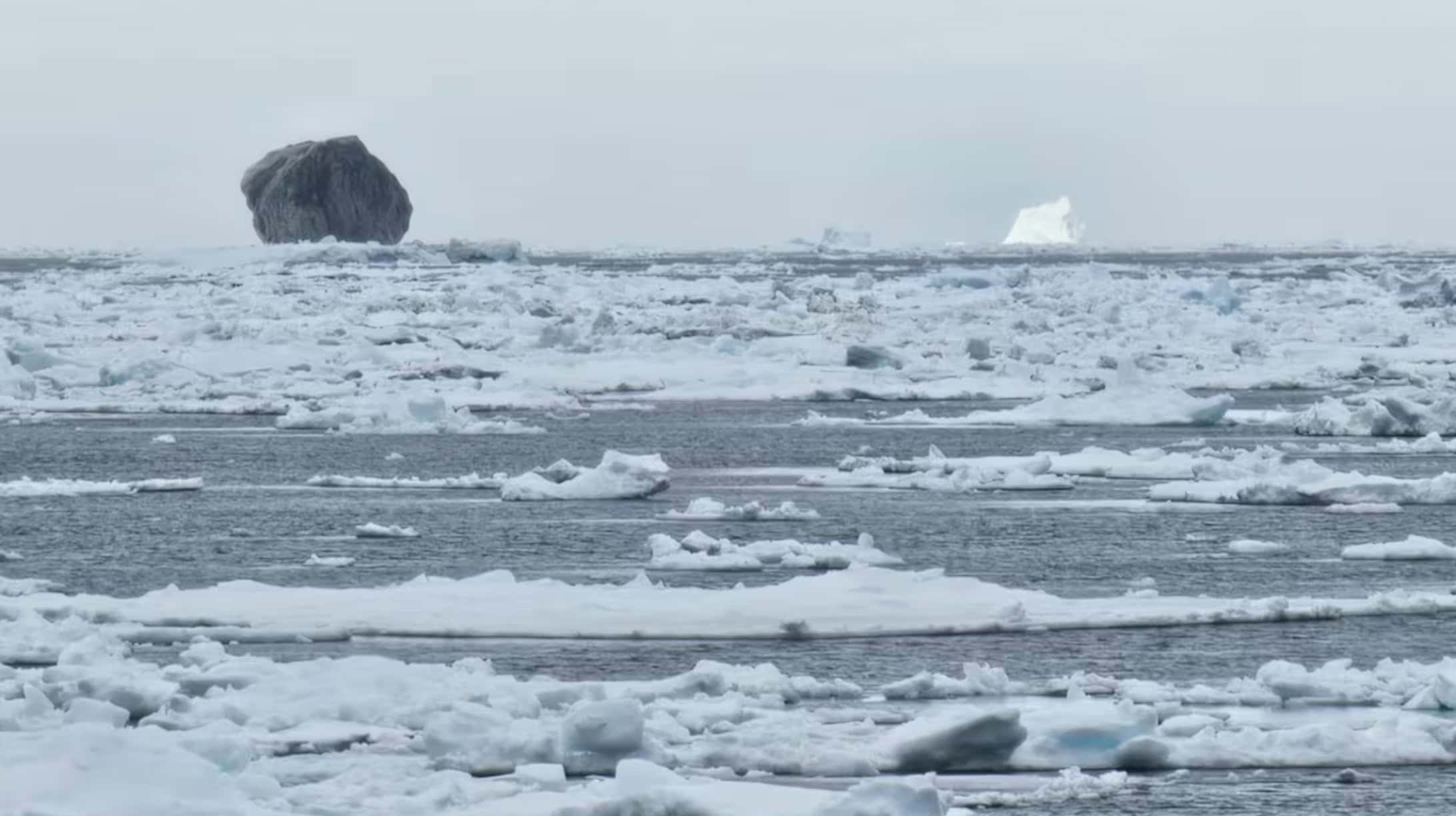
Black Iceberg Spotted Off the Coast of Labrador Intrigues Scientists with Possible Origins Involving Dirt, Volcanic Ash, and Even Asteroid Impact.
In the cold waters of the North Atlantic, icebergs are a common sight. However, in May, one iceberg caught attention for its unusual appearance.
Off the coast of Labrador, a fisherman captured an image of a completely black chunk of ice, standing out from the traditional white blocks in the region.
A Rare and Astonishing Record
Hallur Antoniussen, a fisherman from the Faroe Islands, was the one who took the photograph. He was aboard the shrimp fishing vessel Saputi, over 100 kilometers from the coast of Labrador, when he spotted the phenomenon through the ship’s crane.
-
China is testing a train that will operate at 400 km/h in daily service, which is 80 km/h faster than the French TGV, and uses carbon fiber, magnesium alloys, and more than 4,000 sensors to become the fastest commercial train on the planet.

-
Forget about having an air fryer, electric oven, and steam pot taking up space in your kitchen because a 30-liter smart oven combines all these functions, automatically selects the ideal temperature, and even turns off by itself when cooking is done.

-
Engineers rewrote all the apps from scratch and bet everything on a buttonless screen: now the creator of the iPhone says that Apple needs to make the same revolution again because of AI.

-
Researchers in the U.S. have created a flying robot that transforms into a land vehicle while still in the air. The technology, based on aerodynamic transition, converts landing into a scene worthy of Transformers and redefines mobility between sky and ground.


“It’s all black. Almost diamond-shaped,” Antoniussen described. Despite his 50 years of experience fishing off the coast of Greenland, he claimed he had never witnessed anything like it.
The image quickly gained traction on social media. On Facebook, where it was published, it received thousands of comments. Some users joked about the iceberg’s unusual appearance. “It’s an Oil Berg,” wrote one internet user. Another commented: “It looks like a giant woolly mammoth!”
Possible Explanations for the Unusual Coloring
Intrigued, experts sought to understand the phenomenon. CBC reached out to Lev Tarasov, a physicist and glacier systems modeler at Memorial University, to analyze the case.
According to Tarasov, the most likely explanation is related to dirt accumulated in the ice over thousands of years.
The Greenland glaciers, from which the iceberg likely originated, act like gigantic grinding machines. As they move slowly toward the sea, these glaciers scrape the rocky bed beneath them.
This friction turns the rocks into fine dark powder, which eventually becomes trapped in the ice. Over time, these particles become frozen in the deeper layers.
The Journey of Ice Over the Centuries
According to Tarasov, some ice currents in Greenland can move up to 20 kilometers per year, which is equivalent to a few meters per hour.
These currents act like conveyor belts, transporting the ancient, debris-laden ice to the coast, where it eventually breaks off in the form of icebergs.
Generally, the calved icebergs have white or light blue coloring, but occasionally, older blocks saturated with debris emerge with darker hues.
Tarasov estimates that the ice from the black iceberg is at least 1,000 years old. However, he does not rule out the possibility of it being even older, potentially reaching up to 100,000 years.
Other Hypotheses Considered by Scientists
Without the collection of direct samples, it is impossible to determine the exact origin of the dark materials. Therefore, other theories are also evaluated by experts. One of them involves the presence of volcanic ash trapped in the ice over the centuries.
Glaciers, as they advance, can accumulate soot from wildfires or layers of volcanic ash deposited by eruptions. These particles end up being frozen within the ice.
Iceland, known for its intense volcanic activity, and the subglacial hotspots beneath Greenland are mentioned as possible sources of this material.
Additionally, Tarasov mentions an even more unusual hypothesis. There are records of an asteroid impact in northwestern Greenland, at the Hiawatha Crater. If the black iceberg originated near this region, it may contain dust resulting from the cosmic collision that occurred hundreds of thousands of years ago.
Despite its exotic appearance, the fate of the black iceberg follows the natural course of these blocks of ice. As it drifts southward, through Baffin Bay and along the coast of Labrador, the iceberg continues to gradually melt.
According to Tarasov, most of the clean ice has likely already dissolved, leaving only the dense, debris-laden core. This final fragment, heavier and more compact, represents the last remnants of the original iceberg, now slowly disintegrating.
Even with the theories raised, the black iceberg remains shrouded in some mystery, standing out as a rare and fascinating example of the natural forces acting on glaciers over millennia.







Seja o primeiro a reagir!