





 Portuguese
  English
  Spanish
  4 min of reading
  1 comment


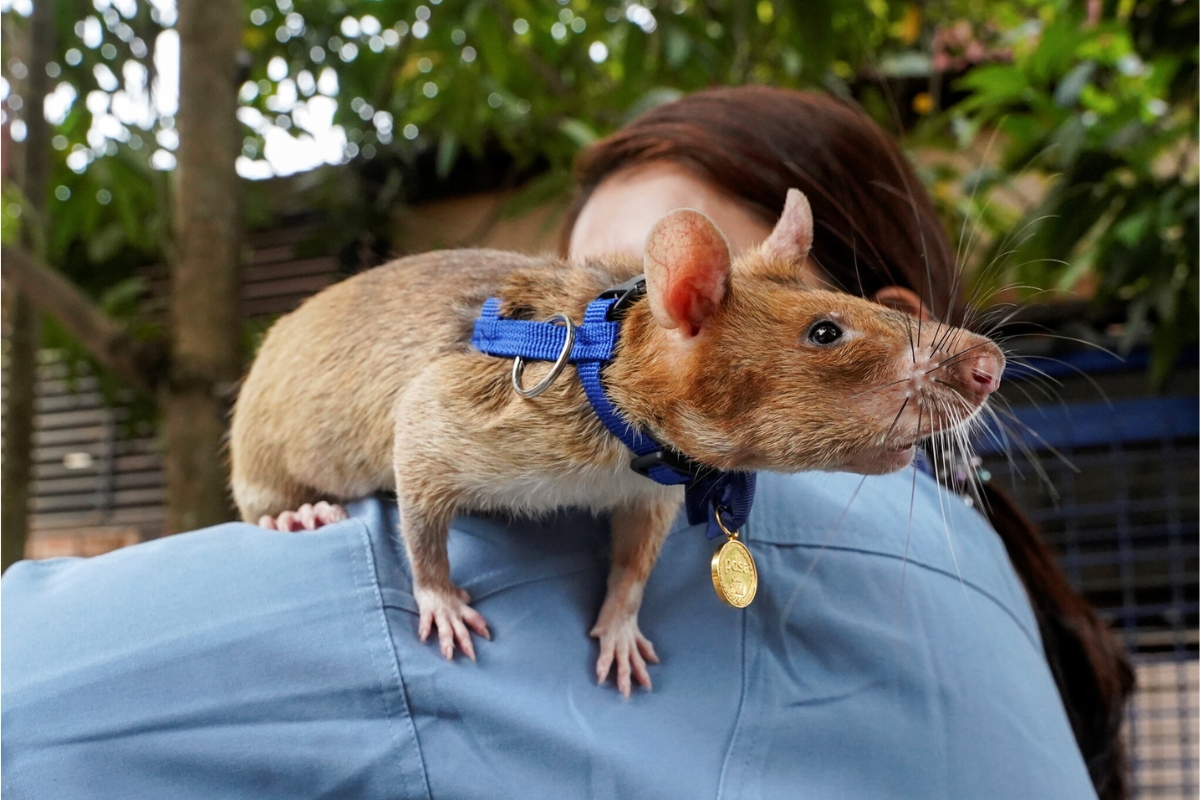


In Cambodia, Magawa Conducted Landmine Detection with Dozens of Findings to Clear Areas and Save Lives, Advancing Humanitarian Demining and Drawing the Attention of Authorities and the International Public
Magawa was not a robot, nor a state-of-the-art military device. She was an African giant rat trained to locate landmines and explosives hidden in the ground of Cambodia.
What seemed impossible for many became routine in the field. With her sense of smell and a specific training method, she helped locate dozens of threats that could maim or kill civilians.
The information was released by the BBC, a British public news broadcaster.
-
He started running at 66 years old, broke records at 82, and is now a subject of study for having a metabolic age comparable to that of a 20-year-old, in a case that is intriguing scientists and inspiring the world.

-
Oldest tree on the planet reappears after 130 years of searches: Wattieza, 385 million years old, was 10 meters tall and had no leaves or seeds; Gilboa fossils in New York solved the mystery in 2007.

-
A 48-square-meter house assembled in hours with 4,000 bricks made of recycled plastic that does not absorb moisture, has natural thermal insulation, and costs less than 90,000 reais in a complete kit.

-
Luciano Hang revealed that Havan’s air fleet has already accumulated more than 20,000 landings, 10,000 flight hours, and 6 million kilometers traveled, and he says that without the planes, the company would never have grown so quickly.


Throughout her life, Magawa became one of the most recognized symbols of modern humanitarian demining, gaining international recognition and a historic decoration for a rodent.
Who Was Magawa and Why Did She Become a Reference in Humanitarian Demining in Cambodia

Magawa was a southern giant pouched rat of the species Cricetomys ansorgei, known for her large size, keen sense of smell, and gentle temperament.
She was born in November 2013, although some sources indicate 2014, and was raised in a training center in Tanzania.
After her training, she was sent to Cambodia, one of the most contaminated countries with landmines and unexploded ordnance after decades of conflict.
The detail that attracted the most attention was her efficiency in areas where human risk is constant, and every square meter of soil can hide a dangerous artifact.
How Training Taught the Rat to Recognize Explosives by the Smell of TNT
The work started before entering the field. The training was based on conditioning, making the animal associate the smell of explosives, mainly TNT, with a food reward.
In controlled tests, she learned to differentiate areas with and without the target odor. When she succeeded, she received food, such as pieces of banana or peanuts, reinforcing the expected behavior.
Later, the process advanced to training fields with deactivated mines. In actual work, Magawa moved with a harness between two human guides.
When she detected the smell of explosives, she scratched the ground to mark the spot. Then, the team arrived with safe methods to remove or detonate the material.
The Light Weight That Prevented Accidents and the Advantage Over Conventional Metal Detectors

There is a practical reason for using this type of animal. African giant rats are light enough not to trigger most landmines, greatly reducing the risk during the search.
Another advantage arises when the terrain is filled with fragments and inert metal. While metal detectors may “beep” for scrap, the rats ignore anything that does not smell like explosive.
The result is faster work in areas saturated with war remnants, with less time wasted on false alarms.
From 39 to Over 70 Mines Found, What the Numbers Show About the Scale of the Work
In Cambodia, Magawa operated for approximately five years in active service, with operations linked to the Siem Reap region.
During that time, different sources attribute to her the detection of around 39 to over 70 landmines, in addition to several dozen other unexploded ordnance.
All together, there were over 100 potential threats located and forwarded for neutralization by specialized teams.
Even when the numbers vary among records, the impact is direct. Each artifact found means one less chance of an accident for residents, farmers, and children in rural areas.
Gold Medal in the United Kingdom in 2020 and the Immediate Effect on Perception About Rats

In 2020, Magawa received the PDSA Gold Medal, considered the animal equivalent of the George Cross, the highest civilian decoration for bravery in the United Kingdom.
She was the first rodent to receive the medal in 77 years of the institution’s history, a milestone that surprised and increased visibility for humanitarian demining.
The recognition also changed the way many people perceive rats. Instead of associating them with dirtiness, the focus shifted to intelligence, training, and usefulness in missions that save lives.
The shift occurred strongly in public opinion and helped bring the issue of landmines into discussion in more places.
Retirement in 2021, Death in January 2022, and the Legacy That Continues to Influence Projects
As she aged for her species, Magawa began to slow down. In 2021, she was officially retired from field operations.
Even off the front lines, she continued to support the training of younger rats for a period, serving as a sort of reference for the team.
In January 2022, the responsible organization reported that Magawa died at the age of 8, after a few days of sleeping more and having less appetite. According to the report, she passed away peacefully in Cambodia, accompanied by her regular caregiver.
The repercussion was immediate, with tributes and images of her in action circulating on social media. For many, her story became proof that a small animal can play a gigantic role in the safety of entire communities.
Magawa showed that humanitarian demining does not rely solely on expensive machines, and that creative solutions can speed up the removal of mines, return lands for use, and reduce the daily risk for families living near contaminated areas.









Maravilhosa..que venha muitas ratas como ela.
Essa matéria acende a curiosidade de como um **** desprezado pela sociedade pode revolucionar muitas pesquisas..Lembrem se roedores são altamente inteligentes e vivem em sociedade organizada entre eles..Tem muito a nos ensinar..
Que venham mais Megawa.