





 Portuguese
  English
  Spanish
  5 min of reading
  0 comments


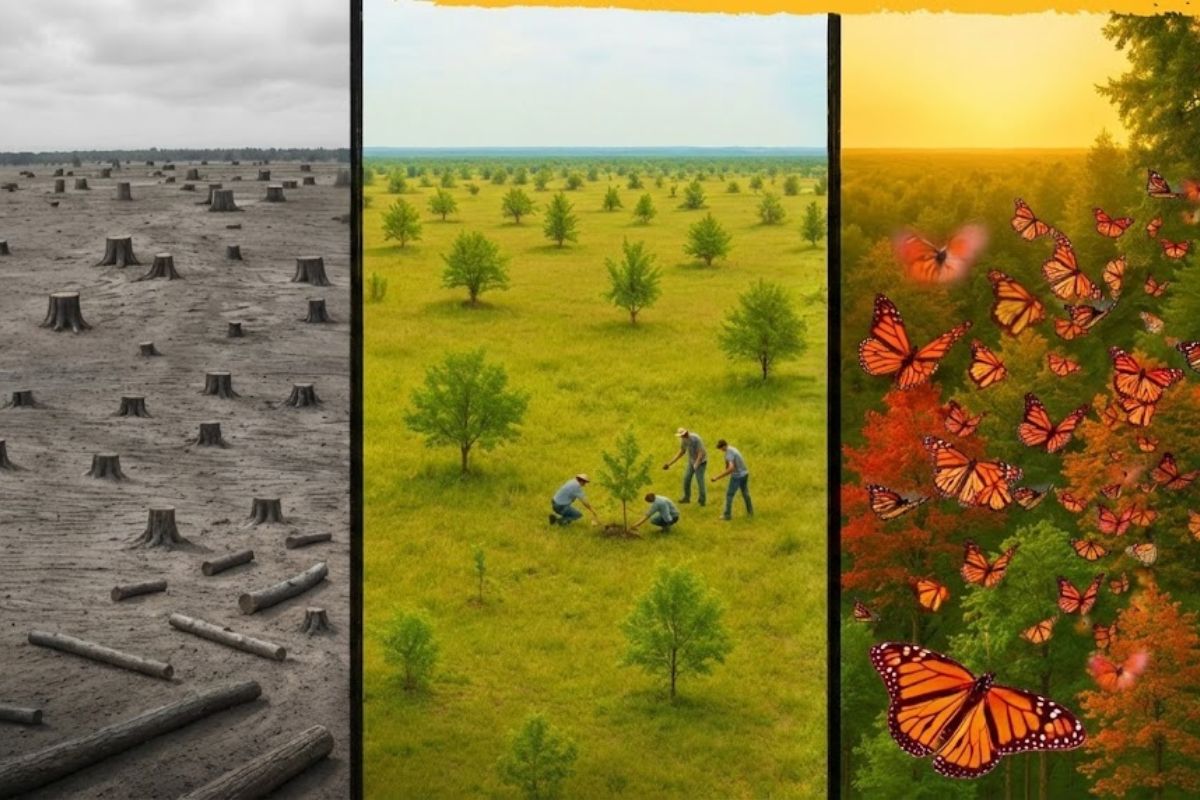
In The Monarch Butterfly Forest, In Central Mexico, Millions Travel 3,000 Kilometers From Canada And The US To Spend The Winter. Scientists And WWF Mexico Replant 180 Hectares With 360,000 New Trees In Indigenous Nurseries, While Climate Change, Pesticides And Cartels Of Illegal Extraction Pressurize The Microclimate And Take Down The Colonies
The monarch butterfly forest in Mexico has become a race against time to keep one of the most impressive natural phenomena on the planet standing: millions of butterflies migrating together for 3,000 kilometers to a specific set of fir forests in the center of the country, where they spend the winter in dense colonies.
The urgent scenario combines active habitat recovery and multiple simultaneous threats. The monarch butterfly forest is being replanted on a large scale, while tree loss from diseases associated with unstable climate and the advance of illegal extraction attributed to cartels erode the delicate balance of temperature and humidity that keeps the colonies alive.
The 3,000 Kilometer Migration And The “Super Generation” That Lasts Up To Nine Months

Every year, at the end of summer in Canada and the United States, the monarchs mobilize en masse and fly for about six weeks to Mexico. With wings described as “thin as paper” and weighing half a gram, they traverse a continent overcoming constant obstacles, functioning as an army of pollinators.
-
In Kenya, engineer Nzambi Matee created “bricks 2.0” using packaging plastic: a mixture with sand, heated and pressed; they are 5 times more resistant, already have official licensing, and are being used in streets and construction projects.

-
More than 20,000 positions could be opened, and thousands of technicians are starting to be trained in Brazil, as the expansion of data centers creates an urgent race for professionals to keep the internet, cloud, and artificial intelligence running 24 hours a day.

-
China approves the 15th Five-Year Plan 2026-2030 to become a global power: prioritizes brain implants, 6G with AI, humanoid robots, flying cars, quantum technology, and nuclear fusion, while strengthening defense and the economy.

-
HONOR X80i arrives with a massive 7,000 mAh battery, a 120 Hz AMOLED display with a brightness of 6,500 nits, and the new Dimensity 6500 Elite chip, promising up to 22 hours of video playback and impressive performance in casual gaming.


What makes the journey viable is a crucial biological detail: most monarchs live four to five weeks, but those that arrive in Mexico belong to the super generation, with a lifespan of eight to nine months. This extended generation is responsible for completing the trip south, surviving the winter in Mexico, and initiating the return north in spring. After reproducing, this super generation dies, and then three more generations complete the route back north until the cycle begins again.
How They Find Mexico Without “Having Been There Before”

The monarch butterfly forest relies on a navigational ability that has long been a mystery. Ancient theories included magnetic fields, visual cues in the landscape, and scent trails, but the proposed explanation points to an even more specific mechanism.
First, there is an annual biological clock that triggers the departure around September or October. In flight, monarchs use the position of the sun as a compass to locate south. However, the sun shifts position throughout the day, so they need to know the time. The described solution is a second biological clock located in the antennas. To study the process, scientists measured brain activity and used miniature flight simulators, reinforcing that the behavior is traceable in the laboratory.
The Microclimate That Keeps The Colonies Alive And Why The Forest Is “An Umbrella”

In central Mexico, the monarch butterfly forest functions as a structure for physical and climatic protection. The central argument is that these forests provide the right temperature and humidity, like “an umbrella” that creates a crucial microclimate during the cold months.
Even within the forest, the margin for error is small. The monarchs are highly sensitive, and choosing the wrong spot can mean excessive cold. Stability only exists when the entire ecosystem is healthy, which directly links the survival of the colonies to the condition of the trees, soil, and surrounding climate conditions.
Chain Threats: Unpredictable Climate, Diseases, Illegal Extraction And Chemicals On The Route


The monarch butterfly forest is being lost through two main pathways described as simultaneous. One is the cutting of diseased trees, with disease associated with climate change and unpredictable weather, which destabilizes the ecosystem and facilitates the entrance of pests and diseases.
The other is illegal logging, pointed out as a business operated by cartels, with safety risks high enough to make certain areas impractical to visit. Furthermore, butterflies face exposure to herbicides and pesticides along the migratory corridor, amplifying pressure beyond Mexico and connecting the problem to three countries.
Accelerated Replanting: 180 Hectares, Eight Indigenous Nurseries And 360,000 New Trees
The operational response cited for the monarch butterfly forest stems from a local structure: eight seedling nurseries managed by indigenous peoples who own these forests. The announced restoration aims at 180 hectares of priority areas, with a scale specified as 180,000 trees, going beyond symbolic actions.
The plan has been expanded with the doubling of funding, raising the total to 360,000 new trees in central Mexico. The logic is to reconstitute enough forest cover to restore the microclimate and rebalance a habitat where colonies have already “massively” declined in recent years, according to evaluations associated with decades of conservation work.
Monitoring The Colonies: 0.9 Hectare, Jump To 1.8 Hectare And The Abyss To The Historical
Beyond planting, the monarch butterfly forest relies on data. The monitoring described does not attempt to count butterflies one by one. The method is to measure the area of forest occupied by a colony and use this indicator to guide research and protection policies in the US, Mexico, and Canada.
The most sensitive cut is the recent comparison. The previous season was noted as the second worst ever recorded, with colonies occupying about 0.9 hectare. In the current season, the cited number is 1.8 hectare, double, interpreted as a sign of improvement and cooperation from the continental corridor. The estimate associated with this size suggests more than 60 million butterflies in these forests, still far from the historical range mentioned for the population: between 300 million and 1 billion.
What Changes Outside Mexico: Milkweed, Native Flowers And Refuges Along The Corridor
The monarch butterfly forest is the “winter home,” but migration depends on the entire path. Monarchs primarily feed on milkweed and nectar from flowers, and by doing so spread pollen and sustain ecological functions in the environments they pass through.
The practical actions cited for citizens along the migratory corridor are to plant milkweed and wildflowers in gardens, creating refuges distributed across Canada, the United States, and Mexico. The logic is to reduce food and resting gaps so that millions can complete the six weeks of flight and maintain the intergenerational cycle.
The monarch butterfly forest in Mexico is at the center of a dispute between restoration and collapse: millions travel 3,000 kilometers, depend on a specific microclimate, and face threats ranging from unstable climate and diseases to illegal extraction attributed to cartels and exposure to pesticides along the route. The described response combines colony area monitoring, replanting 180 hectares, indigenous nurseries, and the goal of 360,000 new trees, trying to bring the current population closer to a past that ranged between 300 million and 1 billion.
In your opinion, what most threatens the monarch butterfly forest: illegal extraction operated by cartels or the climatic instability that makes the trees sick?







-

-

3 pessoas reagiram a isso.