





 Portuguese
  English
  Spanish
  5 min of reading
  0 comments


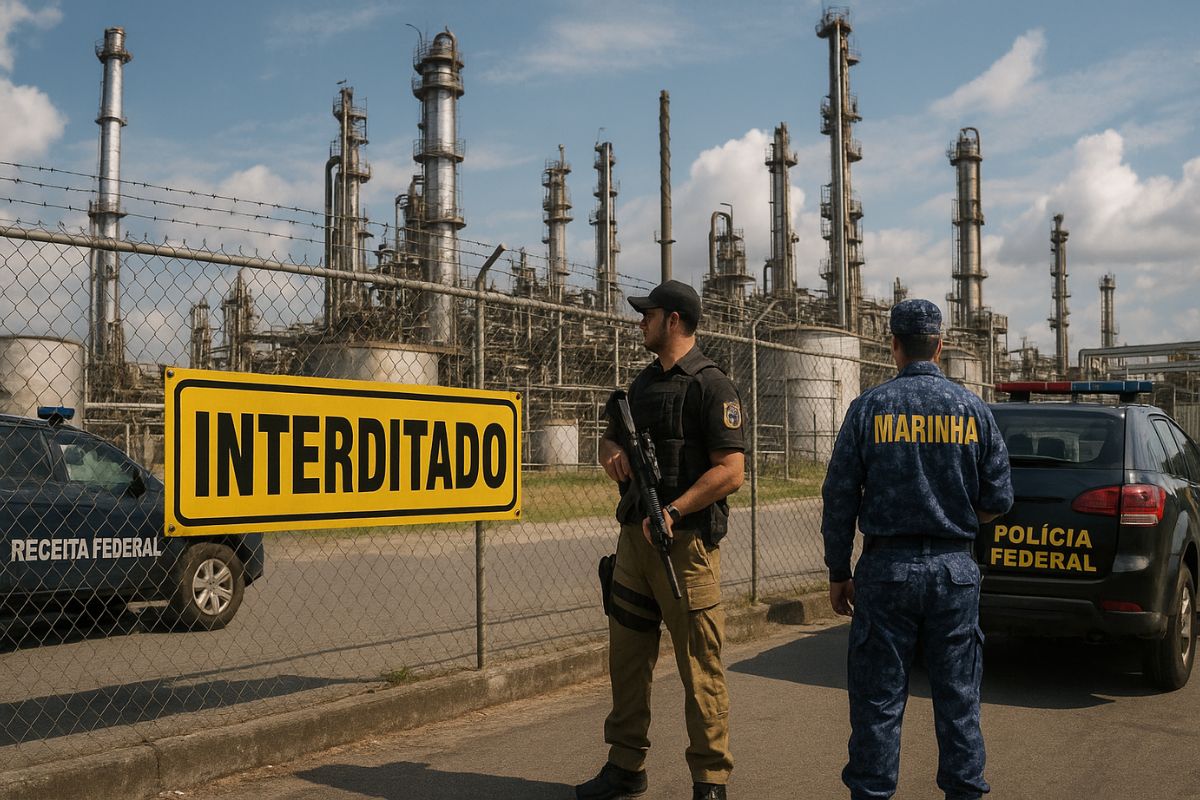
The Manguinhos Refinery Was the Target of a Joint Action by ANP with PF, Receita and Navy in Rio de Janeiro, with Seizure of Cargo and Suspension of Tanks, While Investigations Examine Adulteration and Irregular Imports, According to O Globo
The Manguinhos Refinery was shut down by the National Agency of Petroleum after an operation involving the Federal Police, Federal Revenue, the Brazilian Navy, and the Ministry of Mines and Energy. The action, detailed by O Globo, investigates a set of practices ranging from alleged fuel adulteration to incorrectly declared imports, focusing on the origin and processing of the derivatives.
According to O Globo, the regulatory crackdown has expanded based on evidence gathered from criminal and fiscal fronts. Authorities suspect that part of the fuel placed on the market did not go through regular refining and that the plant may have operated as a front for ready-made imported product, in addition to possible operational safety irregularities in tanks and flow lines.
What Sparked the Shutdown and Who Is Under Investigation
The ANP confirmed the immediate shutdown of activities related to the sealed tanks and the seized cargo, prohibiting movement and mixing until further notice.
-
The largest food company on the planet, JBS, has just opened a 4,000 square meter laboratory in Florianópolis to develop customized proteins that modulate muscle mass gain, immune response, and metabolic performance.

-
After nearly 30 bids and competition among industry giants, a Spanish company purchases one of the largest airports in Brazil for almost R$ 3 billion and takes over the management of Galeão in a concession that will last until 2039.

-
The Federal Revenue Service now automatically cross-references everything you declare with data from banks, credit cards, brokerage firms, and insurance companies, and any discrepancy between your income and your expenses triggers an alert in seconds.

-
Amid global tensions, Brazil blocks the United States’ proposal at the WTO and paves the way for a trade crisis and possible retaliations.


According to O Globo, the refinery came under scrutiny in an investigation that reaches distribution chains and stations linked to money laundering, mentioning clients and intermediaries such as 76 Oil, Manguinhos Distribuidora, and Rodopetro.
Still according to O Globo, the collection of over a hundred samples included naphtha, condensate, gasoline, diesel, and methyl aniline.
The central hypothesis is classification fraud in imports to evade controls and taxes, as well as adulteration of quality specifications.
If confirmed, the practice would affect competition and consumers, posing risks to engines and emissions.
How the Import Scheme Operated and What the Receita Is Looking For
One of the focuses of the Federal Revenue, reported by O Globo, is the declaration of gasoline as naphtha to simplify controls and reduce regulatory costs.
This maneuver, in theory, opens a gap for tax evasion and masking of origin, especially if the product is resold in chains that simulate operations between interposed companies.
The investigation also targets “sales simulation” of imported goods, making it difficult to trace the true responsible parties for each step.
The documentary triangulation and the use of opaque corporate structures are among the technical lines being evaluated by auditors.
If there are material inconsistencies, liability may reach managers, distributors, and logistics operators.
Seizures, Financial Impact, and Regulatory Risks
In the same operation, authorities seized about 91 million liters of diesel fuel, valued at over R$ 290 million, as well as approximately 115 tons of chemical additives, according to O Globo.
The volume is significant and suggests potential scale of irregularities in the derivatives chain.
Beyond direct losses, regulatory risk increases for the entire network that may have acquired products without quality and origin backing.
Stations and distributors mentioned in the proceedings may face administrative sanctions and, potentially, civil and criminal actions, if awareness or participation in the schemes is confirmed.
Operational Safety and Fuel Quality
The ANP pointed out irregular safety standards in tanks and flow systems. This is not a technical detail.
Tanks out of compliance increase the risk of fire, leakage, and environmental contamination.
On the consumer side, off-spec fuel can increase consumption, damage engines, and post-treatment devices, as well as harm environmental targets.
The robustness of metrological controls and traceability will be decisive at this stage.
The agency reinforced the prohibition on moving or mixing any cargo associated with the shut-down tanks.
Only complete laboratory analyses should revalidate products and allow for any redeployments.
What Refit Says and What Are the Next Steps
Refit denies the irregularities and claims to have a “proven track record of legitimate activities”.
In a statement cited by O Globo, the company states it operates in a limited volume audited by the ANP and asserts to have received authorization to expand its refining capacity.
The defense maintains regulatory compliance and promises to cooperate with the authorities.
In the short term, the continuity of the inspections on the more than a hundred samples will be decisive. Based on the reports, the ANP may maintain, expand, or modify the shutdown.
The Receita will continue with the audit of import and sales documents, while the PF investigates any criminal association and tax evasion.
The Navy operates in the area of security and cargo traffic, especially in maritime movements.
Effects on the Market, Competition, and Consumers
Shut-downs of this magnitude reverberate in the short term in regional supply logistics.
If the blockage persists, other bases and distributors are likely to reallocate volumes to Rio and adjacent areas, mitigating shortages.
The risk of price hikes depends on the duration of the blockage and the appetite of competitors to fill the gap.
In the medium term, the disciplining effect may raise the compliance standard of the sector.
Fraud distorts prices, erodes tax revenue, and penalizes those who follow the rules.
If oversight maintains its cadence, the competitive gain falls on compliant companies, while consumers benefit from quality and predictability.
The case of the Manguinhos Refinery exposes a sensitive knot in the fuel chain, quality, origin, and safety. If there is evidence of fraud, the response must be firm and systemic.
If there are specific failures, the correction should be quick and transparent, with clear communication to the market and consumers.
If you refuel in the Rio area, have you noticed changes in price or availability in recent days? For those working in distribution, do current controls account for preventing triangulations and adulterations? Share how this affects your routine, from the station to the fleet. We want to hear from those who live the chain in practice.







Seja o primeiro a reagir!