





 Portuguese
  English
  Spanish
  3 min of reading
  38 comments


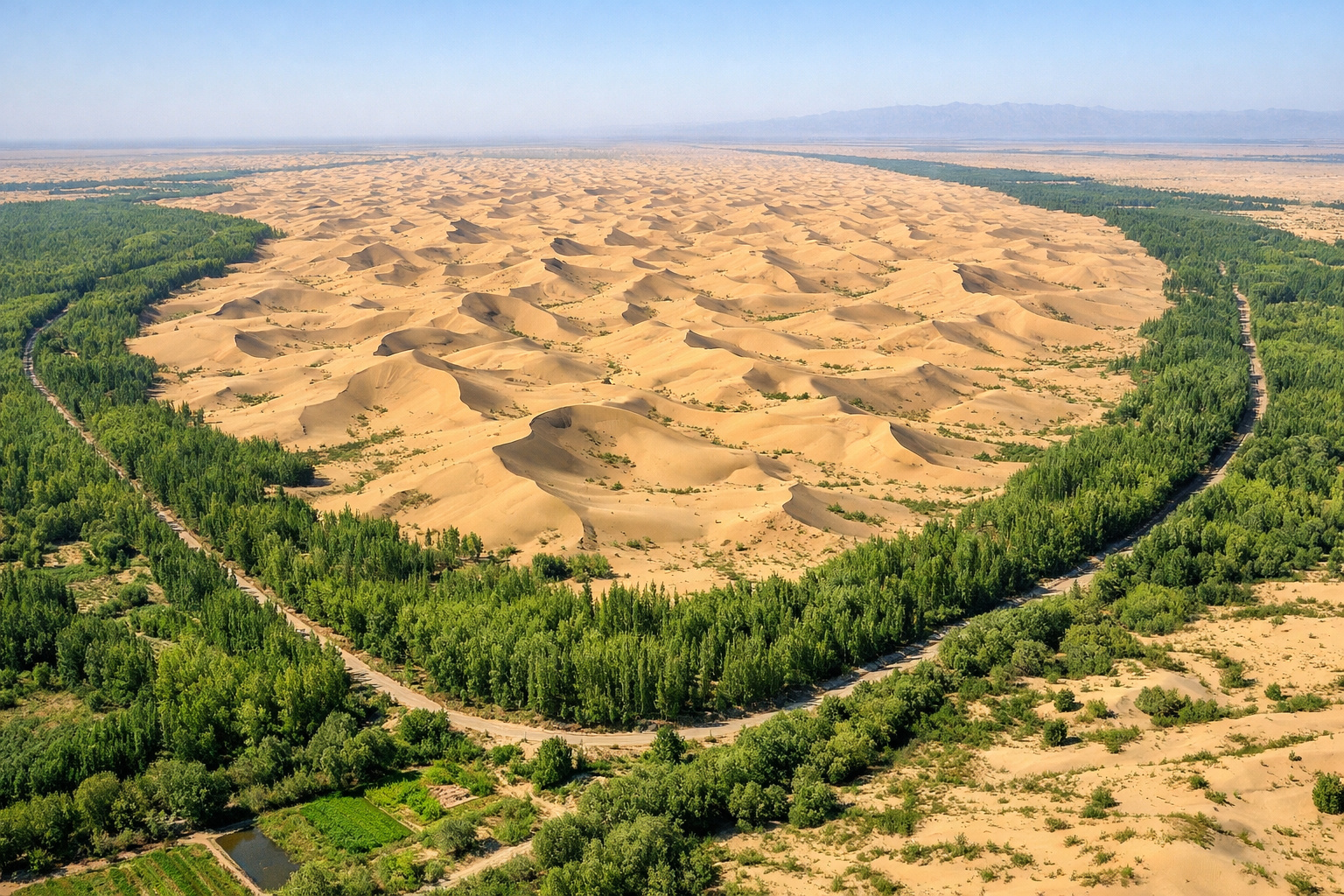


After Almost Five Decades of the Three North Program, Known as the Great Green Wall, Areas Around the Taklamakan Have Begun to Act as Carbon Sinks According to 25 Years of Analysis Released in PNAS and Reported by Live Science
For a long time, experts viewed deserts as inhospitable areas, dominated by extreme heat and little biodiversity. However, scientists began to revise this view when they analyzed recent data on climate change. In the case of China, researchers identified a surprising phenomenon in the Taklamakan desert.
The scientific journal “Proceedings of the National Academy of Sciences (PNAS)” published the study, and the Live Science portal reported the results. The researchers investigated how Chinese environmental policies have altered the carbon balance of the region over the past decades.
What Has the Planting of 66 Billion Trees Caused in the Taklamakan?
The Taklamakan desert is located in northwestern China, and high mountains surround the entire area, blocking moisture from entering. As a consequence, the location has transformed into a vast sea of constantly moving sand. Nevertheless, in 1978, the Chinese government initiated the Three North Program, also called the Great Green Wall.
-
Sustainable mansion in Colorado made with over 1,500 recycled tires, clay, cans, and bottles has 414 m², solar energy, rain sensors, a stable with 23 stalls, and is for sale for $1.3 million.

-
UN alert reveals that oceans are warming at a record pace, Arctic ice may disappear in summers, and coral reefs are heading towards climate collapse.

-
Mato Grosso has just signed a plan that could quietly change the origin of the wood used by the industry and transform planted forests into a key component of sustainable supply by 2040.
-
The giant reservoir that São Paulo needs to avoid collapse is surrounded by sewage, microplastics, and illegal settlements, while nearly 22 million people live in the region that depends on urgent water solutions.


The government launched the project with two clear objectives: to halt the advance of desertification and to reduce sandstorms through the planting of trees on the edges of the desert. Since then, environmental teams have planted more than 66 billion trees in the region.
This number impresses not only because of the volume but also due to the territorial scale involved. Additionally, researchers have begun to systematically monitor the environmental impacts of the project.
To measure the results, scientists analyzed about 25 years of vegetation records around the Taklamakan. Based on this data, they identified a significant change in the behavior of carbon in the region.
How Did the Region Start to Capture More CO₂ Than It Releases?
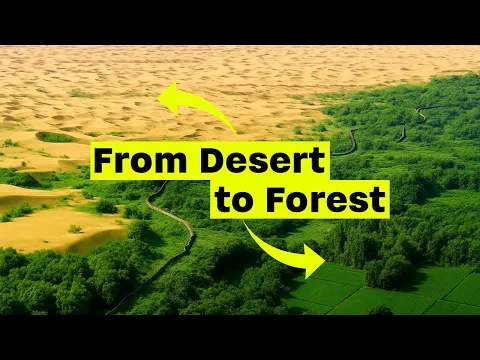

Researchers have observed that, after decades of reforestation, areas around the desert have started to absorb more carbon dioxide (CO₂) than they release. In other words, the region has begun to function as a carbon sink.
The newly established vegetation captures CO₂ during photosynthesis and stores carbon both in biomass and in the soil. Thus, reforestation has directly altered the local atmospheric balance.
Furthermore, scientists highlighted that deserts, by nature, emit little carbon. Therefore, when trees grow in these areas, the balance tends to become positive in terms of capture.
However, specialists emphasize an important point: industrial technologies such as Carbon Capture and Storage (CCS) still remove larger volumes of carbon in a controlled manner. Thus, reforestation does not replace advanced technological solutions but complements climate mitigation strategies.
Limits, Challenges, and What Still Requires Monitoring
Despite advances in the CO₂ balance, researchers have not confirmed that the program has fully managed to halt the desert’s expansion or decisively reduce sandstorms.
Additionally, the arid environment imposes constant challenges, such as water scarcity and the adaptation of planted species. Therefore, scientists continue to monitor the evolution of the ecosystem.
On the other hand, the study broadens the global debate on climate solutions. It shows that long-term public policies can transform areas considered unproductive into allies in the fight against global warming.
In this way, China reinforces its position in large-scale reforestation strategies. At the same time, the case of the Taklamakan demonstrates that tackling climate change requires multiple approaches, from reforestation to technological innovation.
Do you believe that reforestation projects in deserts can really help curb climate change or should they just be complementary solutions?








Eu li em outra reportagem que essas árvores alteraram o ciclo da água na região. Removendo muita água do solo e prejudicando outras regiões, inclusive interferindo nos ciclos das chuvas, ou seja raramente a intervenção humana consegue ser realmente benéfica. No máximo quando conseguem realmente reparar estragos causados por nós mesmo. Reflorestar áreas destruídas. Mas ainda assim corremos o risco de a natureza nos castigar.
Acredito que as florestas vão captar o excesso de co2 da atmosfera, e deixar o ar mais puro.
Sou a favor de plantar 50 bilhões de árvores na Amazônia Brasileira nos próximos 50 anos. 1 bilhão de árvores por ano.
De até 6000 espécies diferentes, mas todas de espécies nativas e/ou endêmicas da Amazônia. Incluindo espécies raríssimas, ameaçadas de extinção e recém descobertas.
E com a ajuda de cientistas pois certas espécies de árvores que existem em certas partes da amazônia não existem em outras