





 Portuguese
  English
  Spanish
  5 min of reading
  0 comments


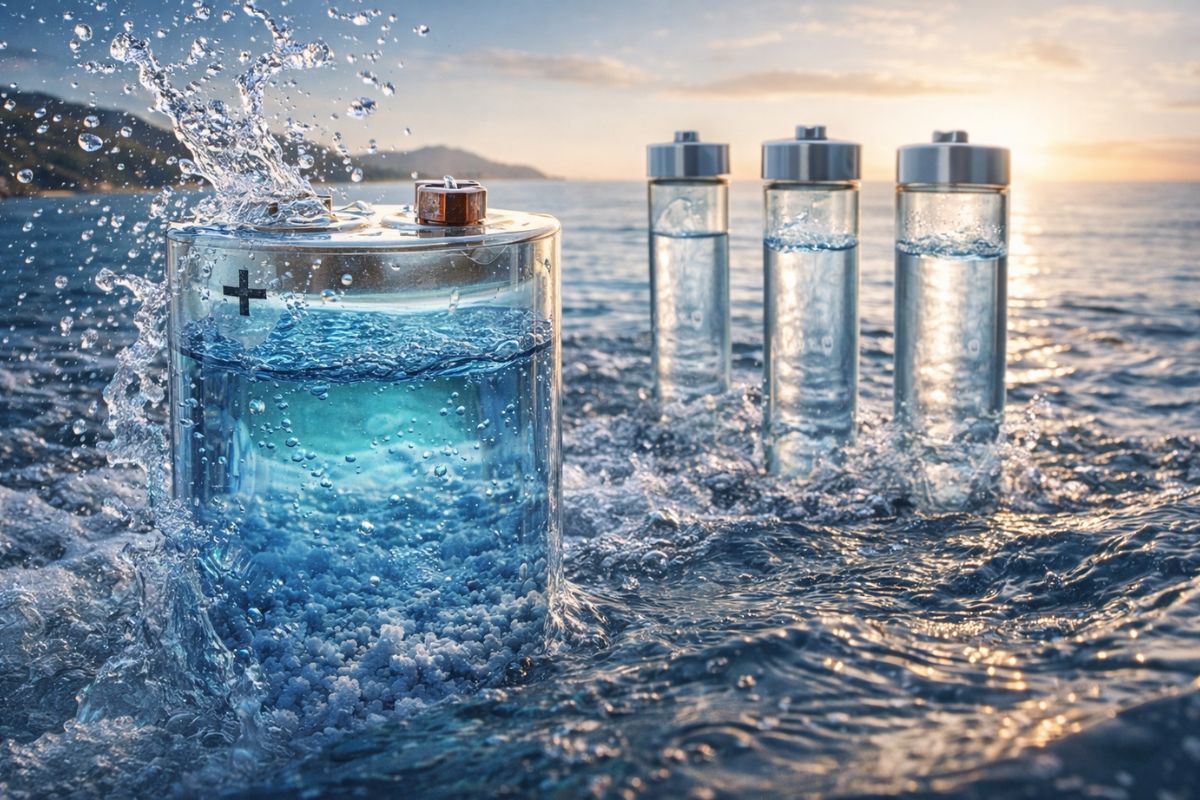
Scientists from the University of Surrey discovered that keeping water within an essential sodium battery compound almost doubles the charge capacity, accelerates charging, and when tested in seawater, the material also removes salt from the solution while storing energy.
Science sometimes advances through complex discoveries that take decades to be understood. Other times, progress comes from an idea so simple that no one had tried it before. Researchers from the University of Surrey discovered that keeping water within a critical sodium-ion battery material, instead of removing it as has always been done, drastically increases performance. The hydrated version of the compound stores almost double the charge, charges faster, and remains stable for over 400 cycles, placing it among the best sodium battery materials ever reported by science.
But the surprise did not stop at storage capacity. When the same material was tested in seawater, it continued to function effectively and also removed sodium ions from the saline solution, in a process called electrochemical desalination. This means that in the future, a sodium battery could store energy and produce fresh water at the same time. The research was published in the Journal of Materials Chemistry A and paves the way for cheaper, safer, and more versatile alternatives to the lithium batteries that dominate the current market.
What the scientists did differently with water in the battery material
The compound in question is sodium-vanadium oxide, a material already known and studied for years in the field of sodium-ion batteries. Traditionally, this compound undergoes thermal treatment to remove water, because it has always been believed that the presence of moisture would cause problems in the battery’s operation.
-
Man builds house using foam panels, wooden base, adjustments with cement, impresses with the result by eliminating intense heat, extreme cold, and humidity inside the property with a simple solution.

-
While the USA prioritized the quantity of fighters, China surprised with a different tactic by planning to produce up to 300 aircraft per year, while the American fleet shrank by more than 60% and the F-35 does not keep up with the growing global demand.

-
5 tips to make the most of the longest passenger train journey in Brazil: it’s 13 hours and about 664 km with over 30 cities along the route, views of the Rio Doce, the best side of the carriage, and strategic dining times.

-
The army raises the alert signal and prohibits men from leaving the country without military authorization: the requirement is a tactic for expanding from 180,000 to 260,000 soldiers by 2035 in Germany.

The team from the University of Surrey decided to challenge this assumption and test the material in its hydrated form, without eliminating the water from the process.
The result surprised even the researchers themselves. The hydrated nanostructured sodium vanadate, named NVOH, exhibited performance almost twice that of standard cathode materials for sodium batteries.
Dr. Daniel Commandeur, a researcher at the School of Chemistry and Chemical Engineering at the University of Surrey and the lead author of the study, admitted that the results were completely unexpected. The water, which everyone thought was an obstacle, turned out to be just the missing ingredient to unlock the material’s potential.
The numbers that explain why this water battery changes the game
The research data is striking. The hydrated version stored almost double the energy compared to the dry version of the same material, which undergoes conventional thermal treatment.
In addition to storing more, the water-containing compound also charged faster and maintained stability for over 400 charge cycles, a key indicator for the commercial viability of any battery.
This performance places NVOH among the best cathodes ever reported for sodium-ion batteries in the scientific literature. To put it in context, lithium-ion batteries dominate the current market but rely on expensive and environmentally problematic materials.
Sodium, on the other hand, is abundant and cheap. The major obstacle has always been matching the performance of lithium batteries, and the discovery that water enhances the sodium material significantly shortens that distance.
The discovery that the same battery desalinates seawater
In addition to its performance as a battery, the Surrey team tested the material in a particularly demanding environment: seawater. The NVOH not only continued to function effectively in saline solution, but also removed sodium ions from the water.
Simultaneously, a graphite electrode extracted chloride ions in an electrochemical desalination process, meaning the system stored energy and cleaned the water at the same time.
Dr. Commandeur described the possibility as exciting, stating that the discovery demonstrates that sodium-ion batteries can do more than just store energy.
In the long run, this means it would be possible to design systems that use seawater as a safe, free, and abundant electrolyte, producing fresh water as part of the process. In a world where the scarcity of drinking water is a growing problem, a technology that generates clean energy and desalinates at the same time has enormous implications.
Why science is seeking alternatives to lithium and how water plays a role in this race
Lithium-ion batteries have revolutionized modern technology, but they have limitations that the industry is well aware of. Lithium is expensive, concentrated in a few countries, and its extraction has significant environmental impact.
Sodium, in contrast, is available almost everywhere on the planet, including in seawater, and costs a fraction of the price. The barrier has always been technical: sodium batteries simply did not store enough energy to compete.
The discovery from the University of Surrey changes this equation by showing that water, the most common resource on Earth, could be the key to unlocking the potential of sodium batteries.
Instead of complicating the system, the presence of water in the material improves capacity, charging speed, and stability. And when combined with the ability to desalinate seawater, the technology gains a dual dimension that no lithium battery offers.
What is needed for this water battery to reach the market
The research published in the Journal of Materials Chemistry A represents a proof of concept in the laboratory, not a product ready for the shelves. The next steps involve scaling up the production of hydrated NVOH, testing the technology in real-world conditions, and assessing the economic viability of large-scale manufacturing.
Electrochemical desalination as a byproduct of a functional battery also needs to be validated outside the laboratory before it becomes a commercial application.
Potential uses include large-scale renewable energy storage for power grids and applications in electric vehicles. By simplifying the production of high-performance sodium batteries, the Surrey team brings sustainable energy storage closer to commercial reality.
Water, which for decades has been seen as a contaminant to be eliminated, may end up revealing itself as the most valuable ingredient in the entire production chain.
What do you think of a battery that works better precisely because it keeps water inside it? And does the idea of desalinating seawater while storing energy seem feasible or too far-fetched? Leave your opinion in the comments. Discoveries like this challenge everything we thought we knew about batteries.








Seja o primeiro a reagir!