





 Portuguese
  English
  Spanish
  5 min of reading
  0 comments


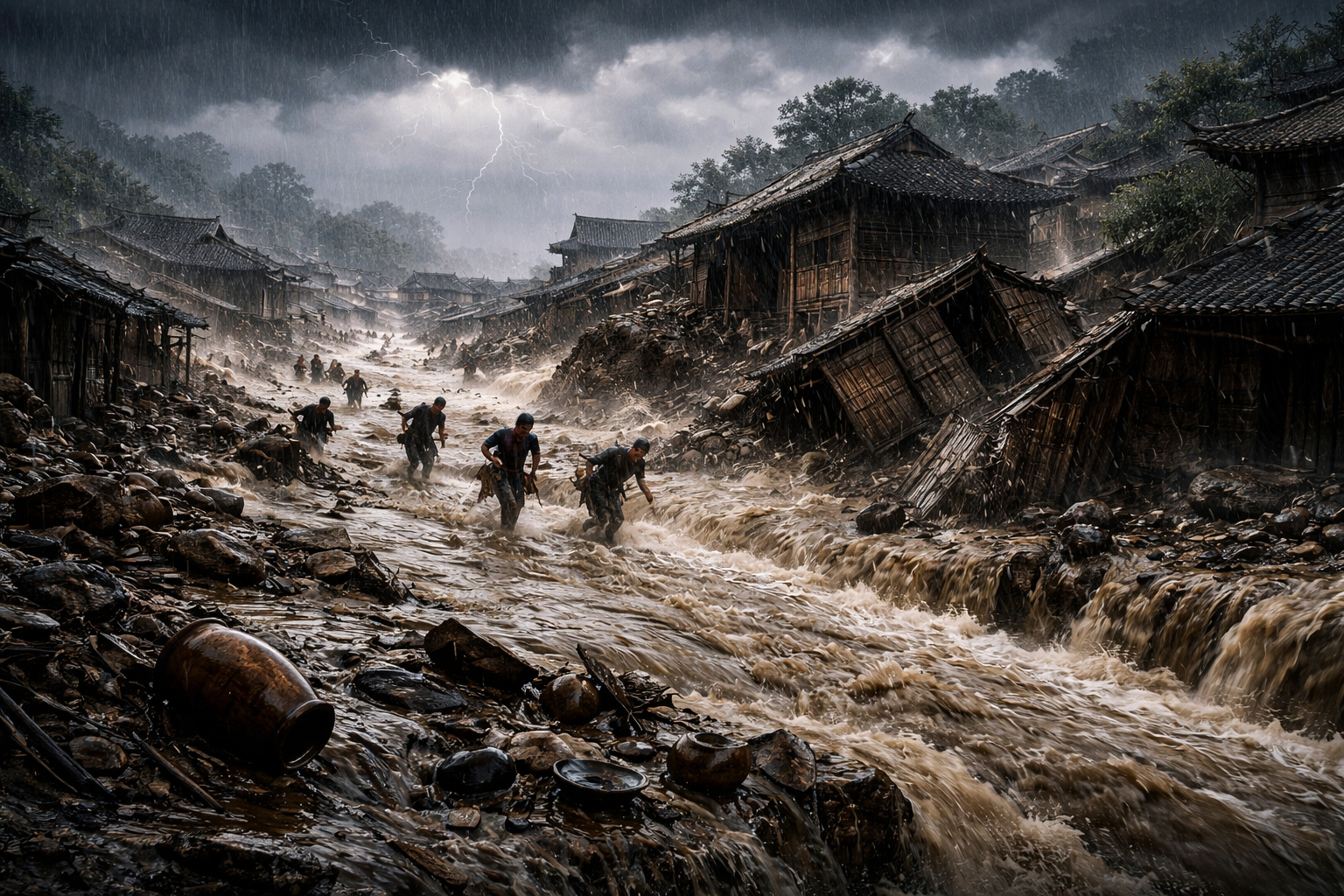
Study reveals that 140 years of heavy rain caused the collapse of the Shijiahe civilization 3,950 years ago, in a pattern similar to the current climate.
According to researchers from the University of Oxford and the China University of Geosciences (Wuhan), in a study published in the journal National Science Review in January 2026, the mystery that archaeologists have debated for decades about the collapse of the Shijiahe civilization has finally been solved, and the answer contradicted the most popular hypotheses. It was not invaders from the Central Plains. It was not an epidemic. It was the rain.
More specifically: it was the rain that did not stop. For 140 consecutive years, the Middle Yangtze Valley in central China received more than 1,000 millimeters of rain per year, the longest period of high rainfall identified in the entire historical reconstruction of a thousand years that the team built. Lakes overflowed. Low-lying plains became permanently flooded. Fertile lands for farming and settlement shrank. And a civilization that had built palaces, defensive walls, sophisticated water management systems, and a jade industry recognized as the most advanced of the Chinese Neolithic simply collapsed and people fled to the mountains.
The Shijiahe civilization and its advanced hydraulic engineering before the great classical civilizations
To understand the magnitude of the collapse that occurred about 3,950 years ago, it is necessary to understand the level of complexity that the Shijiahe civilization had achieved.
-
What is it like to live inside a $13 billion aircraft carrier where 5,000 military personnel eat 17,000 meals a day and spend months sleeping in cramped bunks?

-
Without a button, sensor, or any electronic system, Harvard scientists create a solar device that decides on its own whether to generate energy or heat and could transform energy use in homes and buildings.

-
Neither Brazil nor the USA: China produces over 60% of the world’s farmed fish and accounts for about 40% of all global seafood, using industrial-scale aquaculture megafarms to influence the international market and supply billions of people.

-
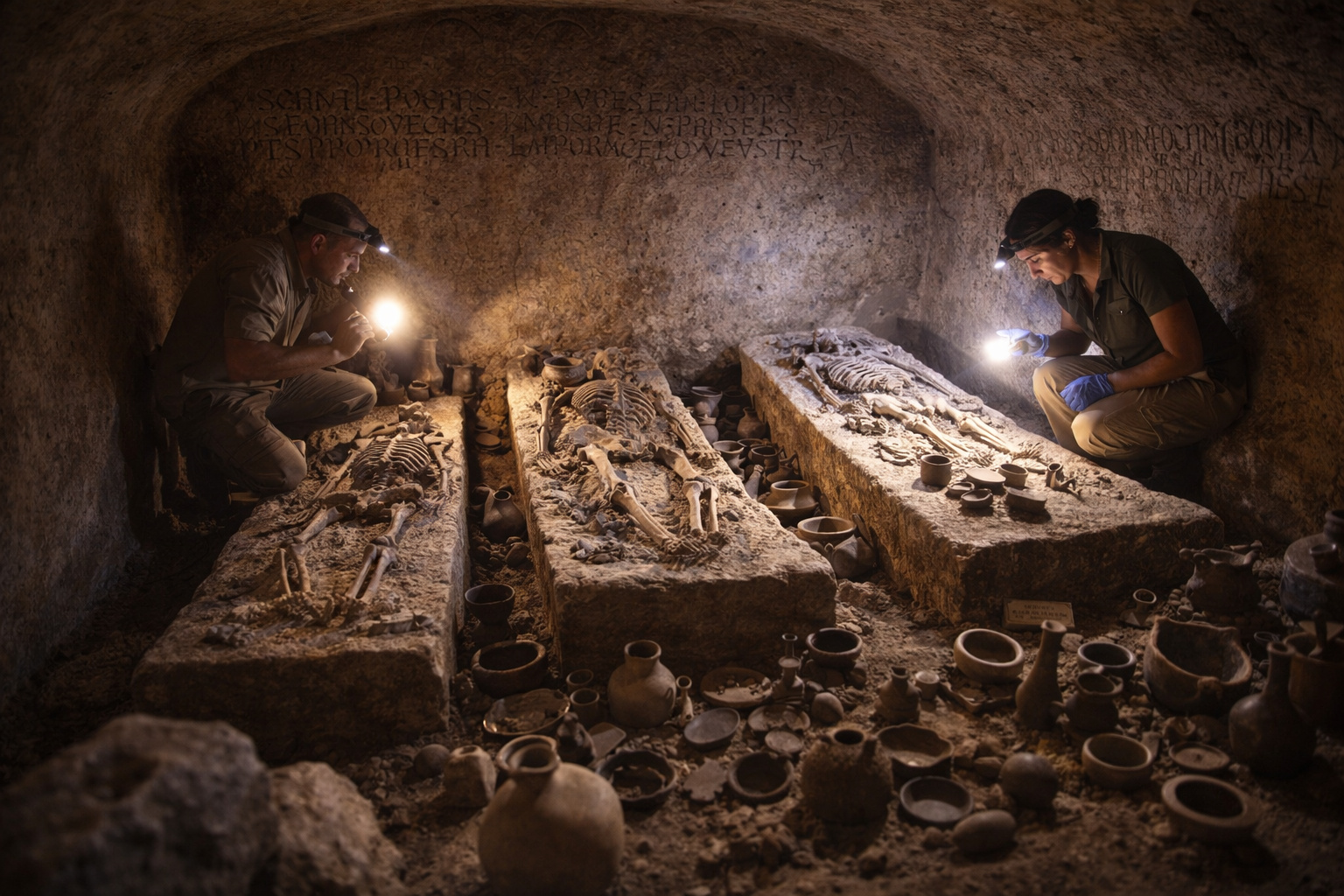
Archaeologists opened the only Etruscan chamber never looted in 2,600 years and found four individuals lying on stone beds with 110 intact objects around them, and the inscriptions found in the tomb have not yet been deciphered because the Etruscan language is a mystery that science has not yet solved.
About 4,600 years ago, this culture already exhibited advanced urban characteristics in the Middle Yangtze region, with palaces, defensive walls, structured social organization, large-scale pottery production, and a jade industry considered one of the most sophisticated of the Chinese Neolithic.

This development occurred before the construction of the Great Pyramid of Giza and contemporaneously with other great ancient civilizations. The Shijiahe was not a simple agricultural community, but a consolidated urban system, with trade networks and technical mastery over the environment.
The central element of this organization was hydraulic engineering. Drainage systems, canals, and water control structures allowed society to thrive in an environment subject to climatic variations. For centuries, these systems functioned. The problem was not the water itself, but the amount and, mainly, the duration.
How speleothems revealed 140 years of extreme rain in the Yangtze Valley
The solution to the archaeological mystery was made possible by a sophisticated climate reconstruction technique based on speleothems — mineral formations in caves that record, layer by layer, the environmental conditions of the past.
The researchers analyzed a speleothem identified as HS4, collected from the Heshang Cave. Throughout its formation, each deposited layer preserves the chemical signature of the rainwater from that period. The team conducted 925 isotopic measurements to accurately reconstruct annual precipitation over a thousand years.

The result was a continuous climatic record, which revealed prolonged periods of drought and excessive rain. Among these periods, one stood out: an interval of approximately 140 years of precipitation above 1,000 mm annually, coinciding exactly with the decline of the Shijiahe civilization.
The impact of persistent rain: flooding, loss of land, and abandonment of cities
When the climatic data were compared with the archaeological record, the correlation was direct. During the period of heavy rain, the lakes in the region expanded, the plains were flooded, and the habitable and arable areas decreased drastically.
Initially, the hydraulic systems of Shijiahe managed to absorb the excess water. However, over the years — and after decades — these systems were overwhelmed. The soil entered permanent saturation, the channels overflowed, and the agricultural fields disappeared under water.
This process did not occur abruptly, but in a continuous progression. Each year, the margin for recovery decreased. With each compromised agricultural cycle, food security weakened. Over time, remaining in the valley ceased to be viable.
Evidence indicates that the population migrated to higher areas, settling in mountainous regions. This displacement was not temporary. It persisted for centuries, and the previous urban model was never reconstructed under the same conditions.
The most disturbing discovery: ancient rains smaller than modern records
One of the most relevant points of the study is the comparison between the rains during the collapse period and modern records.
The data show that the maximum levels of annual precipitation during the collapse — about 1,200 mm — are lower than the highest volumes recorded in the last 120 years in the same region, which reach approximately 1,500 mm.

This indicates that the determining factor was not the extreme intensity alone, but the persistence over time. The rain that destroyed the Shijiahe was not the most intense ever recorded, but it was sufficiently constant to exceed the society’s capacity to adapt.
This finding has direct implications for the present. Modern urban systems are also designed based on historical patterns. When these patterns change continuously, the infrastructure becomes insufficient.
The global climatic event 4.2 kyr and the simultaneous collapse of ancient civilizations
The collapse of Shijiahe occurred during the so-called 4.2 kyr climatic event, a global disturbance recorded about 4,200 years ago that coincided with the decline of various ancient civilizations.
This event did not manifest uniformly. In the Middle East, it was characterized by severe droughts associated with the collapse of the Akkadian Empire and the weakening of the Old Kingdom of Egypt. In central China, on the contrary, it manifested as excessive rain.
This difference reflects a reorganization of global atmospheric circulation, where climatic patterns are shifted. What was dry becomes wet, and what was wet can become arid. The result is the simultaneous collapse of societies in different regions of the planet due to distinct climatic causes, but with a common origin.
The lost legacy of the Shijiahe civilization and the limit of human adaptation to climate
The collapse of Shijiahe represents not only the end of a civilization but the loss of a complex system of social, technological, and economic organization.
The culture had developed trade networks, specialized production, and hydraulic infrastructure capable of sustaining a dense population for centuries. When the system collapsed, this level of organization was not rebuilt under the same conditions.
Populations survived, but the urban model disappeared. Knowledge was fragmented. Physical structures were abandoned.
The case of Shijiahe establishes a clear limit: societies can adapt to climatic variations within certain parameters, but when these variations become persistent for decades or centuries, adaptation may cease to be sufficient. The rain did not need to be extraordinary. It just needed to be constant — for 140 years.







Seja o primeiro a reagir!