





 Portuguese
  English
  Spanish
  7 min of reading
  0 comments


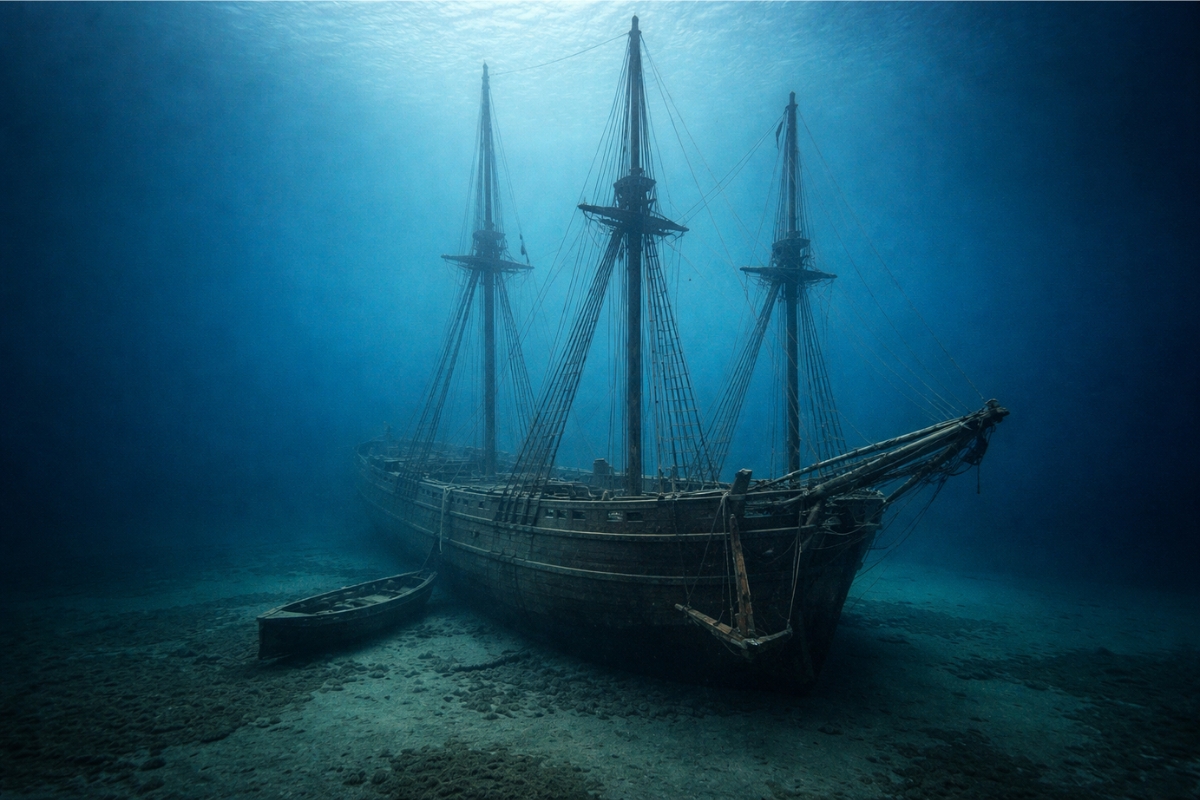
Lost since 1894, the Ironton was found on the bottom of Lake Huron in an upright position, with its structure preserved, anchor visible, and lifeboat near the hull, revealing how the cold water helped freeze a historical tragedy in time.
For over a century, the name Ironton survived only in nautical records, accounts of tragedy, and the fragmented memory of one of the most dramatic episodes of navigation on the Great Lakes. Sunk in 1894, the schooner-barge disappeared into the cold waters of Lake Huron and, over the decades, became a kind of historical ghost.
What no one imagined was that the ship would not only be found but would emerge before underwater cameras in an impressive state of preservation. Raised from the bottom of the lake, with the three masts still standing, the Ironton became one of the most fascinating discoveries in North American maritime archaeology.
What was the Ironton and why does it matter
The Ironton was a schooner barge, a type of vessel widely used in the 19th century on the Great Lakes. In practice, it was a barge with sailing characteristics, designed to be towed by steamships and integrated into the intense commercial system that moved coal, timber, iron ore, and grain throughout the region.
-
What the Public House of Julius Caesar was like inside in the Roman Forum: layout, atrium with compluvium and impluvium, tablinium and peristyle, and the scandal of the Bona Dea, revealed in an AI recreation.

-
While digging a trench next to a pool in Germany, workers found more than 1,500 silver coins from 1320 in the rubble, revealing a treasure buried for over 700 years.

-
Flight Helios 522, the “ghost” flight with 121 people: the commercial aircraft flew for more than 2 hours on autopilot after a pressurization failure left pilots and passengers unconscious and only stopped when it ran out of fuel.

-
Mars may have hidden for a long time an answer to the loss of its atmosphere, after the Curiosity rover found a mineral that stores carbon in rocks from Gale Crater.


This technical detail helps explain why the find goes far beyond a simple beautiful shipwreck. The Ironton represents a decisive phase in North American maritime history, when sailing navigation and mechanical propulsion coexisted in a hybrid, efficient, and risky logistics typical of an industrial transition period.

The night of September 26, 1894
On the night of September 26, 1894, the Ironton was heading without cargo towards Marquette, being towed by the steamship Charles J. Kershaw. Along with it was another barge, the Moonlight, forming a set of vessels that depended on the good functioning of the tugboat to maintain stability and course in open waters.
But something went wrong suddenly. The Kershaw’s engine failed, and the situation spiraled out of control in no time. Then, the towing cable of the Ironton came loose, leaving the ship adrift in an area already known for treacherous currents, unpredictable winds, and little margin for corrective maneuvers.
The fatal collision with the steamer Ohio
Out of control, the Ironton ended up crossing the path of the steamer Ohio, which was carrying grain and navigating through the same region. The collision was devastating. In a matter of moments, two vessels were thrown into the center of a maritime tragedy that would be recorded in the newspapers of the time and later in historical literature about the Great Lakes.
The episode was even more dramatic because the Ironton did not sink immediately in a simple and predictable manner. Its crew attempted to abandon the ship in a lifeboat, but the evacuation failed amid the chaos. The result was deadly: five crew members died, and only two survived the disaster.

The human detail that made the find even more moving
One of the most impressive elements of the modern discovery was the material confirmation of what ancient accounts described. According to historical documentation, the lifeboat linked to the crew’s escape was not released in time, directly contributing to the tragedy.
Decades later, when archaeologists located the Ironton, they also found the lifeboat still near the wreck. This type of evidence has enormous archaeological value because it connects written records to the physical scenario of the disaster, almost as if the bottom of the lake had frozen the final moment of the vessel.
How the ship was found after so long
The rediscovery of the Ironton was announced by the NOAA in partnership with other institutions related to underwater research and the state of Michigan. The work took place within the Thunder Bay National Marine Sanctuary, a protected area in Lake Huron famous for concentrating a large number of historical shipwrecks.
The search did not happen by chance or in a single expedition. In 2017, researchers located the Ohio, the other ship involved in the collision. This helped refine hypotheses about the Ironton’s final position. Later, new analyses of historical records, wind, drift, and trajectory allowed for a more precise search area to be defined.
The technology used in locating the Ironton

To find the ship, the team resorted to advanced underwater prospecting resources. Among them were the multibeam sonar, capable of mapping the bottom’s relief with high resolution, and a surface autonomous vehicle called BEN, used to efficiently and safely expand the sweep.
After the initial identification, specialists used ROVs — remotely operated vehicles — to confirm the identity of the wreck and capture detailed images. In a later stage, a new expedition captured high-definition videos, allowing for more precise documentation of the structure of the hull, masts, and elements associated with the wreck.
Why the state of preservation impressed so much
The Ironton measures about 191 feet, equivalent to just over 58 meters, and rests in deep waters of Lake Huron. What stood out the most was the fact that it was in an upright position, with much of its structure still recognizable, something rare even in famous archaeological contexts.
The three masts remain upright, parts of the rigging can still be seen, and even the anchor remains attached to the bow. This set of details makes the Ironton an extraordinary example of preservation. It is not just a hull on the bottom of the lake: it is practically an intact historical scene, frozen in time.
The role of the cold waters of Lake Huron
There is an important scientific explanation for this level of preservation. The waters of the Great Lakes are cold and fresh, which drastically reduces some common deterioration processes in salty marine environments. Corrosion occurs differently, and destructive organisms present in the ocean do not always survive in these conditions.
Moreover, the depth and relative stability of the environment help preserve wood, hardware, and parts of the ship that, in other contexts, would be much more degraded. Therefore, many shipwrecks in the Great Lakes exhibit exceptional states of preservation, and the Ironton has become one of the most emblematic cases of this characteristic.
Thunder Bay and the famous “Shipwreck Alley”
The Ironton was located in an area nicknamed Shipwreck Alley. The name is not an exaggeration. The area of Thunder Bay has a long reputation for danger to navigation, with a history of sudden storms, dense fog, rocky shallows, collisions, and abrupt changes in crossing conditions.
Today, the Thunder Bay National Marine Sanctuary protects about 4,300 square miles and is home to over 200 known shipwrecks. This makes the region a true natural laboratory for maritime archaeologists, naval historians, and underwater conservation specialists.
Why the Ironton became such a powerful case for maritime archaeology
From a scientific point of view, the Ironton brings together rare elements in a single archaeological site. It has strong historical documentation, is associated with a well-recorded accident, maintains remarkable structural integrity, and still presents evidence that reinforces the human narrative of the tragedy, such as the presence of the lifeboat next to the ship.
From a narrative point of view, the impact is even greater. The public does not see just old wood in the dark: it sees a 19th-century ship in an upright position, intact masts, preserved hardware, and silent marks of a fatal night. It is this combination of technique, memory, and mystery that makes the Ironton such a magnetic find.
A shipwreck that rewrites the relationship between history and image
For decades, the Ironton existed as a story told in documents, articles, and period records. Now, it can be seen. And that changes everything. When underwater archaeology can transform an ancient account into a concrete image, it creates a rare bridge between the imagined and the verifiable.
In the case of the Ironton, this bridge is especially powerful because the discovery does not contradict the known history — it reinforces it. The ship lost for 125 years reappears almost intact, silent, monumental, and technically revealing. More than a well-preserved shipwreck, it has become a time capsule of commerce, naval engineering, and human fragility in the face of the cold waters of Lake Huron.








Seja o primeiro a reagir!