





 Portuguese
  English
  Spanish
  6 min of reading
  0 comments


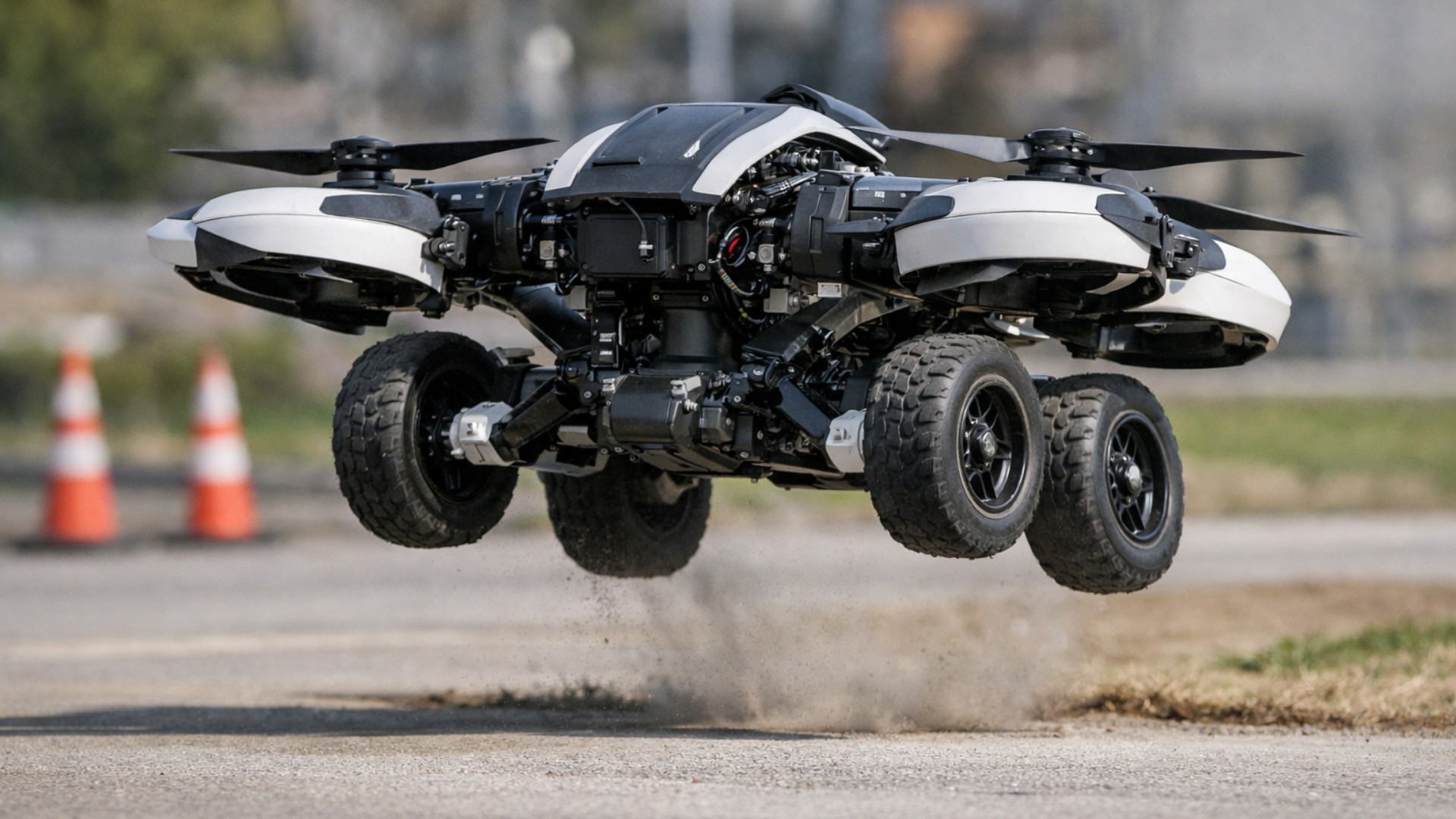
Hybrid technology advances with robot that changes shape during landing and integrates flight and terrestrial movement in a single continuous motion, increasing efficiency, control, and possibilities for applications such as deliveries and robotic exploration.
Researchers at the California Institute of Technology in the United States have developed a robot capable of flying like a drone and, still in the final descent phase, changing its configuration to touch down already prepared to move on wheels.
Named ATMO, short for Aerially Transforming Morphobot, the system was designed to transition between aerial and terrestrial movement without the typical pause of this type of operation, transforming a complex maneuver into a clear example of integration between engineering, control, and robotic mobility.
Transformation in the air redefines the concept of landing
Unlike conventional solutions, the central point of the project is the moment when the robot undergoes structural transformation, abandoning the logic of landing first and only then reorganizing its components to initiate terrestrial movement.
-
Spread across two continents, with 197 parabolic antennas in South Africa, 131,000 2-meter antennas in Australia, and a range of up to 150 km, the SKA begins to “listen” to the Universe on an unprecedented scale and accelerates the search for black holes, primitive galaxies, and nearly invisible radio signals.
-
Goodbye batteries: a new sensor created by Japanese scientists uses sweat as an energy source and points to a promising path for more sustainable devices, with greater autonomy and less need for frequent recharging.

-
The Brazilian Army inaugurated the assembly line for the Guaicurus armored vehicle with a contract for 420 units by 2033, and the same vehicle has already been tested in combat in Afghanistan and Lebanon by European armies.

-
Xiaomi launched a 10-kilogram washing machine for less than R$910.00, so slim that it fits inside a kitchen cabinet with only 15 millimeters of clearance, featuring 24 washing programs and voice control.


In this case, the ATMO changes its posture while still in the air, in the final moments of descent, completing contact with the ground already in a wheeled configuration, which requires precise control in a phase considered critical for aerial vehicles.
Although the change may seem simple in videos, it involves a classic challenge of aerospace engineering: maintaining stability close to the ground amid unpredictable airflows generated by the propellers.
According to Caltech, this continuous transition increases the system’s agility and reduces the chance of operational failures, especially in uneven terrain where hybrid robots often face difficulties resuming movement after landing.
Structure combines propellers and wheels in the same system
To enable this dynamic, the structure of the ATMO was designed to concentrate distinct functions in a single mechanical set, allowing the same elements to act in both flight and terrestrial movement without the need for independent modules.
The robot uses four propellers to stay in the air, while the fairings that enclose these components take on the role of wheels as soon as the terrestrial configuration is activated during the controlled descent.
All the change depends on a single motor responsible for moving a central joint, raising the assembly to flight mode or lowering its height for wheeled mode, which simplifies the system and reduces mechanical complexity.
According to the authors, this choice reduces the number of actuators and minimizes potential failure points, a relevant factor for operations in unpredictable environments.
Challenge is in the aerodynamics close to the ground
More than transforming the structure, the main challenge of the project lies in executing this change during the most sensitive phase of descent, when the interaction between the airflow and the ground can directly affect the vehicle’s behavior.
As the robot approaches the surface, the air propelled by the propellers returns in turbulent patterns that can alter lift, stability, and speed, requiring quick and precise responses from the control system.
In the case of ATMO, the complexity increases because the propellers change angle simultaneously with the body reorganization, creating a dynamic condition that requires real-time coordination between aerodynamics and mechanics.
To handle this scenario, the researchers combined experimental tests with a predictive control system capable of continuously adjusting the robot’s response based on the distance to the ground and the configuration assumed during the maneuver.
Ground effect can help — or hinder landing
During the experiments, the aerodynamic behavior of the ATMO was analyzed with load cell measurements and flow visualizations, allowing precise observation of how air moves around the robot during the final approach.
The analysis revealed that the so-called ground effect can act both positively and negatively, depending on the angle and configuration adopted by the robot during the controlled descent.
In one of the tested configurations, with a 50-degree tilt, proximity to the ground increased thrust by nearly 20%, contributing to a smoother and more controlled transition.
On the other hand, at higher angles, the behavior reversed and there was a loss of thrust, a condition considered critical as it increased the risk of impact with the ground beyond what was expected.
Control system operates in three phases
The control strategy was structured into three well-defined stages, allowing the robot to progressively adapt its behavior throughout the descent until completing the transition between operating modes.
Initially, the ATMO performs a conventional flight in aerial configuration, maintaining stability and standard control while reducing altitude in a controlled manner until reaching the ideal point to initiate the transformation.
Next, the system enters the flight phase with transformation, gradually adjusting its structure and redistributing forces to prepare for contact with the ground without compromising the stability of the assembly.
Finally, close to the ground, the robot operates in a specific regime that balances orientation, speed, and wheel angle to complete the landing continuously, already ready to move in a terrestrial environment.
According to the researchers, the system has been validated in different experimental demonstrations, showing stable landings even in conditions close to the limits of the actuators.
Research continues with Caltech multimodal robots
The development of ATMO was led by Ioannis Mandralis, with participation from other researchers at Caltech, and is part of a line of studies aimed at increasing the versatility of robots capable of operating in multiple environments.
In materials released by the university, the concept is associated with strategies observed in nature, especially in animals that adapt the use of their bodies to alternate between different forms of locomotion.
Additionally, the project continues previous research by the institution, such as the M4, a multimodal morphobot that had already demonstrated the ability to fly, roll, and balance using shared components.
Applications range from deliveries to robotic exploration
Caltech emphasizes that the robustness provided by this type of system can have a direct impact on practical applications, especially in areas that require adaptable mobility and continuous operation across different types of terrain.
Potential uses include commercial deliveries and robotic exploration missions, where the ability to land and immediately continue moving can significantly expand the range and efficiency of operations.
While terrestrial platforms face limitations against elevated obstacles, aerial systems deal with load and autonomy restrictions, creating a scenario where hybrid solutions emerge as a promising alternative.
By combining these two forms of locomotion into a single architecture, ATMO aims to overcome structural limitations and advance the development of more versatile and efficient robots.
Continuous transition points to a new generation of robots
Despite the visual impact associated with transformation in mid-air, ATMO has not been presented as a commercial product, but rather as a proof of concept validated through experiments and peer-reviewed scientific publication.
The main advancement lies in the demonstration that the continuous transition between flight and terrestrial movement can be performed in a controlled manner, paving the way for new approaches in the development of hybrid robots.
By replacing the traditional logic of static landing with a landing already oriented towards movement, the project reinforces a trend in contemporary robotics focused on the integration of mobility, adaptation, and autonomy in multifunctional systems.







Seja o primeiro a reagir!