





 Portuguese
  English
  Spanish
  6 min of reading
  0 comments


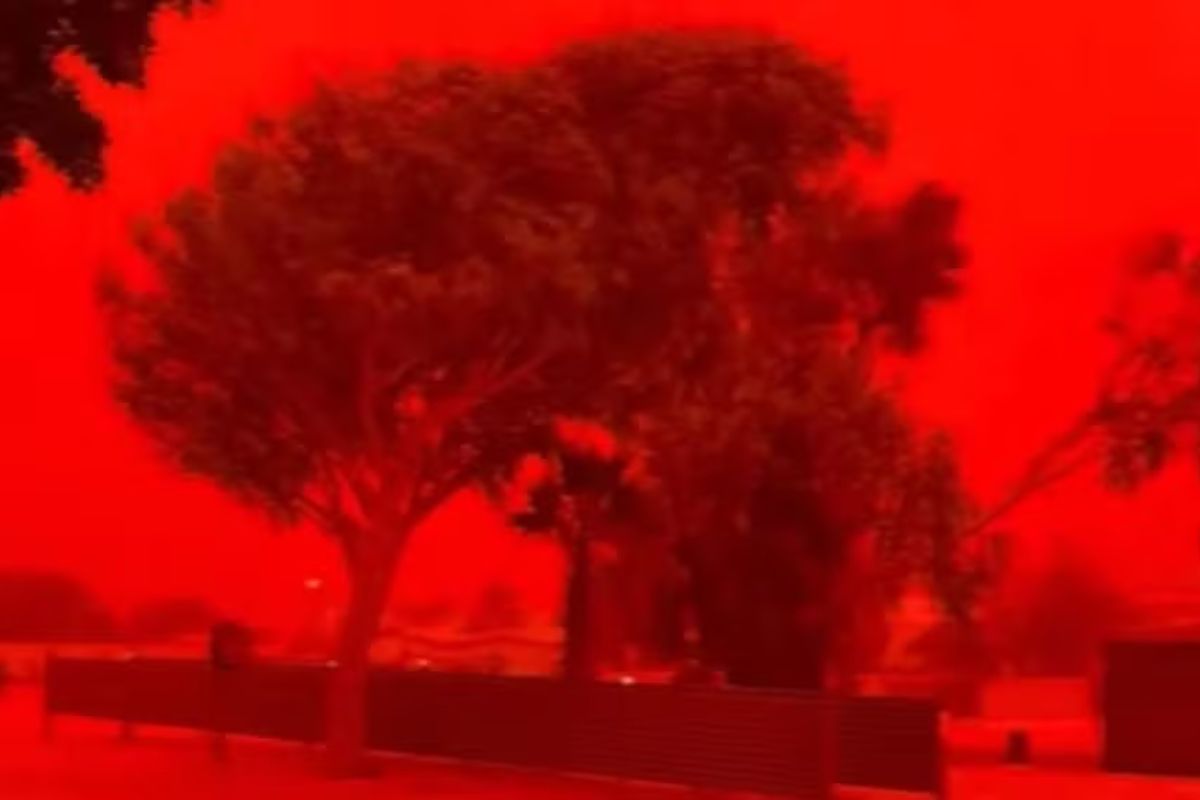
The completely red sky that took over the west of Australia before the arrival of Cyclone Narelle was caused by extreme winds that lifted iron oxide-rich dust from the arid soil, creating a landscape that residents described as apocalyptic as the storm hit the coast with gusts of up to 250 km/h, tearing off roofs and cutting power in cities like Exmouth.
Residents of western Australia woke up to a scene that looked like it was straight out of a science fiction movie. The completely red sky described as “blood tones” by those who witnessed it took over the horizon in the Shark Bay region before the arrival of Cyclone Narelle, a category 3 storm that hit the coast with winds of up to 250 km/h. The images went viral on social media and generated astonishment worldwide, but the explanation for the phenomenon is terrestrial, not supernatural.
Cyclone Narelle brought not only destructive winds and heavy rains. Before reaching the coast, its winds lifted enormous amounts of dust from the arid Australian soil, a soil naturally rich in iron oxide, the same compound that gives the red color to the outback’s land. This dust suspended in the atmosphere filtered sunlight and painted the sky a deep red, reducing visibility and creating a visual effect that transformed the day into something residents called apocalyptic. The phenomenon is documented by science, but rarely reaches this intensity.
Why the sky turned completely red before Cyclone Narelle

The explanation is physical, not mystical. The soil in the arid regions of Australia contains high concentrations of iron oxide, the same compound that gives rust its characteristic color. When strong winds sweep through these areas, they lift microscopic particles of this soil into the atmosphere. Once suspended, these particles interact with sunlight, filtering out blue wavelengths and predominantly allowing red and orange tones to pass through.
-
New 100% clean fuel produced in Brazil could retire diesel.

-
Plastered walls become a trend and end up being the perfect choice for finishing; the secret of the 2 coats that prevent waste in painting.

-
With 333 meters and equivalent to a 20-story building: China launches a supertanker that transports 2 million barrels, has 540,000 m² of area, and saves $5 million per year.

-
Brazil becomes a beacon of hope for ending plastic waste by leading a global plan that could prevent millions of tons from entering the oceans.

The result is a completely red sky that covers everything: horizon, clouds, and even the light reaching the ground. Under normal conditions, dust storms in Australia produce orange or yellow tones.
But the intensity of the winds from Cyclone Narelle lifted such a large amount of dust that the effect was drastically amplified, creating the blood-red hue that shocked residents and went viral on social media.
Meteorology experts emphasize that the phenomenon is not supernatural. The completely red sky is a natural consequence of the massive suspension of iron-rich dust particles in the atmosphere something well documented in the arid regions of the planet.
What made this episode exceptional was the combination of extremely iron-rich soil with cyclonic winds exceeding 200 km/h.
Cyclone Narelle: category 3 with winds of 250 km/h
Cyclone Narelle hit the coast of Western Australia as a category 3 tropical system, bringing gusts of approximately 250 km/h in some areas.
The storm caused immediate destruction: roofs were torn off in cities like Exmouth, there were floods on urban roads, and the supply of power and water was interrupted in various locations.
Authorities issued emergency alerts for multiple regions, advising residents to seek shelter and stay away from windows and fragile structures. The winds from Cyclone Narelle not only caused structural damage; they were also responsible for lifting the dust that turned the sky completely red, connecting the visual phenomenon to the storm’s destructive force.
The cyclone also drew attention for its unusual trajectory. After hitting the coast, the system crossed different parts of Australia over thousands of kilometers a rare behavior for tropical cyclones in the region, according to experts.
Even with the gradual weakening after making landfall, authorities warned that there was still a risk of heavy rains, strong winds, and flooding in the areas through which the former cyclone passed.
The impact on the Shark Bay region and coastal cities
The Shark Bay region, in western Australia, was where the completely red sky appeared most intensely.
The images captured by residents show a landscape where everything houses, streets, vegetation was bathed in intense red light, as if a filter had been applied over reality. Visibility dropped drastically, and the environment resembled the surface of Mars more than an Australian city.
In Exmouth, a coastal city directly in the path of Cyclone Narelle, the damage was more concrete. Roofs of homes and businesses were torn off by the winds. Streets were flooded with the combination of heavy rain and storm surge.
The supply of electricity and water was cut off, leaving residents without essential services while the storm was still passing through the region.
Emergency teams were mobilized to assist the most affected areas, but the extent of the damage could only be fully assessed after the cyclone passed.
For residents who saw the red sky before the storm arrived, the phenomenon served as a visual warning of what was to come an experience that many described as the most impressive and frightening of their lives.
What the iron-rich dust of Australia reveals about the outback soil
Australia is globally known for its red soil, especially in the vast expanses of the outback. This coloration is the result of millions of years of chemical weathering: the iron minerals present in the rocks oxidize over time, forming iron oxide the same compound as rust that tints the soil a deep red.
When storms or cyclones like Narelle lift this soil into the atmosphere, the dust carries with it the iron oxide. In suspension, these microscopic particles selectively filter sunlight: they absorb shorter wavelengths (blue and violet) and scatter longer ones (red and orange). The effect is a sky that completely changes color, and the more dust in the air, the more intense the red.
The phenomenon is not exclusive to Australia. Dust storms in the Sahara have caused orange skies in Europe, and similar events occur in parts of the Middle East and the western United States.
But the combination of extremely iron-rich soil with cyclonic winds of 250 km/h made the Australian event particularly dramatic and the completely red sky that resulted from it will be recorded as one of the most impressive atmospheric phenomena in recent years.
Cyclone Narelle and the energy context of Australia
Cyclone Narelle not only caused damage to homes and urban infrastructure. The storm also interrupted production at Chevron’s gas plants located in northwestern Australia a strategic region for global energy supply.
The interruption occurred at a particularly sensitive time, with demand for liquefied natural gas high due to the war in the Middle East and restrictions on energy supply from Russia.
Australia is one of the largest exporters of liquefied natural gas in the world, and Chevron’s facilities on the west coast are a critical part of this supply chain.
The winds from Cyclone Narelle forced the temporary suspension of operations as a safety measure, adding another layer of economic impact to a storm that had already caused destruction in coastal cities and generated one of the most impressive visual phenomena in recent times.
The scenario reinforces how extreme weather events can have consequences that go far beyond the location where they occur. A cyclone that paints the sky completely red in Australia and tears off roofs in Exmouth also affects the price of gas in Asian and European markets a connection that shows how much the global energy infrastructure is exposed to natural forces that do not respect borders.
With information from the portal OGlobo.
Have you ever seen anything like this red sky anywhere in the world? What did you think of the images from Australia during Cyclone Narelle? Leave your opinion in the comments; phenomena like this deserve to be discussed and understood, not just shared on social media.





Seja o primeiro a reagir!