





 Portuguese
  English
  Spanish
  6 min of reading
  3 comments


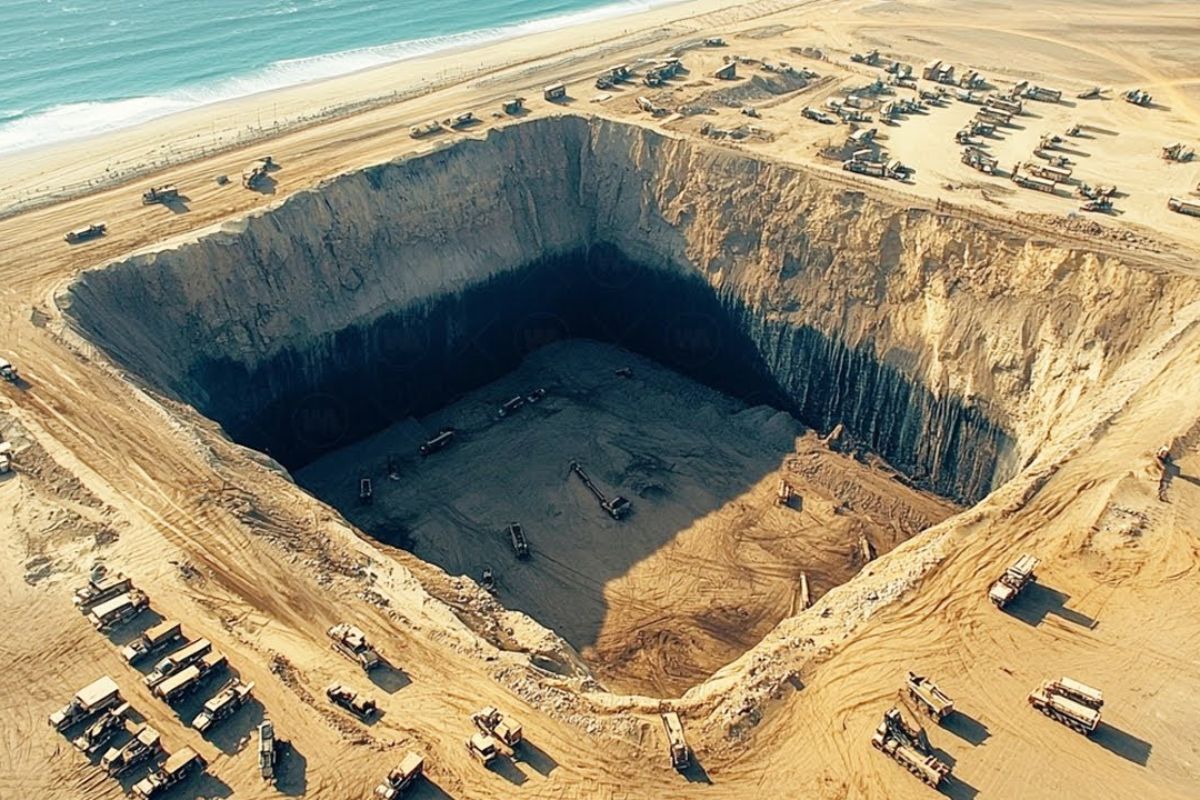


In 2008, a 1,300-Foot Beach in Jamaica Was Loaded onto 500 Trucks; in 2015, a Vessel Sucked Sand from Pari Island. The Pattern Repeats with Illicit Exports, Soaring Prices, and Violence, While Construction Projects Devour Sand and Cause Islands to Sink Before Anyone Notices It All.
It was in July 2008, in the middle of the night, when a convoy stopped in Coral Spring, on the island of Jamaica, and took away an entire beach. Heavy machinery and even shovels ripped 1,300 feet of Caribbean white sand, loaded the cargo onto 500 trucks, and vanished, leaving a scene that looked lunar.
The estimated theft of about one million dollars was never recovered, and the disappearance revealed a mechanism larger than a local crime. When sand becomes a commodity, an island ceases to be a landscape and becomes inventory, exposed to a market that intertwines illegality, corruption, and industrial demand.
The Dawn When a Beach Became Cargo

The attack in Coral Spring was not an improvised theft.
-
A 68-meter tower, which housed a historic brewery in the heart of Germany’s port, balances on a small base and uses activated core concrete for cooling that reduces the need for air conditioning.

-
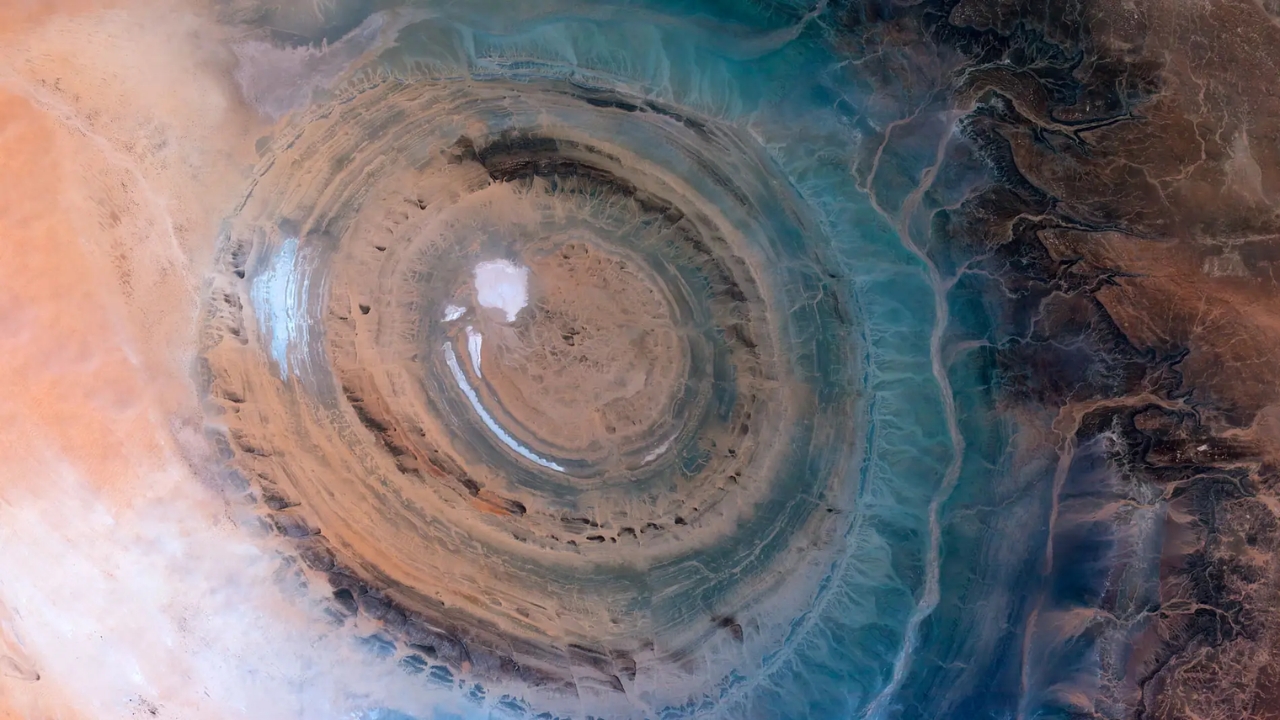
For decades, a 50-kilometer ring structure in the middle of the Sahara has puzzled scientists: visible from space, it reveals layers of millions of years and turns the desert in Africa into a geological mystery.
-
With an unusual prize, Japan transforms office chairs into a resistance race on the streets, the ISU-1 Grand Prix grows, fills events, and pays 90 kilograms of rice.

-
With a façade that resembles a giant zipper, the building in Milan creates a sense of strangeness, featuring lighting that transforms engineering and attracts the attention of residents and tourists.


It was an operation that depended on silent logistics, enough vehicles to move hundreds of tons, and a destination ready to receive the material, associated with a future resort that was left without land.
What was left behind was the simplest proof of the operation: sand does not disappear; it merely changes location.
On an island, this is even more visible because the coast is the very edge of the territory.
When an Island Begins to Truly Disappear

In 2015, fishermen in Indonesia noticed a 98-foot vessel anchored near the island of Pari, in the Thousand Islands archipelago.
The ship was not there by chance: it began to suck enormous amounts of sand, and a large sandbank, where the fishermen would dock, disappeared.
With the sandbank, fishing nets also vanished, and those responsible exited the scene.
The case exposed a recurring dynamic: the stolen sand and gravel are sold to other countries, and what was once an island above water gradually becomes a remnant that sinks.
The Domino Effect on Sand Islands
Uncontrolled extraction has decimated 26 sand islands in Riau province, Sumatra, since 2005.
The alert does not stop there: at least 2,000 small islands in Indonesia are identified as at risk of disappearing sooner or later if excessive removal continues.
On this type of map, the coastline becomes a shrinking graph.
And each lost island is, at the same time, environmental damage, economic loss, and a real reduction of territory.
How Smuggling Organizes to “Make” Sand Disappear
In Morocco, undercover investigations revealed how supply adjusts to demand swiftly.
The promise of mobilizing hundreds of trucks and loaders in a week appeared as something normal, and drivers reported that consortia could organize night deliveries with up to 250 trucks.
The next step is the hardest to undo: mixing smuggled sand with legal material in construction projects.
After that, tracking the origin becomes an almost impossible puzzle, and the sand from an island could end up diluted in the concrete of any city.
From Wheelbarrow to Dredge at Sea
The scale varies. Sometimes, it is a wheelbarrow pushed to the beach, shovels, and direct sale to the buyer.
In larger operations, barges and ships with dredges come into play, usually at night, away from curious eyes, in stretches of unprotected coast where removal can occur without real barriers.
In some scenarios, extraction is not even hidden.
Trucks operate during the day, and the very presence of surveillance at the beach entrance suggests that, in certain places, sand from an island can be taken with cover and institutional silence.
The Manual Mining That Pushes People to the Limit
Near Mumbai, hundreds of small wooden boats anchor over holes in the riverbed.
Each boat gathers crews of six to ten people, with divers going down, filling metal buckets with sand, and returning to the surface for others to haul the load.
The pace is brutal: 200 buckets a day.
The depth has also changed over time.
The work started at 6 meters; then it rose to 39 feet, with a practical limit of 49 feet.
When the bottom becomes even lower, the solution is to look for another spot.
Once again, sand becomes displacement and risk, and the distant island becomes an indirect consequence.
Why Sand Became the Heart of Global Construction
Sand is a central component of concrete, and the construction sector has accelerated in recent decades.
It is estimated that up to 50 billion tons of sand are used annually worldwide, a volume surpassed only by water usage among natural resources.
The scale of consumption helps explain the pressure on beaches, rivers, and island coastlines.
Between 2011 and 2013, China reportedly used more cement than the U.S. in the entire 20th century: 6.6 gigatons versus 4.5 gigatons.
The Size of the Appetite in Concrete Numbers
For a 3,300-Foot highway, the requirement exceeds 27,000 tons of sand. An average concrete house requires about 181 tons.
A hospital may request 3,000 tons.
Just at the Burj Khalifa, 11.6 million cubic feet of concrete were used, which would require over 5 million tons of sand.
And if all the sand used in a year became a wall, the result would be a band 65 feet high by 65 feet wide, wrapping around the entire equator.
In this world, an island does not disappear by magic; it disappears by demand.
Scarcity, Prices, and the Market that Accelerates Theft
With such demand, scarcity appears and the black market grows.
The average price of a ton of imported sand in Singapore was US$ 3 in 1995.
By 2005, it had already reached US$ 190, and continued to rise.
Quality also matters: riverbed sand, lake sand, and shoreline sand are the most desired for construction. When they are scarce, beaches and dunes get included, and sands from an island become targets.
Desert sand, like that from the Sahara, is not suitable for concrete, so “taking from the infinite” does not solve the problem.
Where Does the Sand Go When an Island Shrinks
Singapore has become the largest importer of sand due to land reclamation and territorial expansion, with a growth of 24% associated with sand from neighboring countries.
Even with prohibitions, the flow is believed to have continued through illegal channels.
There is an example that illustrates the magnitude of the imbalance: Singapore recorded the import of 3 million tons of sand from Malaysia in 2008, while Malaysia recorded the export of 133 million tons to Singapore in the same year.
A difference of this size can mean rearranged coastlines and a reduced island in silence.
The Invisible Cost in Fishing, Rivers, and Water
When sand disappears, the local economy feels it first.
In affected areas, fishermen who previously brought in 22 lbs of fish per day now return with 2 lbs.
In rivers, extraction destroys estuaries, habitats, and worsens flooding.
Sand acts like a kind of sponge for the watershed, helping to replenish after droughts.
When too much is removed, natural replenishment cannot sustain the watercourse, supply worsens, vegetation recedes, and coastal ecosystems disappear.
On an island, this means losing natural protection and stability.
The Sand Mafia and the Violence That Accompanies the Truck
The business is not just economic; it is also violent.
In Makueni County, Kenya, conflicts related to sand between 2015 and 2017 claimed at least nine lives and injured dozens.
In December 2016, two trucks were surrounded near the Muoni River, drivers were attacked, and vehicles were set on fire.
Elsewhere, villagers were attacked and killed while trying to resist illegal mining, and there are reports of hundreds of deaths in confrontations involving sand mafias, police, authorities, and civilians, especially in scenarios where confronting the issue becomes risky.
When the sand from an island enters this route, it carries along a trail of intimidation.
What Can Curb an Island’s Disappearance
There are discussed paths to limit the disappearance.
One of them is to strengthen international oversight in sensitive areas, with certification of wetlands and monitoring by independent committees, creating real barriers against looting.
Another front is technological: systems capable of determining the origin of sand and identifying whether it came from legal or illegal sources.
This would require creating a robust registry of sources for comparison. Without traceability, the sand from an island becomes just another grain within the concrete.
If sand is making an island vanish from the map, what should be the priority: tightening local enforcement, tracing the origin of the material, or limiting construction projects that feed this demand?






Eta! Mas como fazer construir ou não construir, eu acho que mudam de lugar e forma, areia vira concreto e sei lá o que vira cimento. Só a água usada aí volta aos seus estados iniciais, liquido, sólido e gasoso. Tudo no mundo é assim bom aqui, ruim ali, parece pro bem agora, mas num futuro qualquer é ruim.
E os locais de onde tira a matéria para o cimento? Eca! Organizar é destruir e organizar e também desorganizar. Eca! Como fazer para cada coisa ficar no seu lugar.
Nossa será quê vão dar uma de Sérgio naia ou então venderão para quem faz ilha artificial só pôde, concertesa virou ilha artificial.!
Prezados, convertam as informações ao sistema métrico, pois será mais fácil o entendimento para os leitores leigos. Obrigado.