






 Portuguese


Retired aircraft accumulated more than 73,000 flight hours, was decontaminated, prepared, and sunk in 2006, spending almost two decades on the seabed until it transformed into habitat for numerous local marine species
A Boeing 737-200 was deliberately placed on the bottom of the Georgia Strait, Canada, on January 14, 2006. After years of preparation and decontamination, the fuselage was colonized over nearly two decades by fish, sponges, anemones, octopuses, and other marine organisms.
The Boeing was manufactured in 1975 and accrued over 73,000 flight hours before being retired in 2001 due to age and structural issues.
Before its sinking, the aircraft served in the fleets of Pacific Western Airlines, Canadian Airlines, and Air Canada. It was later acquired by Qwest Air Parts for component recovery.
-
The 3-Meter, 600-Kilogram Whale That Walked on Land 43 Million Years Ago, Found in the Egyptian Desert

-
Without Nails or Screws, 11,000 m² Building Uses Engineered Wood with Adhesives, Preserves 38,000 m² of Vegetation, Features 580 Solar Panels, and Wins National Sustainability Award
-
Students from Pará Create Robot to Detect Methane Gas Using Miriti, Scrap Materials, and Programming, Transforming Low-Cost Technology into a Sustainability Tool
-
China Replaces Steel and Plastic with Bamboo Composite for World’s First 100 kW Offshore Solar Platform and Prepares Megawatt-Scale Version to Expand Technology


Engines, landing gear, and other reusable parts were removed at Vancouver Airport. After that, the fuselage arrived at the Artificial Reef Society of British Columbia, also known as ARSBC.
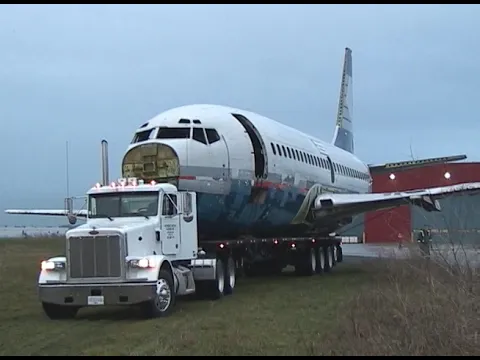

Boeing 737-200 required nearly four years of preparation before being sunk
The idea of turning the old passenger plane into a structure to support marine life came about in 2002. However, placing the aircraft into the ocean required environmental preparation and permits.
The process took nearly four years and involved hundreds of hours of volunteer work. Grease, thermal insulation, and other pollution-inducing materials were removed before the operation.
The surfaces were also cleaned, and openings were made in the fuselage. These modifications were intended to encourage colonization by organisms and ensure a safer passage for divers.
The project also required licenses from Environment Canada and six First Nations communities.
The selected site was offshore from Chemainus on Vancouver Island, approximately 70 kilometers north of Victoria.

30-meter fuselage of the Boeing rested above the seabed
On January 14, 2006, a crane slowly lowered the Boeing 737-200 to its new destination. The aircraft measured approximately 30 meters in length.
At the core, the fuselage was placed on 3.3-meter supports. This configuration keeps the old aircraft elevated, allowing marine animals and divers to pass beneath the structure.
The maximum depth of the site is approximately 27 meters, with much of the fuselage resting about 21 meters below the surface.
Divers can navigate through the former passenger cabin, observe the cargo holds, and reach the cockpit. In the space once occupied by the crew, small fish have found refuge.
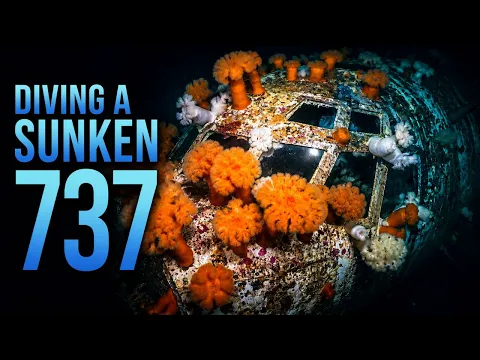
Fish, octopuses, sponges, and anemones now occupy the old airplane
Over the years, initially bare surfaces began to be populated by marine organisms, gradually transforming the industrial structure into an underwater habitat.
Rockfish, lingcod, and juvenile fish that use the structure for shelter have been recorded in the area. Plumose anemones, sea lilies, octopuses, sea cucumbers, and red sea urchins have also been found among the organisms.
The reef was named Xihuw, a term from the Hul’qumi’num language related to the red sea urchins that were once abundant in these waters but whose populations have declined due to pollution and overfishing.
This case also demonstrates that simply placing structures in the ocean does not guarantee the same results. Artificial reefs depend on factors such as location, depth, and design.
While they can support fish communities comparable to those in natural structures and serve as stepping stones for certain species, they do not represent a quick solution for restoring degraded ecosystems.
In the case of Xihuw, the process began before the sinking, involving years of planning, decontamination, fuselage preparation, and site selection.
Afterward, marine colonization gradually transformed the old airplane into a habitat in the Canadian Pacific.
This article was based on information provided in the foundational material regarding the Artificial Reef Society of British Columbia and the Xihuw artificial reef, preserving data, numbers, and information as per the consulted material.


