Portuguese
  Spanish


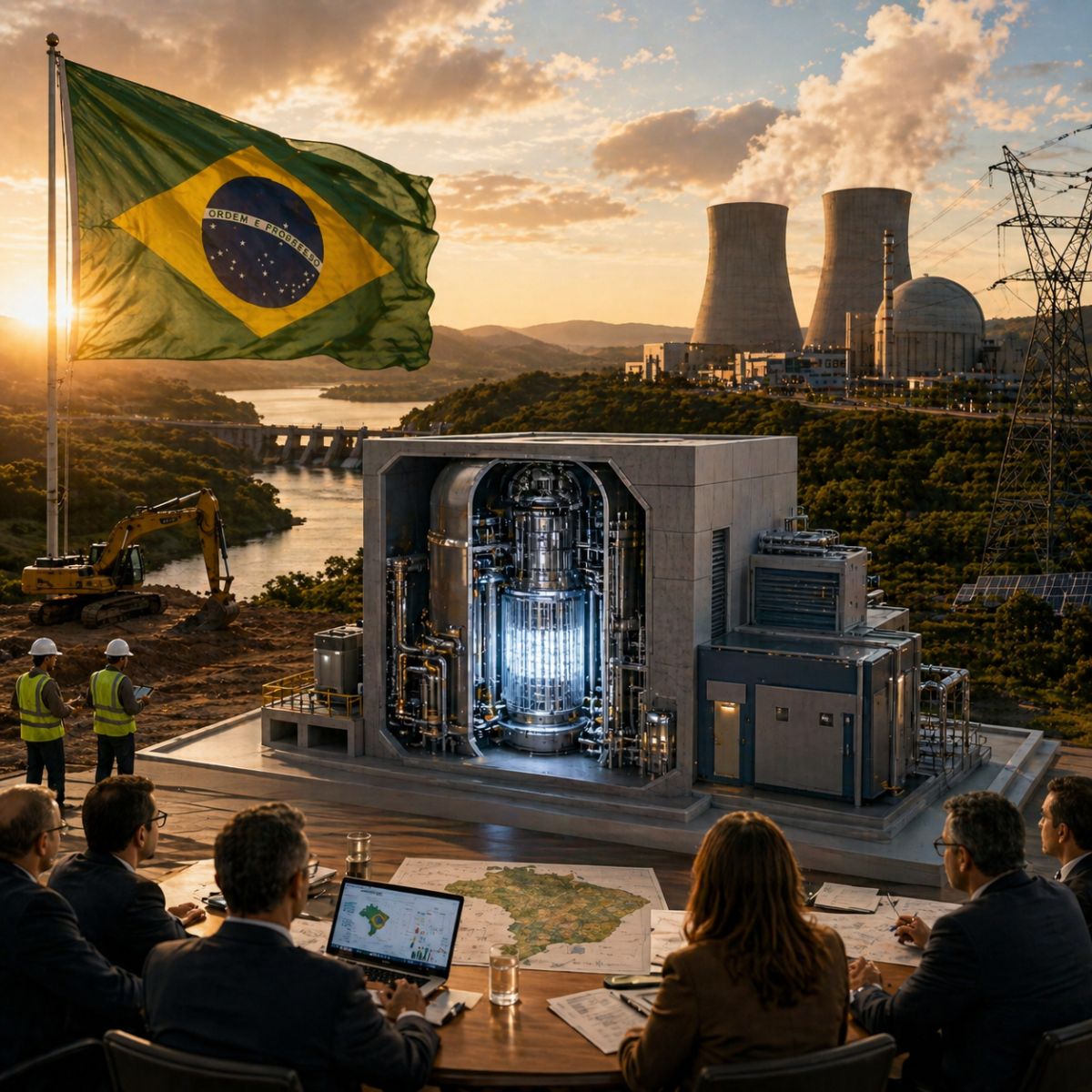

The Ministry of Mines and Energy installed this Tuesday (22) Working Group No. 19, responsible for discussing the necessary infrastructure to bring small modular nuclear reactors to Brazil. The collegiate body brings together governmental agencies, regulators, state-owned companies, and academia to define installation sites, financing models, waste management, and qualified workforce training.
Brazil has just officially put on the table the discussion about modular nuclear reactors, a technology that is gaining ground worldwide as an alternative to diversify energy matrices and enhance energy security. The Ministry of Mines and Energy held the first ordinary meeting of GT-19, a working group created within the scope of the Brazilian Nuclear Program Development Committee to evaluate the technical, regulatory, and institutional aspects necessary for the insertion of small modular reactors, known by the acronym SMR, in the country.
The initiative marks the beginning of a process that may take years, but whose first step is precisely to map what Brazil needs to do to be prepared. Among the priority themes of GT-19 are the definition of sites for reactor installation, radioactive waste management, qualified workforce training, operational models, financing, technology selection, and supply chain development. The Undersecretary of Governance of the MME, Dênis Soares, stated that the proposal is to collaboratively build the necessary foundations for the insertion of SMRs in Brazil, aligning innovation, safety, and energy development.
What are small modular nuclear reactors and why is the world betting on them
According to information released by Gov.br, small modular reactors are compact nuclear power plants, with significantly less power than large traditional plants like Angra 1 and 2. They are designed to be factory-built and assembled on-site, which reduces construction costs and delivery times compared to conventional projects that take decades to complete. Modularity allows for additional capacity to be installed as demand grows, without the need to build an entire plant at once.
-
Company Offering “Stones to Diamonds” Scheme Sells Ruined Italian Homes to Brazilians for 1 Euro, Disappears with Promised Renovations, Leaving Buyers in Debt to Italian Tax Authorities Until 2028 Without Property

-
Plastic Packaging Drives Santa Catarina Industry to 230% Growth, Aiming for R$ 500 Million by 2030 Amid Sector Crisis, with New Gearless Line Expanding in Southern Brazil to Compete in South America

-
Flamengo Star Invests in Brazilian Coastal Luxury Real Estate as Itapema Surpasses Balneário Camboriú in High-End Market Growth
-
Brazil to Issue “Panda Bonds” in China, Aiming to Raise Up to 5 Billion Yuan at Lower Interest Rates Than Dollar Debt


In the international scenario, SMRs are considered a relevant alternative for countries seeking clean and constant energy, without depending on climatic conditions such as sun and wind. Powers like the United States, United Kingdom, Canada, and France are already advancing in modular reactor projects, and China inaugurated the world’s first commercial SMR in 2023. For Brazil, which already has nuclear experience with the Angra plants, the technology represents an opportunity to expand its atomic capacity without repeating the megaproject model that historically faced delays and budget overruns.
What GT-19 will define and who participates in the discussions
GT-19 was instituted by CDPNB Resolution No. 43, of January 2026, and brings together representatives from different segments of the Brazilian nuclear sector. The inaugural meeting was attended by governmental bodies, the National Nuclear Safety Authority, state-owned companies, the productive sector, and academic institutions, configuring an integrated approach that seeks to cover all angles of the challenge.
The themes that the group needs to address are complex and interdependent. Defining where to install reactors requires studies on safety, environmental impact, and proximity to consumption centers. Establishing financing models requires dialogue with development banks and private investors. Selecting the most appropriate technology for the Brazilian profile involves comparing projects from different international suppliers. And training a qualified workforce to operate nuclear reactors is a process that takes years and needs to begin before the plants physically exist.
Why Brazil needs nuclear energy if it already has sun, wind, and water
The question seems obvious in a country with one of the world’s most renewable electricity grids, but the answer lies in energy security. Hydroelectric plants depend on rain, and Brazil has faced severe water crises in recent years that raised energy costs and forced the activation of gas and oil thermal power plants. Solar and wind energy are intermittent: they generate electricity when there is sun and wind, but not when consumption is higher, such as at night.
Nuclear reactors operate 24 hours a day, regardless of the weather, and can run for months without interruption for fuel supply. This constancy is what makes them complementary to renewable sources, not competitors. In an ideal energy matrix, nuclear occupies the role of a stable base upon which solar, wind, and hydroelectric add variable capacity. For Brazil, which is growing in energy demand and needs to keep emissions low, SMRs represent an option that other countries are already adopting.
The challenges Brazil needs to overcome to operate modular reactors
Installing small modular reactors in Brazil is not just a technical decision. The country needs to update its nuclear regulatory framework, which was designed for large plants and does not contemplate the specificities of SMRs. The National Nuclear Safety Authority will have to develop licensing criteria adapted to the new technology, a process that involves safety analysis, radiological protection, and emergency plans different from those applied to Angra.
Radioactive waste management is another sensitive point. Although SMRs generate less waste than conventional plants, Brazil still does not have a definitive repository for nuclear waste, and any new program will need to address this issue before entering operation. Financing is also a challenge: modular reactors cost less than large plants, but still require investments of hundreds of millions of dollars that need government guarantees or partnerships with the private sector.
What to expect from the working group in the coming months
The expectation is that GT-19 will elaborate a consolidated document with guidelines and recommendations capable of subsidizing strategic decisions within the scope of the Brazilian Nuclear Program. The group will not build reactors, but will define the conditions for Brazil to be able to receive them, a planning work that precedes any concrete investment in infrastructure.
The schedule has not been disclosed in detail, but the pace of meetings and the complexity of the topics suggest that the first results should emerge throughout 2026. For Brazil, the creation of GT-19 follows the international movement of SMR expansion and signals that the country does not want to be left out of a technology that could redefine the energy sector in the coming decades. The question that remains is whether the speed of discussions will be compatible with the urgency of the energy transition that the world faces.
Do you think Brazil should invest in modular nuclear reactors or concentrate resources on solar and wind? Tell us in the comments what you think about nuclear energy in the country and if you believe SMRs can be a solution for Brazilian energy security.