





 Português
  Inglês
  Espanhol
  3 min de leitura
  0 comentários


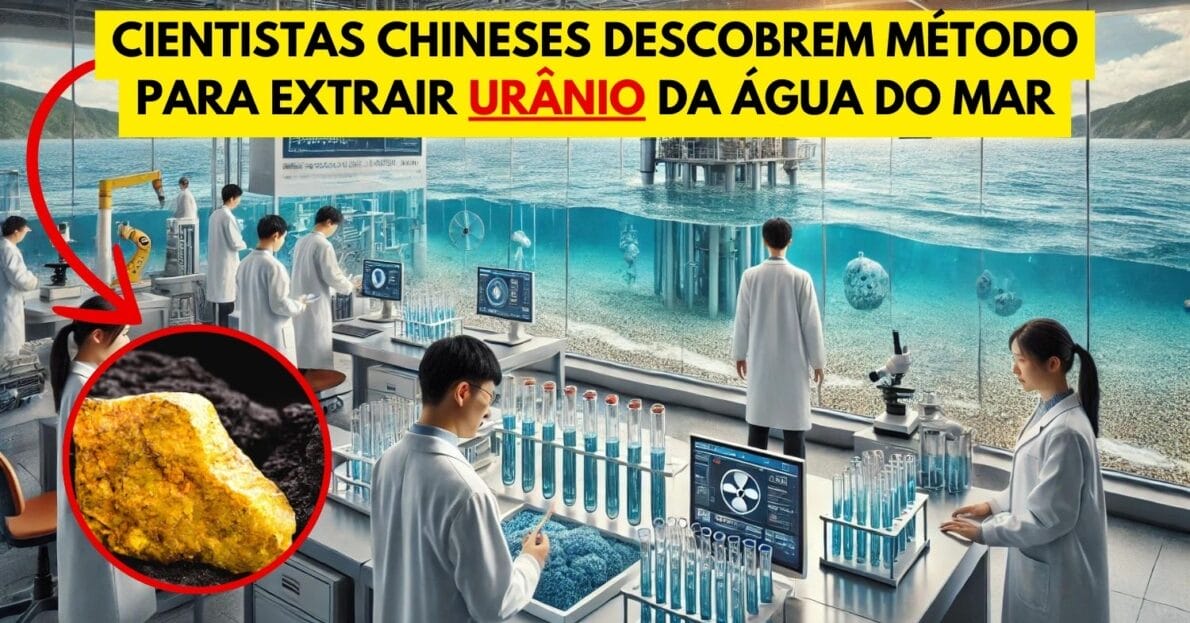
Chinese Scientists Develop Organic Material Capable of Extracting Uranium from Seawater, Making Nuclear Energy More Sustainable and Economical.
Nuclear energy is one of the most powerful and controversial energy sources today. With the growing demand for clean and efficient energy, scientists around the world have sought innovative ways to extract uranium, the essential fuel for nuclear reactors. Recently, Chinese scientists made a significant step in this direction by developing a organic material capable of extracting uranium from seawater efficiently and economically. Let’s better understand this discovery and its potential impact.
The Challenge of Uranium Extraction
Uranium is a heavy metal crucial for nuclear energy generation, but its traditional extraction involves mining rocks, a costly and environmentally impactful process. The idea of extracting uranium from seawater is not new, but it has been challenging due to the low concentration of uranium in the oceans. To give you an idea, one ton of seawater contains only 3.3 milligrams of uranium.
Scientists in China have developed an organic material that promises to revolutionize the way we extract uranium from the sea. This material is described as having a “remarkable uranium adsorption capacity”, in addition to being economically viable and environmentally friendly.
-
Found in one of the most radioactive places on Earth, this Chernobyl fungus may be doing something with radiation that no one has been able to explain to this day.

-
A bright yellow mushroom imported from Asia escaped from a cultivation farm in the United States in 2010 and is now aggressively spreading across 25 states, destroying entire communities of native fungi in American forests.

-
Buried under China, a colossal machine weighing 20,000 tons began operating as the largest neutrino detector on the planet and, in just 59 days, surpassed results that science took half a century to achieve.

-
Iran enters the center of a climate alert after the war emitted 5.6 million tons of CO2 in two weeks, surpassing the annual pollution of entire countries.




The research highlights that this adsorbent has a significantly higher uranium selectivity compared to advanced adsorbents using amidoxime groups for uranium extraction.
How Will Scientists Extract Uranium from Seawater?
The developed material is made from DNA enzymes and composite microspheres derived from ion exchange between sodium alginate and calcium ions. These microspheres show high selectivity for uranium, displaying a uranium-vanadium ratio of 43.6 in simulated seawater and 8.62 in natural seawater. This means that the material can accurately distinguish uranium from other ions present in seawater.
One of the most impressive aspects of this new adsorbent is its sustainability. The material can be recycled and is easy to synthesize, in addition to having significant mechanical robustness. This makes it not only an efficient solution but also practical and environmentally responsible.
The recyclability and ease of mass production are significant advantages that could reduce operational costs and minimize the environmental impacts associated with uranium extraction.
Material Discovered by Chinese Scientists Shows Exceptional Performance Even in Prolonged Immersion in Seawater
Extracting uranium from seawater is a task comparable to finding a needle in a haystack. The presence of other ions in seawater makes the process even more complicated, but the new material developed by Chinese scientists shows exceptional performance even in prolonged immersion in natural seawater.
This highlights the robustness and effectiveness of the material in real-world conditions, not just in controlled laboratory environments. In addition to uranium extraction, research suggests that these DNA-based adsorbents may be used to recover other valuable metal ions from seawater.
Specific DNAzymes have the ability to recognize various metal ions, which could open doors for the recovery of other important mineral resources present in the oceans. This could include rare metals and other critical elements for the technology and energy industries.
Capacity to Extract Uranium from Seawater May Help to Secure a More Stable Supply of the Metal
The ability to extract uranium from seawater efficiently could have a considerable impact on the nuclear energy industry. The availability of uranium extracted from non-traditional sources may help to ensure a more stable supply and reduce dependence on terrestrial mines.
This is particularly important as the world seeks cleaner and more sustainable energy sources. Nuclear energy, when managed safely, offers a low-carbon alternative compared to fossil fuels.
The discovery by Chinese scientists represents an advancement in the extraction of uranium from seawater, an innovation that could transform the nuclear energy industry. With a organic material that is efficient, economical, and environmentally responsible, we are one step closer to making nuclear energy an even more viable and sustainable option for the future.
The ability to extract uranium effectively may not only ensure a continuous supply for nuclear reactors but also open new possibilities for the recovery of other valuable resources from the oceans.








Seja o primeiro a reagir!