





 Portuguese
  English
  Spanish
  5 min of reading
  0 comments


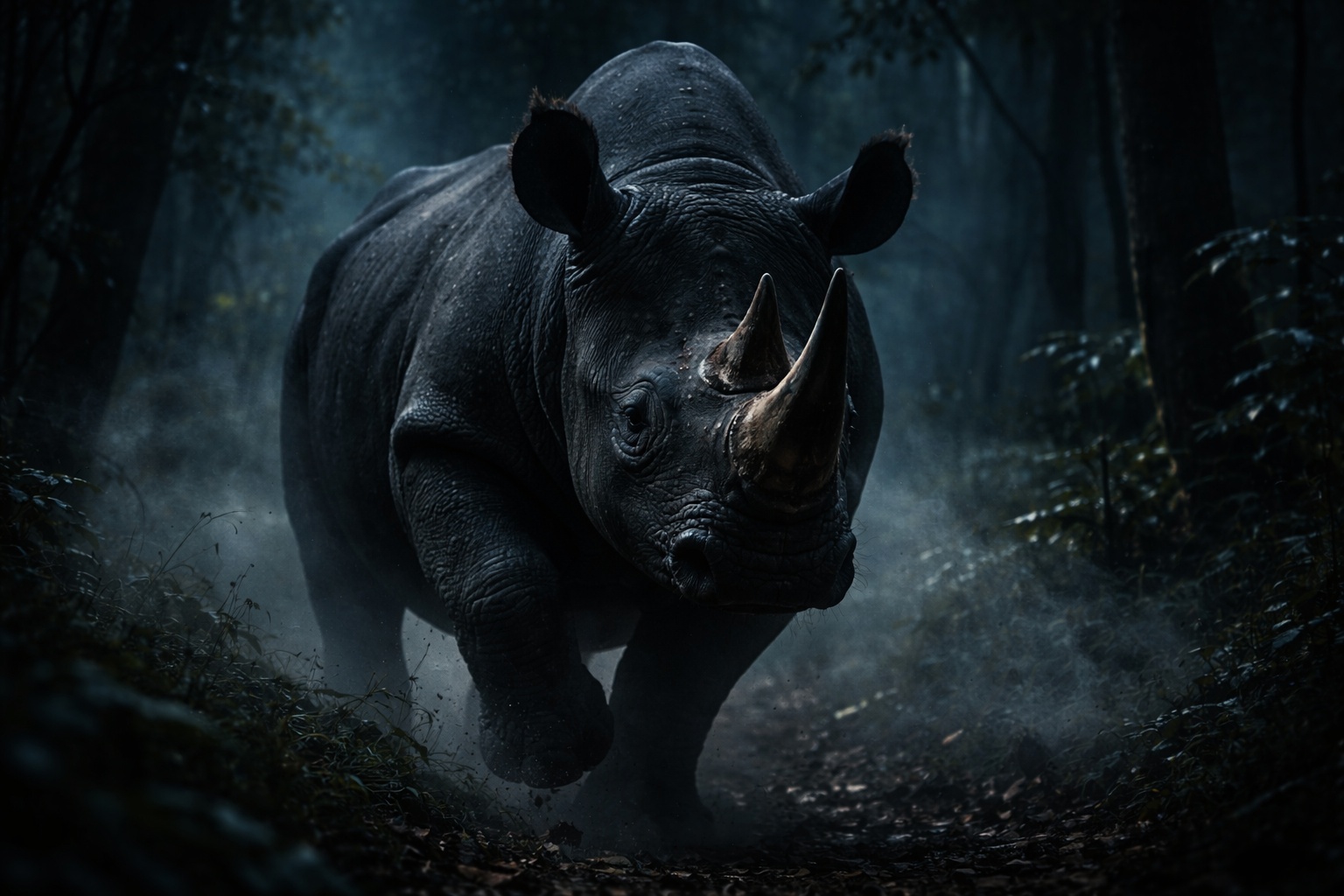
With Limited Vision, The Black Rhino Navigates Dense Forests at Night Using Smell, Sound, and Spatial Memory to Survive in Hostile Territories.
The black rhino (Diceros bicornis) is one of the most imposing mammals in Africa, but its strength is not the most decisive attribute for survival. In dense, dark environments filled with invisible obstacles, it operates almost like a “sensory tank” that trades vision for reading smell, sound, and geography. Although it is a giant that can weigh over a ton, it is also an animal that relies on nocturnal discretion to avoid lethal confrontations and navigate an intricate mosaic of thickets, clearings, trails, and water sources.
Contrary to popular imagination that portrays rhinos as blind and aggressive creatures, the black rhino is an animal of fine decision-making: it does not fight unnecessarily, avoids physical conflict, and relies on a sensory system based on smell and hearing that allows it to move in scenarios where human vision would be practically useless. Night, in this context, is not a disadvantage — it is camouflage.
Limited Vision and The Challenge of Seeing in Dense Thickets
The black rhino’s vision is short, especially for distant objects. In clearings, this is already a hindrance; in dense vegetation, the limitation intensifies. Still, this does not make it a vulnerable animal. It means that the brain has prioritized other sensory channels to form a map of the territory.
-
With a cost per shot close to zero, the DragonFire laser could change naval warfare in 2027 and provide British ships with nearly unlimited defense against drones.

-
A British startup creates tires that generate electricity in electric vehicles when passing over potholes, speed bumps, and cracks.

-
Scientists have created robots made with living cells that have their own nervous system, swim on their own, explore the environment, and self-organize without any genetic engineering, and now they want to do the same with human cells.

-
Students create a solar-powered ambulance that operates without a plug, without fuel, and still keeps medical equipment running in remote areas.



When a human would depend on light to recognize trees, trails, stones, and obstacles on the ground, the rhino uses smell and sound as indicators of position.
This sensory architecture works even when the forest filters wind, diverts sounds, and distorts echoes. This is where biology compensates for the visual deficit with a highly refined system of odor detection and vibrations.
Smell as a Map: The Invisible Cartography of The Territory
Most of the black rhino’s navigation occurs through its nose. The species has an extremely acute sense of smell capable of identifying other individuals, predators, and even subtle changes in the environment. Chemical marks left on bushes, feces, urine, and bodily secretions act as traffic signals: who passed, when they passed, where they went, the sex, reproductive condition, and even the mood of the individual.
This information allows the rhino to avoid unwanted encounters, especially with other males, who can be territorial and regulates movement routes according to risk. The forest, in this sense, is not just a physical space but a network of chemical messages that the animal reads as if they were invisible signs.
Fine Hearing and Silent Avoidance in The Understory
If the nose makes the map, the ears act as the radar. The black rhino uses hearing to detect faint sounds, such as breaking branches, vibrations from footsteps, and movements of leaves pushed by other animals. Sounds that would sound like “generic noise of the forest” to us are interpretive data of direction, distance, and movement for it.
This auditory system reinforces the avoidance strategy: instead of running toward risk, the rhino takes longer paths to circumvent potential encounters. This provides energy and safety advantages, reducing the need for confrontations, which can result in serious injuries. The strength exists, but it is a last resort.
Spatial Memory and Nocturnal Routes Charted in The Dark
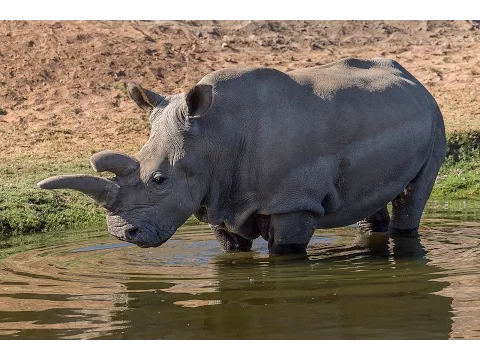
The black rhino does not walk randomly. It maintains a robust spatial memory of where water sources, willows, access trails, open fields, unsafe areas, and routes with less dense vegetation are located. This memory is built over months and years and reinforced by night-time repetitions.
This behavior creates “invisible corridors” in the understory, which only make sense to those who use them. Predators or humans may look at the same vegetation and see only chaos; the rhino sees paths that unfold like three-dimensional mental maps. This explains why, even with limited vision, it rarely collides with obstacles.
Territory, Encounters, and The Real Risk of Conflict
The conflict between rhinos is not the rule; it is the exception, but when it occurs, it involves brute force and the risk of piercing by horns.
Therefore, the strategy of the black rhino is to avoid reaching this point. It knows who is in the territory using smell, sound, and memory. This system prevents unnecessary encounters and reduces the risk of serious injuries.
Night favors this model. While large predators heavily rely on vision to detect prey or avoid threats, the rhino trusts sensors that work even without light. The result is a system of “negative choice”: choosing what to not encounter is as important as choosing movement routes.
Humans: The Silent Predator That Changes Behavior
Historically, the greatest risk to the black rhino is not large carnivores, but humans. Therefore, populations living near areas with human activity modulate their schedules to minimize contact.
In many places, individuals have begun to move more at night precisely because the human risk decreases. Using darkness as a barrier is a behavioral adjustment that reinforces the species’ ecological intelligence.

This detail creates an important dissonance: the rhino is not fleeing from the lion or the hyena; it is avoiding machines, weapons, and open trails.
A Sensory Tank Built for The Forest, Not for The Spectacle
In practice, the black rhino shows that strength and weight are not the center of its survival. What sustains the species is the intelligent reading of an invisible world: olfactory traces, micro-sounds, memory of paths, and a system of avoidance that reduces harm and preserves energy.
The forest, which may seem chaotic to a human observer, is for it an interconnected information system that tells who is there, where they passed, and what the route of least risk is. Darkness is not a problem; it is a tool.








-

Uma pessoa reagiu a isso.