





 Portuguese
  English
  Spanish
  3 min of reading
  0 comments


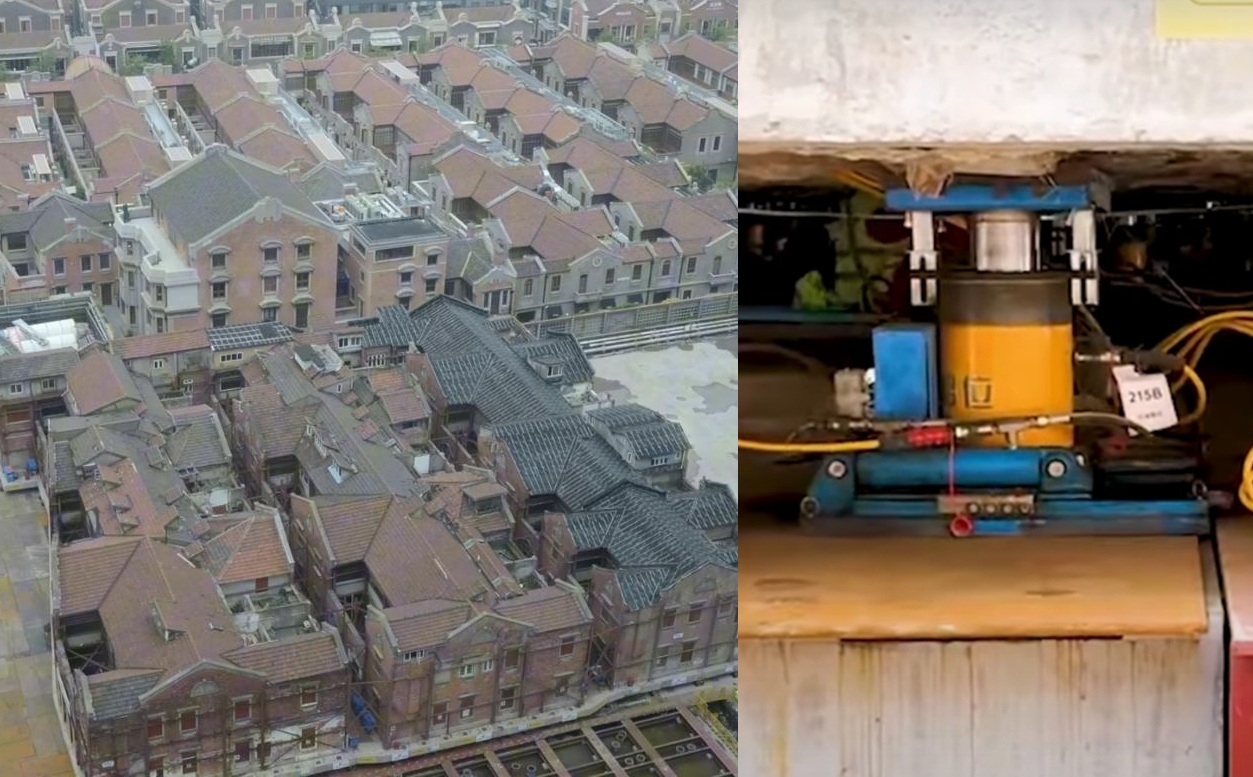
With 432 Robots, 7,500-Ton Historical Building in Shanghai Is Temporarily Moved to Enable Modern Subterranean Works and Metro Expansion.
In Shanghai, China, an impressive feat of civil engineering is capturing global attention. A historic complex weighing 7,500 metric tons is being moved by robots while subterranean works progress at the site.
The Movement of Huayanli
The Huayanli complex, built between the 1920s and 1930s, occupies 4,030 square meters. It is part of the Zhangyuan area, which has over 140 years of history. Its architecture combines Western and Chinese elements, highlighting the cultural value of the structure.
The building is being moved about 10 meters per day to allow for the construction of a new subterranean structure.
-
NASA engineer creates project for a “nearly theoretically viable” engine capable of reaching 99.99% of the speed of light, but this problem must be solved first.
-
Bahia becomes a key player in the new BRICS plan for a sovereign data center and brings Brazil closer to the competition for the future of cloud computing and AI.

-
Giant and invisible structure that has been around for decades emerges near the Solar System and could change what astronomy knows about the birth of stars.

-
Research gives new weight to the quipu and suggests that the Inca Empire developed an advanced method for organizing and processing data, with a structure of knots and strings that now brings the artifact closer to logics used in computing.

There will be 53,000 square meters of cultural and commercial spaces, a parking lot with over 100 spaces, and a transportation center that will connect Shanghai’s Metro lines 2, 12, and 13.
According to the local government, the project stood out for its technical challenges. The dense layout of historic structures, including the large Zhangyuan hall, a 1928 building that housed a night school for patriotic education in the 1940s, made the use of traditional engineering methods difficult.


The 432 Robots Responsible for the Movement
The task of moving the building is being carried out by 432 small walking robots. These robots can lift the structure in a controlled manner and then advance slowly while bearing the weight of the construction.
The project is considered the largest of its kind in China, taking into account the size, weight, and complexity of the operation. As the area consists of narrow alleys and very close old buildings, conventional equipment would not be able to operate safely.
To overcome these difficulties, drilling robots capable of navigating narrow corridors and small doors were employed.
In addition, special earth-moving robots with foldable arms that operate in spaces up to 1.2 meters wide were also used during the work.
Advanced Technology in Engineering
In addition to the physical robots, the project also relied on artificial intelligence. Deep learning AI helped the machines identify different types of soil, distinguishing clay obstacles from denser solids.
Engineers used Building Information Modeling (BIM) and point cloud scanning to create detailed 3D models of the structure and the surrounding area. With these models, it was possible to predict collision risks and accurately plan the building’s movement routes.
For earth removal, curved routes and a conveyor belt system, similar to an industrial production line, were created. This method ensured greater efficiency and less impact on the area during excavations.
Project Completion and Historical Preservation
When the subterranean construction is completed, the Huayanli complex will return to its original location. The project aims to integrate the historical preservation above ground with modern subterranean facilities, linking the new cultural and commercial spaces to the neighboring skyscrapers and districts of Shanghai.
According to Zhang Yi, general manager of the Shanghai Construction No. 2 (Group) company, the proposal combined innovation with respect for heritage, ensuring modernization without losing the historical memory of the city.







-

2 pessoas reagiram a isso.