





 Portuguese
  English
  Spanish
  6 min of reading
  0 comments


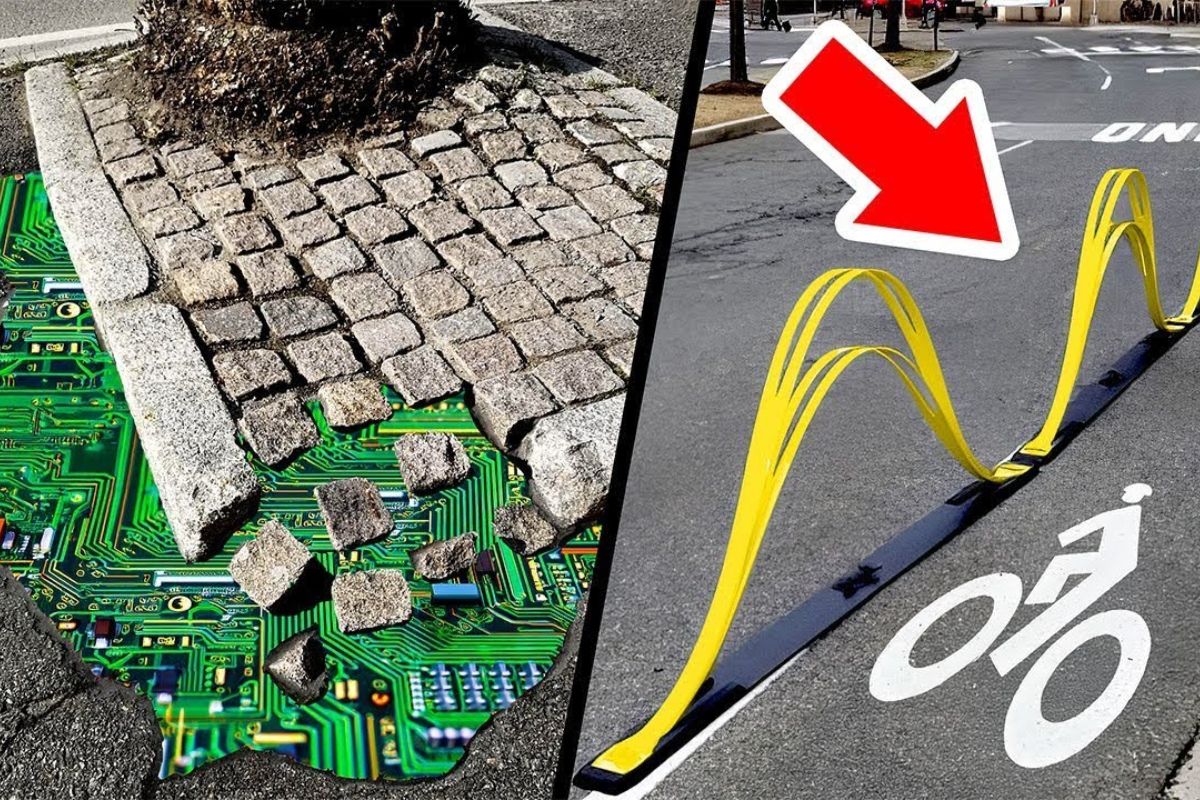
Pothole-Filling Robots, Solar Highways, and Roads That Recharge Vehicles: How Brilliant Road Technologies Are Redesigning Safety, Energy, Traffic, and Maintenance and Will Transform the Routine of Drivers Worldwide
From autonomous robots that fill potholes overnight to solar highways, smart barriers, and roads that charge electric cars in motion, brilliant road technologies are emerging from laboratories, hitting the pavement, and starting to change safety, costs, urban traffic, and the way you drive every day in major cities.
In practice, these solutions mix robotics, artificial intelligence, sensors, and new materials to redesign how roads are built, monitored, and maintained. The promise is to reduce accidents, cut public spending on maintenance, generate clean energy, and make traffic more predictable, directly impacting the routine of those who rely on cars to work, study, or move around cities.
Pothole-Filling Robots and Smart Plastics Against Asphalt Deterioration

Among the brilliant road technologies that have already come to life, pothole-filling robots stand out.
-
Something is happening around the Earth: Inside the huge explosion of fireballs in 2026

-
A hot air bubble coming from Argentina expands over Brazil, causing thermometers to exceed 38 degrees with a thermal sensation of 40 degrees in late March, affecting 6 states at once.

-
The radish leaf that almost everyone throws away has more polyphenols, flavonoids, and fiber than the consumed root, and a 2025 study showed that the leaf contains compounds that protect the intestine, combat inflammation, and may inhibit the growth of cancer cells.

-
A planet that seemed to defy the laws of physics has intrigued scientists for decades, until the James Webb revealed what is really affecting Saturn’s rotation.


Autonomous equipment patrols streets, scans the pavement with imaging systems and artificial intelligence, identifies cracks and deformations, and applies sealants that prevent water infiltration and increased damage.
The logic is simple: act preventively before the problem becomes a critical pothole.
These systems can operate 24 hours a day, reducing the need for large road closures and numerous teams during peak hours.
Meanwhile, materials such as thermoplastic mixtures applied directly to asphalt defects harden within minutes and can last for years, often reinforced with mineral aggregates.
In larger potholes, combinations of gravel and plastic polymers allow for quick repairs that withstand heavy traffic.
The result is a model of continuous maintenance, where brilliant road technologies replace costly emergency actions with quick, frequent, and automated interventions.
For the driver, this means fewer jolts, reduced risk of damage to tires and suspension, and fewer accidents caused by sudden swerves to avoid potholes.
Roads That Recharge Electric Cars in Motion

Another area that illustrates the power of brilliant road technologies is the dynamic electrification of roads.
Instead of relying solely on fixed charging points, some projects install energized rails embedded in the pavement.
A collector installed at the bottom of the electric vehicle makes contact with the rail and transfers energy while the car is moving.
The rail is activated only when it detects an authorized vehicle, ensuring safety for pedestrians and cyclists crossing the roadway.
The transferred power is sufficient to charge a large portion of the batteries over relatively short distances, reducing the need for very large and expensive batteries.
In practice, the concept transforms the road into an extension of the charger, diffusing the charging infrastructure throughout the roadway network.
These solutions can be combined with urban public transport systems and logistics fleets, allowing trucks, buses, and electric vans to travel long distances with less downtime.
For the end user, the result is a scenario in which the fear of running out of charge significantly decreases, and route planning is no longer dominated solely by fixed charging points.
Solar Highways and Pavements That Capture and Return Energy

The brilliant road technologies also leverage the surface of the roads to generate energy.
In some pilot projects, transparent and resistant layers are installed over photovoltaic panels embedded in the pavement.
The same road that receives cars now produces electricity to power street lights, information panels, monitoring systems, and even hundreds of nearby homes.
In cold regions, the captured energy can be used to heat the road, melting snow and ice and maintaining traction, which reduces accidents and eliminates some mechanical removal operations.
In other configurations, networks of tubes beneath the pavement capture heat in the summer, store this thermal energy underground, and release it in winter to heat streets, sidewalks, and even buildings connected to the system.
These energized pavements open up a vision in which the highway ceases to be just a consumer of resources and starts to operate as active infrastructure for energy generation and management, integrated with urban thermal and electrical networks.
It is a paradigm shift that connects mobility, climate, and energy planning in a single solution.
Smart Barriers, Active Speed Bumps, and Next-Generation Traffic Safety
In addition to energy and maintenance, brilliant road technologies advance in protecting drivers, cyclists, and pedestrians.
Side barriers with rotating cylinders, made of high-impact-absorption materials, convert the energy of a collision into rotational motion, redirecting the vehicle at a shallower angle and reducing the chance of rollover or into oncoming traffic.
In speed control, active speed bumps equipped with radar and artificial intelligence emerge.
When a vehicle approaches within the allowed limit, the surface remains flat; if the driver exceeds the speed, the system alters the terrain and creates a slope that causes enough discomfort to induce reduction.
It is a model that selectively penalizes only those who actually drive above the limit, without punishing those who drive regularly.
There are also rear barriers mounted on protective trucks, designed to absorb impacts in construction or emergency situations.
They deform in layers, decelerating the colliding vehicle and protecting workers on the road.
Together, these solutions point to a new generation of roadway safety, where the physical design of the highway acts as an additional layer of protection, complementing enforcement and traffic education.
Industrialized Maintenance, Modular Pavements, and Material Recycling
From a construction viewpoint, brilliant road technologies also seek efficiency in works.
Automated paving machines lay stone or concrete blocks in large modules, with pre-programmed patterns, multiplying productivity compared to manual work.
Specific equipment molds curbs, concrete barriers, and dividers in continuous lines, reducing waste and ensuring dimensional standards.
At the road base, solutions that reuse whole or shredded tires structure the subgrade and increase load-bearing capacity without relying solely on conventional gravel and aggregates.
The goal is to prolong the lifespan of the road, reduce interventions, and give a technical destination to waste that would otherwise occupy landfills.
In resurfacing, chip and sealing techniques apply layers of binders and aggregates over existing pavement, sealing cracks and gaining a few additional years of use at lower costs.
These approaches reinforce a central axis of recent innovation: doing more with less by using automation, standardization, and recycling to reduce costs and accelerate deadlines, while maintaining the required performance level for heavy and varied traffic.
How These Innovations Reach Your Daily Life as a Driver
Although not all solutions are present on Brazilian streets, the set of these brilliant road technologies points to a clear path.
As costs drop, standards are adapted, and successful experiences accumulate, municipalities, states, and concessionaires tend to gradually incorporate inspection robots, smart materials, and dynamic traffic control systems into work and maintenance contracts.
For the average driver, the effects appear indirectly: fewer potholes, less long interruptions for maintenance, clearer signage, pavements that drain water better, safer barriers, and, on the horizon, road infrastructure that communicates with electric vehicles and connected transport systems.
The road ceases to be just a backdrop for movement and begins to act as an active technological platform capable of interacting with vehicles, pedestrians, energy, and data.
In practice, this means changing the way of driving: more stable speed, less dependence on sudden braking, increasing use of electronic vehicle resources, and, in the future, integration with semi-autonomous functions supported by sensors in the roadway.
In your opinion, which of these brilliant road technologies would you most like to see implemented first on the streets and highways of your city?






Seja o primeiro a reagir!