





 Portuguese
  English
  Spanish
  5 min of reading
  0 comments


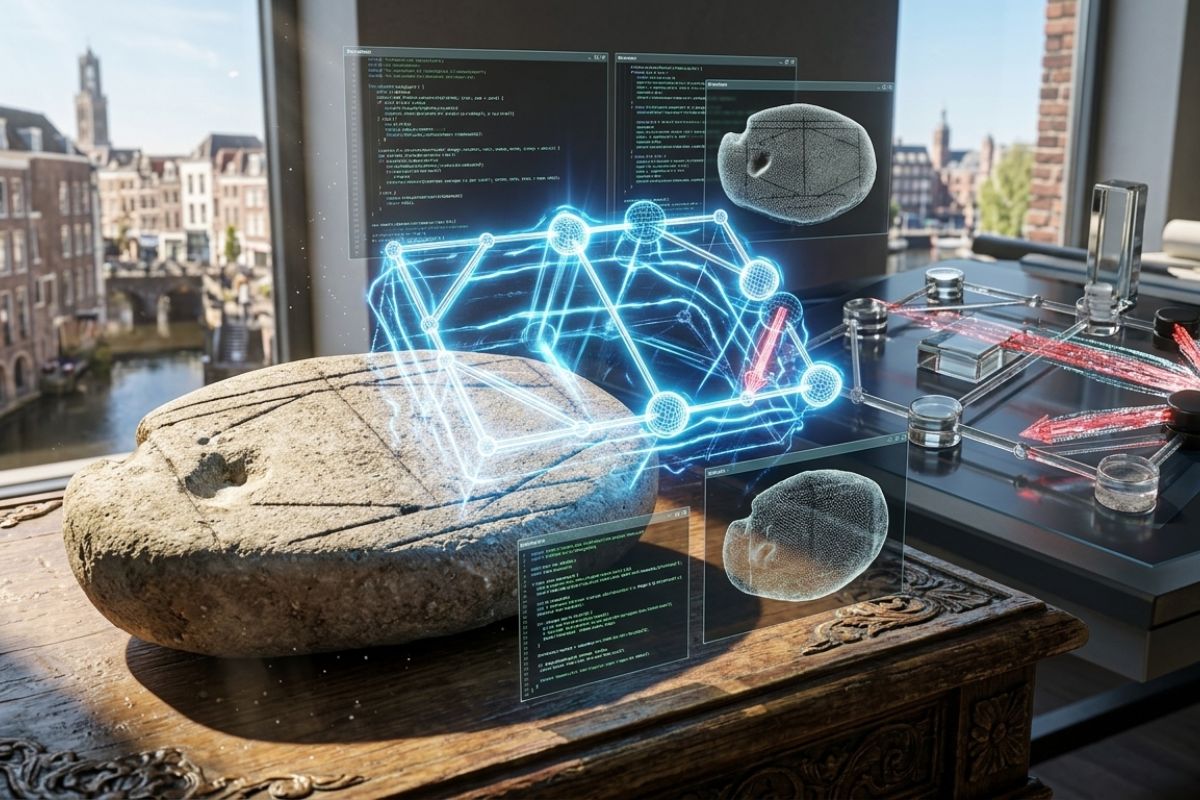
Researchers analyzed a limestone slab found in 1984 in Coriovallum, ran 1,000 simulations per set of rules, and arrived at the type of Roman game that no one could decipher
The Roman game engraved on a small limestone slab found in the Netherlands left experts trapped in a mystery for decades. The object was excavated in 1984 at the ancient settlement of Coriovallum and clearly resembled a board, but without a manual, without ancient text, and without direct reference in classical sources.
Now, after more than 40 years, the Roman game has gained a plausible explanation with the combination of 3D scanning and artificial intelligence. The team tested over 100 sets of rules, ran 1,000 simulations per set, and concluded that the most consistent pattern points to a strategy game of the “blocking game” type, based on trapping pieces and locking movements.
The limestone slab that became a historical puzzle
The board is an oval stone, about 21 by 14.5 centimeters, marked by incised lines that intersect. The shape and grooves suggested a board used with pieces that slid over the surface, but the design did not match the most well-known Roman games from texts, art, or archaeological finds.
-
A scientist proved with a thermal camera that the fan does not cool the environment but reduces the temperature of your skin by up to 6 degrees thanks to a natural mechanism of the human body that almost no one understands how it really works.

-
Scientists find a new explanation for the origin of Earth, which may have formed solely from material close to the Sun, changing an old theory and indicating that Jupiter may have been the cause of it all.

-
Brazilian beaches are among the most contaminated in the world by cigarette butts, with levels up to 40 times above the global average and areas where this waste already represents the majority of all the trash found.

-
2,000-Year-Old Machine Gun: Roman weapon found in Pompeii fires arrows at 109 m/s with an automatic gear mechanism, leaving perfect geometric patterns on the walls and proving its real use in the siege of 89 B.C.

What kept the enigma alive was a physical detail hard to ignore: the wear along the lines did not seem random. There was concentrated friction at specific points, typical of repeated use.
This reinforced the hypothesis that the object was a game, but also raised the big question: how to discover the rules of a Roman game when no one left the rules recorded?
How 3D scanning brought the Roman game to life
The first step was to transform the real board into a reliable digital board. With 3D scanning, the researchers were able to map the lines, the depth of the grooves, and the wear patterns much more accurately than would be possible by visual observation alone.
This digital model was crucial, as it allowed the investigation to shift from being merely interpretative to being testable. Instead of “imagining” how the Roman game worked, the team began to simulate movements and check which rules reproduced the same type of wear recorded on the stone.
AI tested over 100 rules and ran 1,000 simulations per game

With the digital board ready, the researchers set two AI agents to play against each other using a large repertoire of rules already recorded in other ancient and historical board games. More than 100 sets of rules were tested, with 1,000 simulated games for each set.
The goal was not just to see who won, but to observe if the logic of movements generated a friction pattern similar to that of the original board. At the end of the rounds, a small group of possibilities stood out: nine variations of rules showed compatibility with the observed wear pattern.
This funnel is what made the conclusion strong. It was not an aesthetic guess. It was a selection based on compatibility between simulated behavior and real physical marks.
What is a “blocking game” and why does this explain the marks
The most consistent answer pointed to a strategy game known as blocking game. In this type of game, the goal is not necessarily to capture pieces, but to trap the opponent, block routes, and prevent movements until the opponent has no way out.
This aligns with the material evidence. In blocking games, movements tend to concentrate on specific lines and critical points of the board, where attempts to escape or block are repeated. This repetitive pattern is exactly the type of “signature” that can appear as uneven wear.
If the hypothesis is correct, the find suggests that there were variations of Roman strategy games that did not reach us through texts but survived in everyday use, recorded in stone and played repeatedly.
Why wear was the most important clue
The center of the investigation was not just the geometric design. It was the wear. Without the wear, the board could be interpreted as a decorative mark, geometric exercise, or even another practical function. With the wear, it behaves like an object used for repeated interaction.
The team did something that changes the way to tackle archaeological enigmas: they used AI to search for rules that “produced” the same type of wear. In other words, wear became an experimental data point. The board ceased to be just an image and became a physical record of behavior.
What this discovery changes in the archaeology of games

The study is regarded as a milestone because it combines AI simulation with archaeological methods to identify an ancient game. It is a new tool for cases where there is no text, no illustration, and no direct comparison.
This opens a pathway for other mysterious objects. If an artifact has signs of use, grooves, and friction patterns, it may be possible to create a digital model and test functioning hypotheses with simulations. The promise is simple and powerful: modern technology helping to reveal hidden stories in silent objects.
What still remains open, even with AI
Even with a strong hypothesis, there is an inevitable limit: without a historical record describing the game, it may be impossible to confirm with 100% certainty the “original” rule.
AI may have found the best explanation for the marks, but the past does not always leave a template for verification.
Still, the advancement is enormous. After decades of stalemate, the Roman game gained a functional model, a coherent strategic logic, and a technical basis that explains why the marks on the stone are what they are.
And you, do you think that AI really deciphered the Roman game or just found the best possible rule to fit the marks on the board?







Seja o primeiro a reagir!