Portuguese
  Spanish


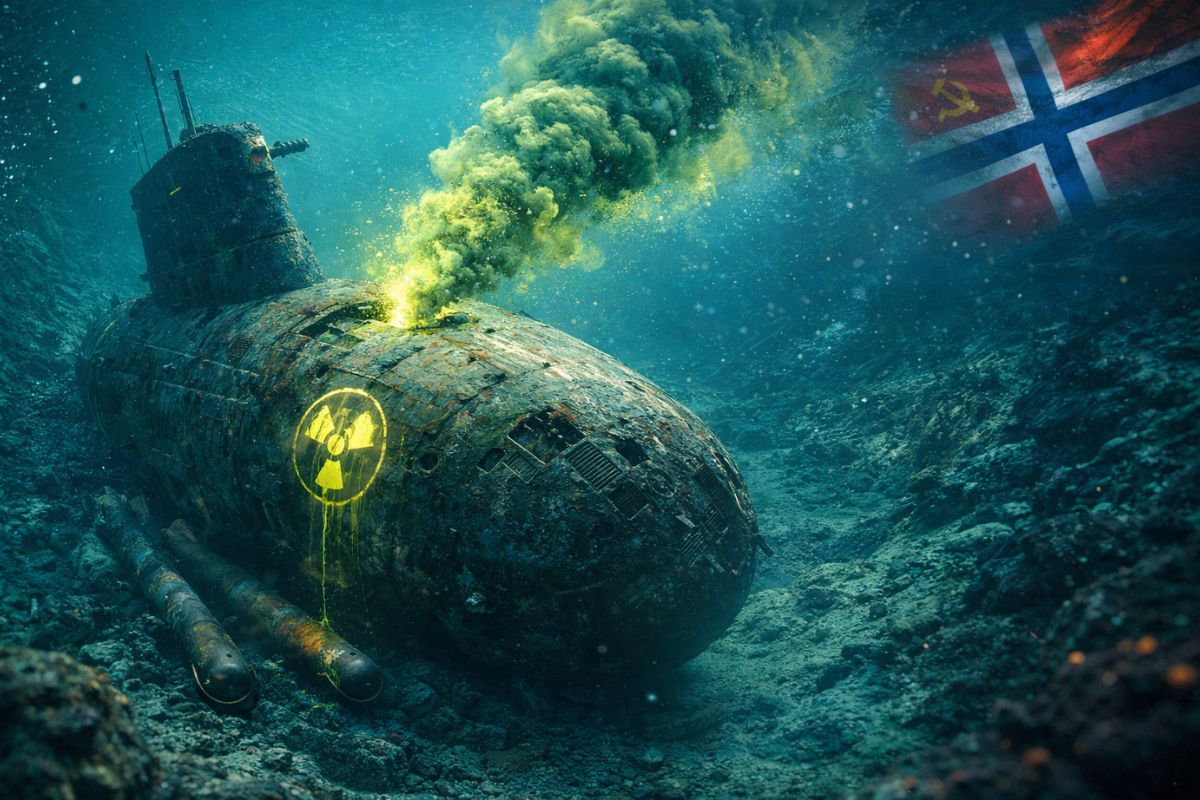

The radioactive leaks detected in the nuclear submarine in the Norwegian Sea involve a nuclear reactor in degradation and maintain the risk of radioactive contamination.
The radioactive leaks from a Soviet nuclear submarine that sank in 1989 have returned to the spotlight after a detailed analysis indicated that the vessel continues to intermittently release radioactive material in the depths of the Norwegian Sea. The case involves not only a nuclear reactor but also two nuclear torpedoes that sank along with the wreckage.
Although the contamination observed so far seems to drop rapidly a few meters from the hull, the scenario still inspires caution. The main reason is that the structure of the submarine continues to degrade, which could amplify leaks in the future and elevate the risk to marine life in the region.
What happened to the submarine?
The Soviet nuclear submarine K278 sank in April 1989 after a fire on board. With it, not only the reactor that powered the vessel ended up on the seabed, but also two nuclear torpedoes. Since then, the wreckage has remained at a depth of 1,680 meters in the Norwegian Sea.
-
Australia deploys poisoned sausages and uses traps, shooting, and fences in a battle against invasive cats that kill over 1.5 billion native animals annually, threatening more than 200 species.

-
NASA Rover Captures “Tired Face” on Mars, Highlighting Human Brain’s Tendency to See Faces in Rock Formations

-
Ancient Stone City in the Desert, Once Home to 30,000, Puzzles Scientists with Nabateans’ Water Mastery 2,000 Years Ago

-
Ancient Creature Thought Extinct Since Dinosaur Era Reappears, Baffling Scientists




Initial investigations already indicated that the submarine had suffered significant damage. The hull appeared cracked, and seawater came into contact with the area where the nuclear torpedoes were located. This situation turned the wreck into a permanent environmental monitoring point.
What the new study identified about the radioactive leaks
More than three decades after the accident, a team linked to the Norwegian Radiation and Nuclear Safety Authority presented a comprehensive analysis of the current state of the vessel.
The survey concluded that the reactor is in a state of degradation and continues to release intermittent radioactive leaks.
According to the researchers, these releases do not occur continuously and uniformly. They appear in sporadic bursts, originating from specific points on the hull, including a ventilation pipe and the area near the reactor compartment. This behavior shows that the problem remains active, even after so many years on the ocean floor.
Why the contamination still seems limited
Despite the presence of these radioactive leaks, the research indicates that the measured contamination drops drastically a few meters from the submarine. This suggests that the released isotopes are dissipating rapidly in the water around the wreckage.
The samples collected from organisms living on the submarine, such as sponges, corals, and anemones, showed slightly elevated levels of radioactive cesium.
Still, the study found no obvious signs of deformities or other visible damage in these marine beings. This is an important finding because it indicates reduced impact so far, although it does not eliminate the risk of future worsening.
What concerns scientists most now


The most sensitive aspect of the case is not only what has already been detected but also what may still happen. The expectation presented by researchers is that the structure of the Soviet vessel will continue to deteriorate over time.
If this occurs more intensely, the radioactive leaks could become broader. In this scenario, the contamination would no longer be concentrated in isolated points and could reach a larger area around the wreckage. It is precisely this possibility that keeps the environmental alert active in the region.
The attempt at containment made in the past
The history of the submarine shows that there was an attempt to reduce risks back in the 1990s. In 1994, an operation was carried out to seal the damaged weapons compartment.
Since then, there is no evidence of plutonium leakage, which differentiates this specific risk from other radioactive materials detected in the most recent analyses.
This does not mean, however, that the problem has been completely resolved. Current monitoring shows that the reactor continues to deteriorate and that radioactive leaks continue to occur intermittently.
In other words, the wreck is not just a historical memory, but an environmental concern that still requires monitoring.
The environmental risk may grow over time
So far, the data indicates that the actual damage seems to have been limited. Nevertheless, the case is far from being considered closed.
The combination of extreme depth, aging structure, and presence of nuclear material keeps the submarine as a potential source of future contamination.
In essence, the scientists’ warning is clear: the problem may be relatively contained at present, but the advancement of degradation could change this picture.
When the structure of a submarine of this type weakens further, the safety margin also decreases.
Do you think that this type of nuclear wreck on the seabed should be the target of a broader international containment operation?