





 Portuguese
  English
  Spanish
  5 min of reading
  0 comments


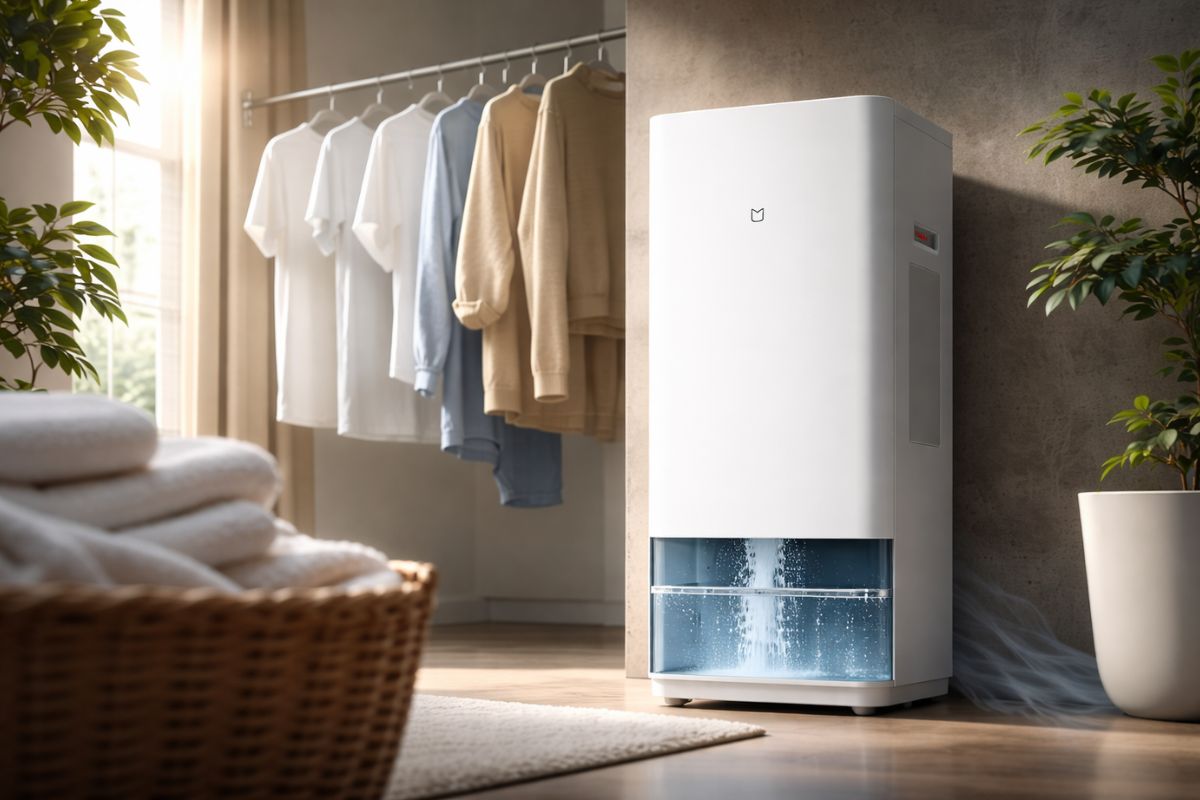
Xiaomi Promises to Dry Clothes in 1 Hour and Cut Up to 67% of Energy: What Changes When a Super Dehumidifier Extracts 60 Liters of Water from the Air and Becomes an Ally Against Mold Inside Apartments, Bedrooms, and Living Rooms, Without Nighttime Noise.
Xiaomi has just placed on the radar an intelligent dehumidifier that targets two very common issues: clothes that don’t dry on humid days and mold that keeps coming back. The proposal is aggressive, extracting up to 60 liters of water from the air per day, reducing the feeling of stuffiness, and even accelerating the drying of hanging pieces in the environment.
The striking point is that Xiaomi doesn’t only sell “power.” It attempts to transform a humidity device into a routine appliance, with silent mode for nighttime use, automatic functioning adjustment, and even functions related to air quality, which changes the conversation about comfort indoors.
What Xiaomi Is Promising, No Mystery

In practice, Xiaomi positions the device as a “two-in-one” solution: dehumidifier to control humidity and “auxiliary dryer” for those who rely on indoor drying racks.
-
An engineer designs a solar plane to fly on Mars at an altitude of 1,000 meters and a speed of 300 km/h, covering 16,000 kilometers in a Martian year, 900 times the distance traveled by the Ingenuity helicopter in three years on the planet before experiencing a rotor failure, and NASA is already funding the feasibility study.

-
A new phenomenon of contactless magnetic friction intrigues scientists and questions a theory that has been valid since the 17th century.

-
An impressive phenomenon in Northern Brazil causes rivers of different colors to flow side by side, revealing secrets about sediments, currents, and biodiversity.

-
While many schools are still struggling with the basics, a teacher in China went viral for having elementary school students build a two-stage rocket using plastic bottles, water, and pressurized air in a science class that caught the attention of the entire world.


The impactful number is the removal of up to 60 liters per day, a capacity that, if applied in the real world according to the environmental scenario, indicates a focus on high and persistent humidity situations.
Another argument is the savings: Xiaomi claims that the variable technology system, with motor adjustment, can yield a reduction of up to 67% in consumption compared to models that operate at maximum load all the time. In terms of use, the promise is simple: the device begins to “modulate” effort as the room’s air changes, instead of maintaining the same rhythm from start to finish.
Why the “Inverter” Becomes the Center of the Story
The heart of the launch is a dual-rotor inverter compressor, and this is not just a technical detail for the specifications.
The idea behind the inverter is to allow performance variation, avoiding constant operational peaks. When the device doesn’t need to push, it doesn’t push, and that’s where the energy efficiency talk comes in.
Xiaomi also highlights noise control. In sleep mode, the reported level is 33.5 dB(A), suggesting possible use during the night, especially in bedrooms.
This point is often decisive because, in many homes, the dilemma is always the same: either the person controls the humidity, or they can sleep without discomfort.
Clothes Drying: Where the “Dryer Effect” Comes In
For those living in apartments and experiencing the cycle of clothes that smell of moisture, Xiaomi bets on an exclusive airflow directioner to accelerate drying on the indoor rack. The promise is to dry up to 10 pieces simultaneously in about 1 hour and 15 minutes, reducing that “endless” time of hanging laundry that never seems to finish.
Here, the most relevant point is the mechanism behind the routine. It’s not just about pulling water from the air; it’s about directing air towards the pieces, creating a less humid environment around the fabric and accelerating evaporation.
If this holds true in practice, the gain is not just speed, but predictability: the person knows when they will be able to wear the clothes without depending on the weather.
Air Purification: What the Five Stages Mean
Besides dealing with humidity, Xiaomi positions the device as a “purifier” by stating that the process has five filtration stages.
The reported list includes a UVC germicidal lamp, plasma generation, antibacterial filters, and removal of particles and formaldehyde, composing a package for air treatment beyond the main function.
What this changes on a day-to-day basis is the health narrative. Xiaomi claims a 98% elimination of bacteria and dust, appealing especially to allergic individuals.
In a humid environment, the concern isn’t just visible mold, but what circulates in the air, and that’s why this type of resource often becomes a central argument when discussing indoor air quality.
Technical Specifications, Drainage, and What to Observe Before Deciding
A practical point that is often overlooked in launches is water disposal. Xiaomi mentions a drainage pump that supports up to 5 meters of vertical drop, which opens up space for more flexible solutions, depending on where the device is located and how the water will be routed.
The model is part of Xiaomi’s ecosystem and is named Mijia Inverter Dehumidifier Max, with an initial launch price in the Asian market of approximately R$ 2,900.
There is still no official date for it to arrive in Brazil, which makes the decision more a matter of monitoring availability than choosing between local versions at this moment.
What This Change Says About the “Post-Humidity” Home
More than just an appliance, Xiaomi is trying to sell an idea: that controlling humidity is part of home automation and not just a reaction to mold.
By combining power, low noise, and automatic adjustment, the device aims at those who don’t want to think about the problem all the time, they just want the house to “function” even in rainy periods.
And that’s where the debate comes in: is it worth investing in equipment that promises to reduce consumption and become part of daily routine, or stick with temporary solutions that only come into play when humidity has already taken over? The answer depends on the type of property, the level of humidity, and how much the person struggles with clothes that don’t dry and closed environments.
And you, have you ever had clothes that “never dry” or mold that returns even after cleaning? Do you think Xiaomi gets it right by mixing dehumidification and air purification, or does that become an exaggeration? If it were in your home, would you use it more in the bedroom, living room, or utility area?







-

Uma pessoa reagiu a isso.