





 Portuguese
  English
  Spanish
  5 min of reading
  0 comments


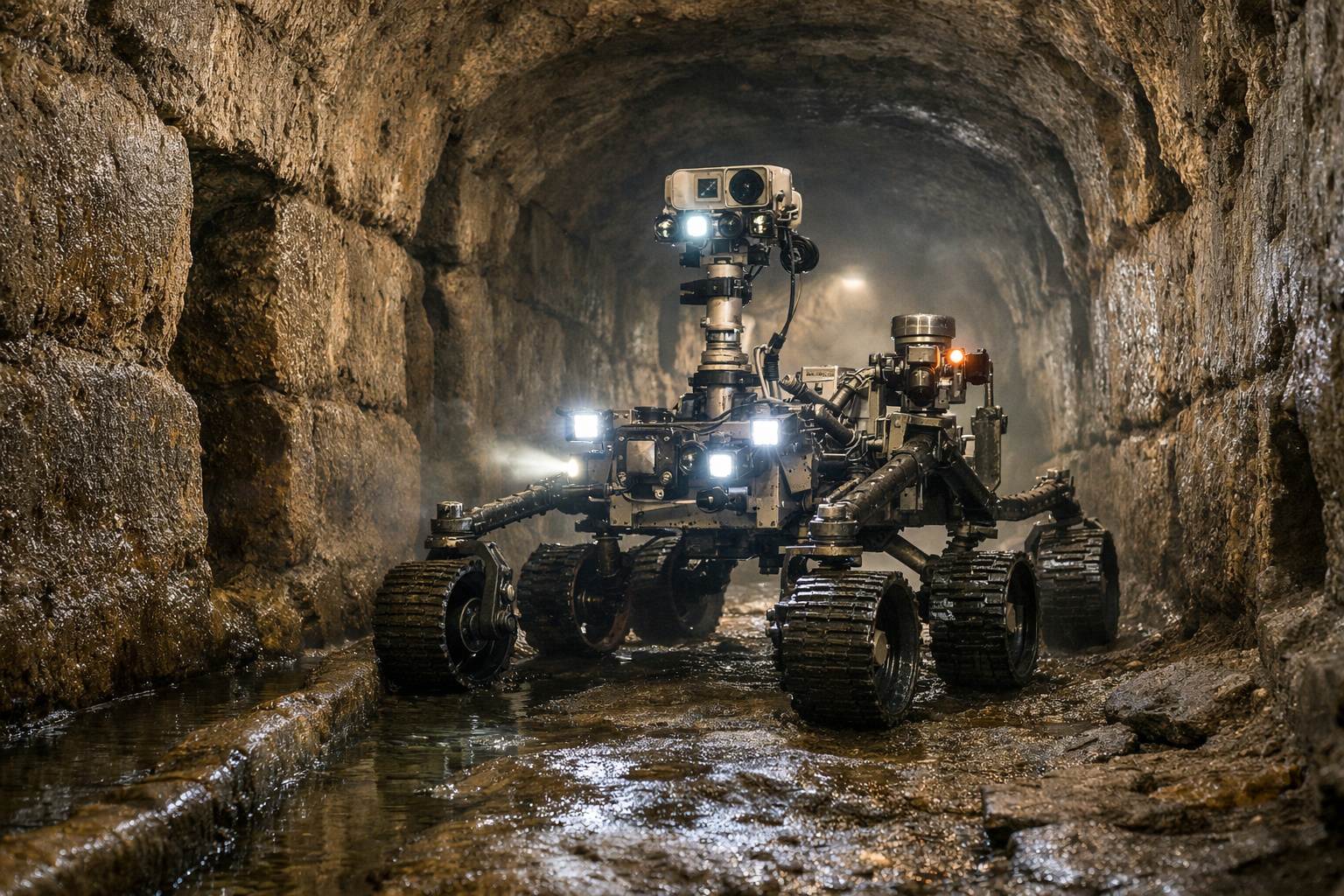
Technology Inspired by Space Rovers Allowed Exploration of Millennia-Old Underground Galleries Beneath One of the Main Centers of Etruria, Revealing Sophisticated Hydraulic Engineering, Religious Rituals, and a Hidden Network of Canals and Tunnels
Directly inspired by the rovers used in the exploration of Mars, the robotic vehicle Magellano traversed kilometers of hidden underground tunnels beneath the ancient Etruscan city of Veii, located just 16 kilometers north of Rome. The mission’s results impressed archaeologists and historians, as it was the first time a complete mapping of this vast underground network was possible using entirely non-invasive methods.
Moreover, the rover was able to operate in areas extremely challenging for human presence. Equipped with a rocker-bogie suspension — a technology also used in NASA’s vehicles on Mars — the Magellano kept its wheels constantly in contact with the uneven ground. Thus, it was able to navigate through narrow, wet, and low-visibility passages while collecting crucial data for the study of the archaeological site.
The information was released by the website Jornal Inside, in a report written by José Fonseca, detailing the exploration conducted by the rover Magellano in the underground tunnels of the ancient Etruscan city of Veii. The article also mentions that the studies are linked to research conducted by the National Etruscan Museum of Villa Giulia and the Chair of Etruscology at Sapienza University of Rome. According to the researchers involved, the application of technology inspired by rovers used in Mars exploration has opened a new chapter in underground archaeological investigation.
-
In a flooded well, archaeologists found a 1,700-year-old Roman egg that still contains clear and yolk intact inside the very thin shell.

-
Something is happening around the Earth: Inside the huge explosion of fireballs in 2026

-
A hot air bubble coming from Argentina expands over Brazil, causing thermometers to exceed 38 degrees with a thermal sensation of 40 degrees in late March, affecting 6 states at once.

-
The radish leaf that almost everyone throws away has more polyphenols, flavonoids, and fiber than the consumed root, and a 2025 study showed that the leaf contains compounds that protect the intestine, combat inflammation, and may inhibit the growth of cancer cells.


In the Depths of Veii
The city of Veii — known as Veio in Italian — was one of the main centers of the ancient Etruscan civilization. From the 8th century BC, the city flourished as an important urban hub of Etruria, featuring organized neighborhoods, religious sanctuaries, and extensive necropolises with richly decorated tombs.
However, what intrigues researchers most today is not just what is on the surface. Beneath the territory of the ancient city existed a complex underground network composed of excavated galleries, aqueducts, and cisterns. These tunnels, known as cuniculi, primarily managed the region’s water, ensuring efficient drainage and constant supply for the population.
During exploration, the rover Magellano traversed both horizontal galleries and vertical shafts. Along the way, researchers were able to map connections between the Campetti plateau, the Cannetaccio valley, and the famous Sanctuary of Portonaccio, one of the most important religious sites in ancient Etruria.
Near the temple dedicated to the god Apollo, archaeologists identified a particularly impressive element: a large sacred pool. Fed directly by the cuniculi, this structure was likely used in purification rituals performed by the city’s inhabitants.
With approximately 20 meters in length, the tank continued to be used even after the Roman conquest of Veii in 396 BC, demonstrating that the site maintained religious and functional importance for centuries.
Technology Inspired by Mars
Just like the famous NASA rovers that traverse the Martian surface, the Magellano was designed to tackle uneven terrains and complex environments. Its rocker-bogie suspension distributes the vehicle’s weight and allows it to overcome obstacles without losing traction.
Thanks to advanced sensors, remote navigation, and data collection systems working from a distance, the rover was able to progress through extremely delicate areas without risking the researchers or the archaeological structures.
This technological set allowed for precise recording of the underground network’s details. By integrating topography, photography, and surface scanning, researchers created a complete three-dimensional model of the ancient hydraulic system.
The collected data revealed over 23 kilometers of underground channels, demonstrating that the Etruscans had a carefully planned engineering system. Thus, it became clear that these galleries were not simple casual excavations, but rather part of a sophisticated urban project.
According to Massimo Osanna, the Director General of the Italian Museums, the use of these technologies represents a decisive advancement in the study of the ancient Etruscan civilization.
“To return to studying the Sanctuary of Portonaccio with rigorous excavations and cutting-edge technologies means to significantly broaden the knowledge of one of the most significant places in Etruria,” he stated.
Sophisticated Etruscan Engineering
The data obtained by the Magellano indicates that the city of Veii operated as an urban system divided into two layers: one visible at the surface and another hidden beneath the ground.
While streets, temples, and organized neighborhoods dominated the exterior landscape, a complex underground system ensured the city’s hydraulic operation. Channels, cisterns, and wells controlled the water flow, preventing flooding and ensuring regular supply.
Additionally, some underground structures appear to have served religious functions. Basins and specific pathways may have been used in cleansing and sanctification rituals, suggesting a strong connection between hydraulic engineering and spiritual practices.
The distinction between hydraulic sections and ritual areas still requires further study. Therefore, researchers plan to analyze materials, excavation techniques, and dating processes to better understand the role of each segment of the underground network.
Among the main results already identified by the archaeologists are:
- Connections between peripheral neighborhoods and the Sanctuary of Portonaccio, indicating an underground network that served mobility and religious rituals.
- Identification of a sacred pool near the temple of Apollo, linked to the cuniculi and purification practices.
- Confirmation of sections used for drainage and water supply in the valley of the Crémere river.
- Continuous mapping of approximately 23 kilometers of underground tunnels, including preserved sections and others partially collapsed.
- Creation of a georeferenced database that will serve for future excavations, conservation, and scientific dissemination.
Next Steps in the Investigation
With the complete map in hand, researchers can now plan extremely precise archaeological probes. Instead of large invasive excavations, surgical interventions can be performed at specific points in the underground system.
Additionally, scientists intend to conduct sediment analyses, study the region’s ancient hydrological regime, and consolidate sections that present collapse risks.
The collaboration between museums, universities, and research centers demonstrates the potential for integrating modern science with historical heritage. By using technology originally created to explore other planets, archaeologists have managed to uncover an invisible city hidden beneath Italian soil.
Thus, the rover Magellano not only mapped ancient tunnels. It also opened a new frontier for modern archaeology, transforming a subterranean labyrinth into a comprehensible system that helps reconstruct the life and engineering of one of the most fascinating civilizations of antiquity.




-

-

3 pessoas reagiram a isso.