





 Portuguese
  English
  Spanish
  5 min of reading
  0 comments


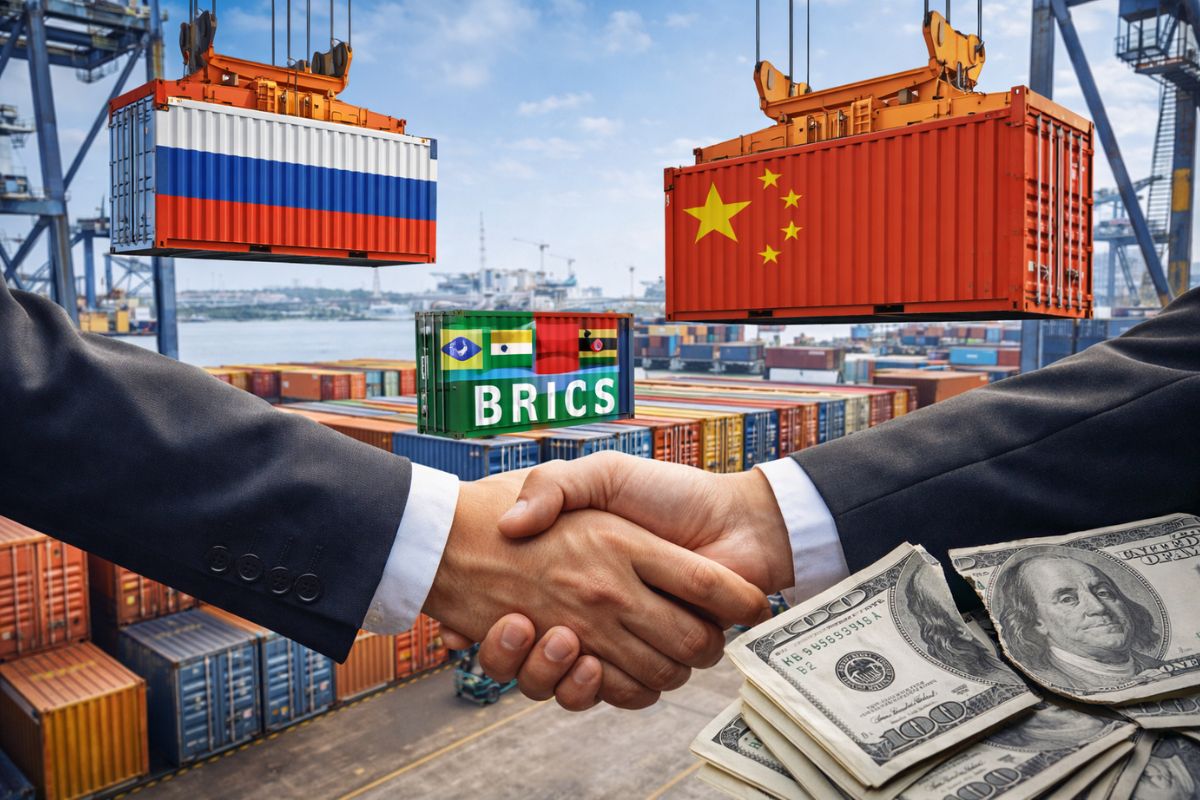
BRICS advances in dedollarization with Russia and China conducting 99.1% of trade in rubles and yuans, Brazil moving 100 billion dollars a year with China in local currency and the bloc developing the BRICS Unit, a digital tool in blockchain that avoids the SWIFT system.
The dollar still accounts for 90% of global currency transactions, but its share in global reserves has fallen from 70% to 59% in two decades. BRICS is at the center of this change: Russia and China already conduct 99.1% of their trade transactions in rubles and yuans, without going through the US dollar. Brazil and China maintain a similar agreement that moves about 100 billion dollars a year in local currency since 2023. What seemed like a distant trend has become measurable reality, and BRICS is building the infrastructure for this practice to spread among all members of the bloc.
The next step is even more ambitious. According to the Senate, BRICS proposed the creation of the BRICS Unit, a digital instrument based on blockchain that serves as a settlement tool for cross-border transactions among members, completely avoiding the Western-controlled SWIFT system. Although still a prototype, the tool is seen as a way to limit the exposure of the bloc’s countries to US sanctions. President Lula, in an interview with India Today TV, denied the creation of a single currency for BRICS but emphasized that the infrastructure for dedollarization is growing rapidly.
What the numbers reveal about dedollarization within BRICS

The data is hard to ignore. Russia and China have shifted from a trade relationship denominated in dollars to 99.1% of transactions in their own currencies, a level that would have seemed impossible ten years ago for two of the world’s largest economies.
-
IBGE’s revision redraws the map of Santa Catarina and changes the borders of 18 municipalities, with Penha gaining a piece of Balneário Piçarras the size of an entire neighborhood without anyone noticing.

-
The Chinese chain that surpassed McDonald’s, Subway, and Starbucks in the number of stores worldwide arrives in Brazil this Saturday with ice cream priced at R$ 3 and a billion-dollar plan to open thousands of units by 2030.

-
Spain launches a 197 million plan to reduce dependence on Europe: 97% of magnesium comes from China; drones and AI will map lithium and neodymium in the Iberian Massif by 2030.

-
Labubu’s owner, the Chinese company Pop Mart, is making a strong entry into Brazil while combating counterfeit versions of the doll that have already become a global craze and led to lawsuits against illegal sales in several countries.

The ruble and yuan have nearly completely replaced the dollar in exchanges between the two countries, creating a precedent that other BRICS members are watching closely.
The agreement between Brazil and China follows the same logic and has already moved about 100 billion dollars a year in local currency since 2023. These numbers show that dedollarization within BRICS is not a political discourse or a statement of intentions.
It is a consolidated commercial practice involving billion-dollar volumes that reduces each country’s dependence on the American financial system. For BRICS, each transaction that bypasses the dollar is one less brick in the structure that supports the hegemony of the American currency.
What is the BRICS Unit and how does it work in blockchain

The BRICS Unit is a digital instrument designed to facilitate payments among the bloc’s countries without going through the SWIFT system.
Based on blockchain technology, the tool acts as a settlement mechanism for cross-border transactions, allowing exporters and importers from different BRICS countries to conduct business using their local currencies with their own compensation system.
The advantage of blockchain for BRICS is decentralization: no country or institution controls the network unilaterally, which reduces the risk of transactions being blocked by sanctions or external political decisions.
The SWIFT system, used by most international transactions today, is controlled by a cooperative based in Belgium and can be influenced by Western pressures, as was evident when Russian banks were disconnected from the platform. The BRICS Unit emerges as an alternative that eliminates this vulnerability.
Why Lula denied the single currency but supports BRICS payment infrastructure
The distinction is important. In an exclusive interview with India Today TV, Lula stated that there is no proposal or debate about a common currency within BRICS.
The Brazilian president was clear: the goal is not to create a currency that replaces the real, yuan, or ruble, but rather to offer more currency options for bilateral agreements among the bloc’s members. The dedollarization of BRICS advances through practical paths, not through a monetary revolution all at once.
The president of the New Development Bank of BRICS, Dilma Rousseff, reinforced this position by stating that operations in local currency are a priority for building a more balanced international financial system.
She emphasized that the dollar’s role as a global reserve currency will not end abruptly, but that the expansion of trade in local currencies is an undeniable and irreversible process. BRICS does not want to overthrow the dollar. It wants to reduce the dependence that makes the bloc’s countries vulnerable to decisions made in Washington.
India’s resistance and the limits of dedollarization in BRICS
Not all BRICS members are moving at the same pace. The Indian Foreign Minister, Subrahmanyam Jaishankar, highlighted that the dollar provides global economic stability and that more stability, not less, is what the world needs.
The Indian Commerce Minister, Piyush Goyal, was even more direct in stating that it is impossible to think of a BRICS currency shared with China.
The Indian position reveals the internal tensions within BRICS about how far dedollarization should go. India maintains strategic relations with both the United States and Russia and China, and has no interest in antagonizing Washington to the point of provoking economic retaliation.
For BRICS to function as a cohesive bloc on financial issues, it will be necessary to find a balance between members who want to accelerate the exit from the dollar and those who prefer a gradual and cautious transition.
What BRICS dedollarization means for businesses and consumers
For exporters, importers, and any company exposed to currency exchange, the expansion of transactions in local currencies within BRICS can bring concrete benefits.
A system where ruble, yuan, and real gain more space can offer more currency predictability and reduce transaction costs that are currently inflated by the need to convert local currencies into dollars before conducting international operations.
The infrastructure for dedollarization is consolidating in BRICS, even if a single currency is not in immediate plans.
The BRICS Unit in blockchain, bilateral agreements in local currency, and the strengthening of the New Development Bank are pieces of a puzzle that, when put together, progressively reduce the weight of the dollar in transactions among the largest emerging markets in the world. The change is slow, but the numbers show that it is happening.
What do you think of BRICS’ strategy to abandon the dollar in transactions among members? Do you believe that the BRICS Unit in blockchain can work or that the dollar will continue to dominate? Share in the comments. This debate about the future of global money affects the price of everything, from fuel to food that reaches your table.








Seja o primeiro a reagir!