





 Portuguese
  English
  Spanish
  5 min of reading
  0 comments


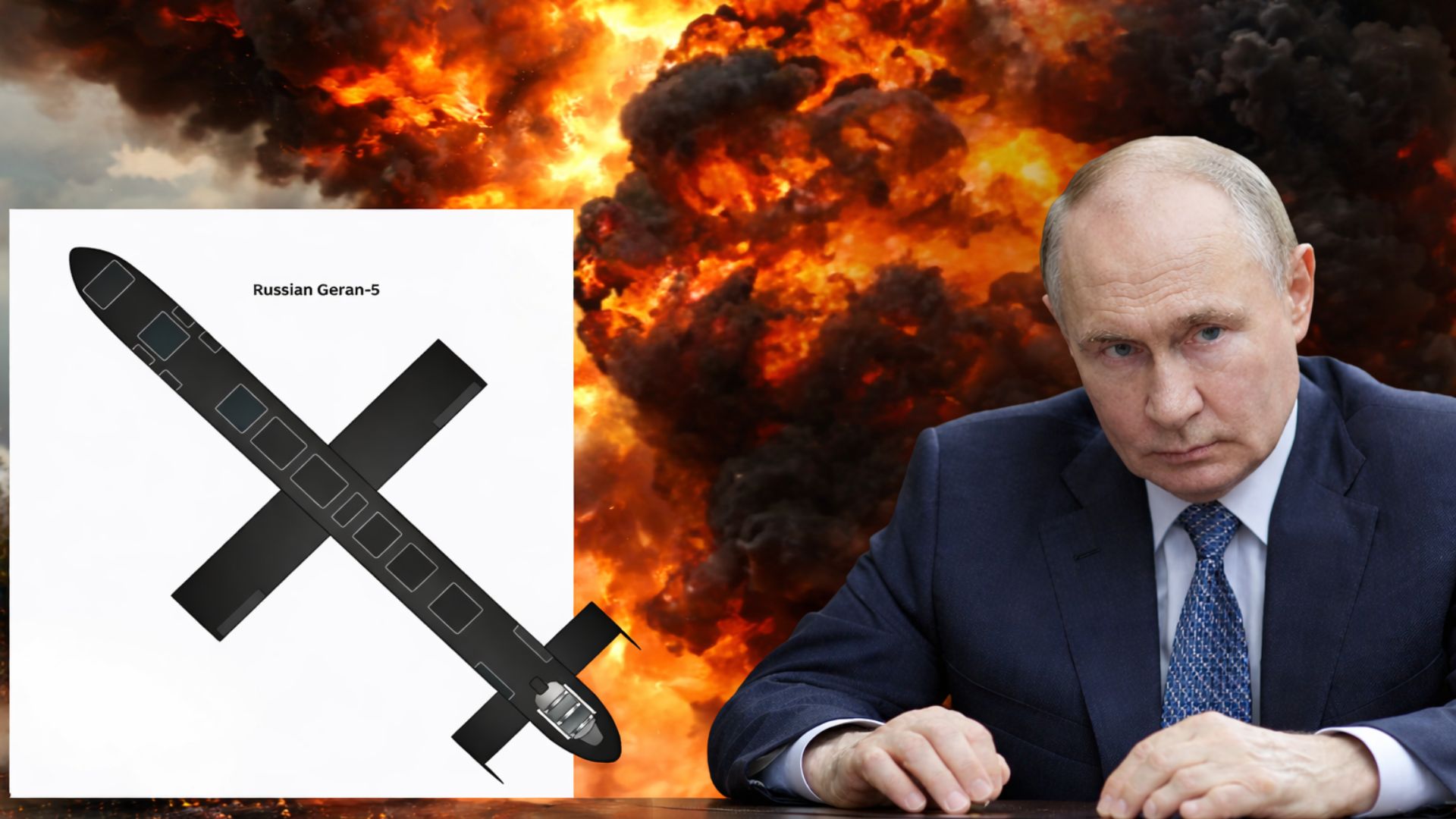
Public Report Exposes Data on the Geran-5, Russian Turbojet Drone, with Speed and Range Numbers That Draw Attention Outside the Military Field. Document Also Lists Manufacturers and Countries Linked to Electronic Components, Expanding Global Interest by Touching on Traceability, Industry, and Supply Chains.
Public reports detailing a new Russian turbojet attack drone have placed the Geran-5 at the center of a dispute that mixes military performance, engineering, and traceability of international components.
The model is described as significantly faster than previous versions associated with the “Geran” family, with a range of nearly 1,000 km and the ability to carry a 90 kg warhead, numbers attributed to the War & Sanctions portal, maintained by the Main Directorate of Intelligence of the Ministry of Defense of Ukraine (GUR).
Geran-5 Specifications Released in Public Report
The main element of interest, besides speed, lies in the data set released in the same database.
-
He started running at 66 years old, broke records at 82, and is now a subject of study for having a metabolic age comparable to that of a 20-year-old, in a case that is intriguing scientists and inspiring the world.

-
Oldest tree on the planet reappears after 130 years of searches: Wattieza, 385 million years old, was 10 meters tall and had no leaves or seeds; Gilboa fossils in New York solved the mystery in 2007.

-
A 48-square-meter house assembled in hours with 4,000 bricks made of recycled plastic that does not absorb moisture, has natural thermal insulation, and costs less than 90,000 reais in a complete kit.

-
Luciano Hang revealed that Havan’s air fleet has already accumulated more than 20,000 landings, 10,000 flight hours, and 6 million kilometers traveled, and he says that without the planes, the company would never have grown so quickly.


The Geran-5 page lists components and manufacturers that, according to Ukrainian intelligence, have been identified from analyzed materials.
The list includes companies based in the United States, Germany, and China, as well as items whose origin is not indicated as identified, reinforcing the global appeal of the topic by involving extensive supply chains and dual-use electronic products.
The specifications presented by War & Sanctions describe equipment with dimensions and parameters that bring the Geran-5 closer to a larger unmanned aircraft compared to simpler, slower attack drones.
According to the portal, the Geran-5 has a length of 6.5 meters and a wingspan of 3.2 meters, with a maximum takeoff weight of 850 kg.
The same document attributes to the system cruise speed between 450 and 600 km/h, range of 950 km, flight time of up to two hours, and operating ceiling of up to 6,000 meters, in addition to the warhead weight of 90 kg.
Turbojet Engine and Why Speed Changes the Game

One of the highlighted items on the page is the turbojet engine identified as “TELEFLY TF-TJ2000A,” associated with a company based in China, according to War & Sanctions’ own listing.
In practice, the presence of a turbojet changes the operational logic of attack drones that, in recent scenarios, usually operate with propeller propulsion and lower speeds.
The combination of higher speed and longer range tends to reduce the time available for detection, classification, and engagement by defensive systems, an aspect noted in coverage by the British newspaper The Guardian when discussing the introduction of faster drones into the conflict.
American, Chinese, and German Parts on the Component List
The same Ukrainian repository includes, in the case of the Geran-5, a list of electronic and communication components associated with manufacturers and home countries.
Among the examples presented on the page are parts attributed to Texas Instruments and CTS Corporation, from the United States, and a component attributed to Infineon Technologies, from Germany, in addition to items associated with Chinese companies.
The catalog also mentions equipment such as network modems, navigation systems, and electronic control modules, always in the format of “name and marking” identification and the country of the manufacturer’s headquarters.
Alabuga and the Industrial Dimension of the Program

The War & Sanctions publication also associates the Geran-5 with a specific industrial structure by displaying a “manufacturer” field referencing “ALABUGA OEZ PPT JSC.”
This mention is relevant because the debate on long-range drones has been accompanied in different countries by analyses of industrialization, component acquisition, and production scalability.
In the text from The Guardian, the discussion is connected to the increasing intensity of attacks and the effort to elevate the sophistication of employed models, alongside increasing volume.
Why the Topic Became Global Curiosity
The way information is presented helps explain why the Geran-5 has generated curiosity outside the axis directly affected by the war.
The page brings, at the same time, numbers that serve as “markers” of performance and a sort of inventory that suggests technical tracing, going beyond generic descriptions.
For readers tracking technology and industry, the idea of a jet attack drone with published specifications and a list of identified parts creates a hook similar to articles that highlight industrial recoveries and specific manufacturing technologies, because it offers the “how it was made” along with the “what it does.”
International coverage helps to amplify the topic by associating the drone with a pattern of evolution: the migration from slower platforms to faster versions with a flight profile that shortens reaction windows.
The Guardian described the Geran-5 as a faster model than previous versions and pointed out that, according to Ukrainian authorities, it would increase pressure on air defense by reducing response time.
In the same material, the newspaper noted claims that analyzed debris indicated the presence of components of foreign origin, converging with the War & Sanctions proposal to expose parts and manufacturers.
Traceability, Semiconductors, and Global Supply Chain
Technically, the War & Sanctions database explicitly outlines speed in the form of a range and treats range as a direct value, which facilitates comparisons with similar drones used over long distances.
Beyond the conflict, these numbers are a recurring reason for interest on Google Discover because they serve as a “scale” of the subject, allowing the reader to quickly gauge what is being discussed.
This type of reading is driven when the text associates performance with a public documentary evidence, such as a database or report describing components.
Another point supporting the topic’s repercussion is the debate about export controls and the international circulation of semiconductors, communication modules, and industrial components that can be applied in both civilian and military uses.
By listing manufacturers and home countries, War & Sanctions shifts the focus of the discussion from the strictly military field to the terrain of global supply chains, where traceability is complex and involves resale, intermediaries, and multiple layers of supply.
This international dimension often piques the interest of readers from different regions because it touches on trade, industry, and regulation, not just geopolitics.








-

-

-

-

10 pessoas reagiram a isso.