





 Portuguese
  English
  Spanish
  4 min of reading
  0 comments


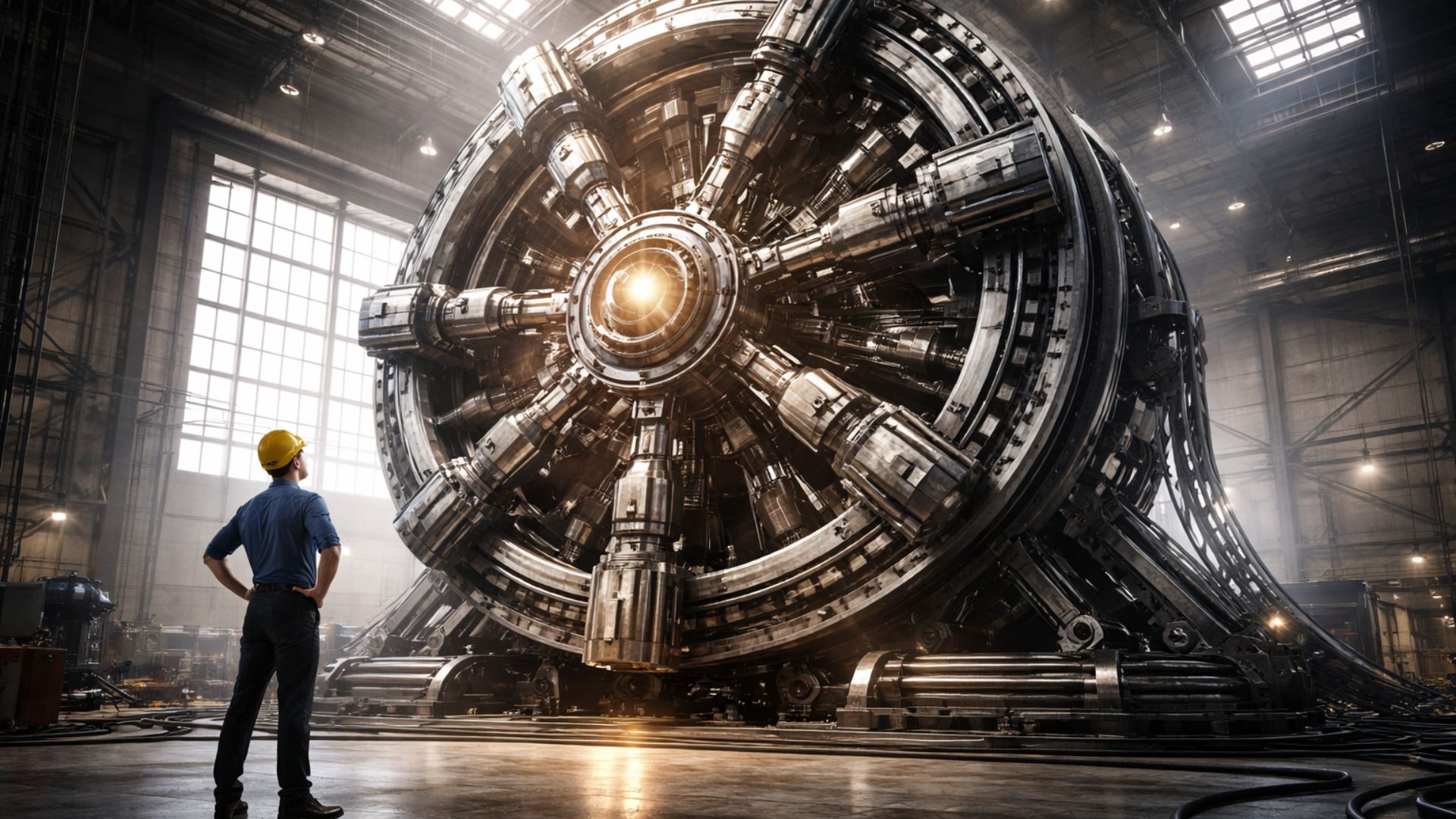
Recent registration reignites debate on continuous energy without fuel and limits of the laws of physics in a proposal that mobilizes global curiosity.
The public re-presentation, between March and April 2026, of documents linked to Russian engineer Viktor Bakhirev has brought back to light an old ambition of engineering: to achieve continuous rotation using only gravity, without the need for a permanent energy supply.
As a result, the proposal gained new momentum after the official Russian patent office, FIPS, began displaying updated records, in which the system is described as capable of moving masses internally in a rotor to sustain rotational movement.
Although recent news treats the idea as something unprecedented, the available documentation reveals a relevant prior history, indicating that the concept had already been formalized years earlier and only returned to public debate due to recent visibility.
-
Abandoned 100-year-old house that was being engulfed by vegetation undergoes a 14-month renovation and has seen its value soar after the final result.

-
Incredible renovation transforms 1864 fire station into a 636 m² luxury apartment, preserves original staircase, features a 90 m² landscaped garden, and is now worth over R$ 100 million.

-
Archaeologists unearthed in Iraq the largest winged bull statue in history, a lamassu 6 meters tall with the body of a bull, eagle wings, and a human head that guarded the throne room of one of the most powerful kings of the ancient world, and the piece was only found because the Islamic State destroyed the mosque that had hidden the palace for over a thousand years.

-
Archaeologists found thousands of sling projectiles dating back 3,500 years concentrated in front of the palace of Troy along with arrowheads, burned buildings, and hastily buried bodies, and now science believes that the war described by Homer in the Iliad may have been real.

In November 2015, for example, a Russian patent associated with Bakhirev was filed, officially published in May 2017, while a subsequent international application appeared with priority from April 2018 and was disclosed in October 2019.
Thus, the movement observed in 2026 represents a resurgence of interest in the proposal, and not the emergence of a new technology, as part of the coverage suggested.
How the gravitational motor with rotor works
In the technical records, the described operation is based on the controlled movement of solid or fluid masses positioned in inclined structures within the rotor, with the aim of continuously altering the weight distribution during the rotation cycle.
The presented logic indicates that this displacement would create a favorable imbalance at certain points of the rotation, generating enough torque to maintain movement, at least from the theoretical perspective described in the documents.
In the version published in 2017, elements such as levers, movable loads, springs, and mechanical limiters appear, while later descriptions expand the concept to include masses in different physical states circulating through internal tracks.
From a historical perspective, this type of proposal is similar to classic designs of unbalanced wheels, which attempt to keep one side permanently heavier than the other to sustain rotation without an external energy source.
Despite the ingenuity of the arrangement, studies accumulated over the centuries indicate that the very repositioning of the masses requires enough energy to neutralize any advantage gained by the imbalance, preventing the continuity of movement.
Laws of thermodynamics and physical limits of the system
Within physics, devices with these characteristics are classified as perpetual motion machines, that is, hypothetical systems capable of operating indefinitely while still producing useful work without additional energy supply.
Under this framework, the first law of thermodynamics establishes that energy cannot be created or destroyed, only transformed, which makes any mechanism that promises continuous energy generation without equivalent input unfeasible.
In light of this, a motor that claims eternal operation with the production of useful energy without external feeding would directly conflict with the principle of conservation of energy, widely validated in different areas of science and engineering.
Furthermore, the second law of thermodynamics imposes additional restrictions by determining that real processes involve losses and an increase in entropy, which prevents the complete conversion of energy into useful work without dissipation.
In this scenario, the idea of perfect continuous rotation encounters not only the conservation of energy but also the practical limitations imposed by irreversible physical processes, present in any real mechanical system.
Why gravity does not sustain continuous motion
Although gravity is fully capable of generating motion from the conversion of potential energy into kinetic energy, as occurs in systems with counterweights or in the fall of objects, this conversion does not sustain itself cyclically without external input.
When attempting to repeat the process continuously, the main obstacle arises: the need to reposition the masses to their initial configuration, a step that requires energy equivalent to that released earlier during the downward movement.
Without an external source to replenish this energy, the system enters energy equilibrium and the inevitable losses, such as friction and internal resistance, cause the movement to progressively decrease until it ceases.
This behavior explains why proposals based on internal weight redistribution face structural limitations, even when they present sophisticated mechanical solutions to try to maintain the imbalance throughout the rotation.
Even if the rotor is designed to create momentary advantages in certain positions, the overall energy balance remains unchanged, and any apparent gain tends to be offset by the energy cost of its own internal operation.
What is known about Viktor Bakhirev’s proposal
The available documentation confirms that there are formal records associated with the name of Viktor Bakhirev and the concept of a gravitational motor, as well as evidence that new documents were incorporated into the Russian database in 2026, boosting recent repercussions.
Despite this, no data has been found that proves the construction of a functional prototype subjected to independent tests capable of demonstrating continuous rotation with net useful energy generation without an external source.
Without experimental validation of this kind, the proposal remains in the realm of concepts registered in patents, without recognition as a proven technology by the international scientific community.
This scenario helps to understand why the idea continues to spark interest and debate, while not altering the consensus established by the laws of physics regarding the limits of energy systems.
Although patents can formalize mechanisms and hypotheses, scientific acceptance depends on rigorous experimental evidence, especially in cases that challenge widely tested fundamental principles.








Seja o primeiro a reagir!