





 Portuguese
  English
  Spanish
  8 min of reading
  0 comments


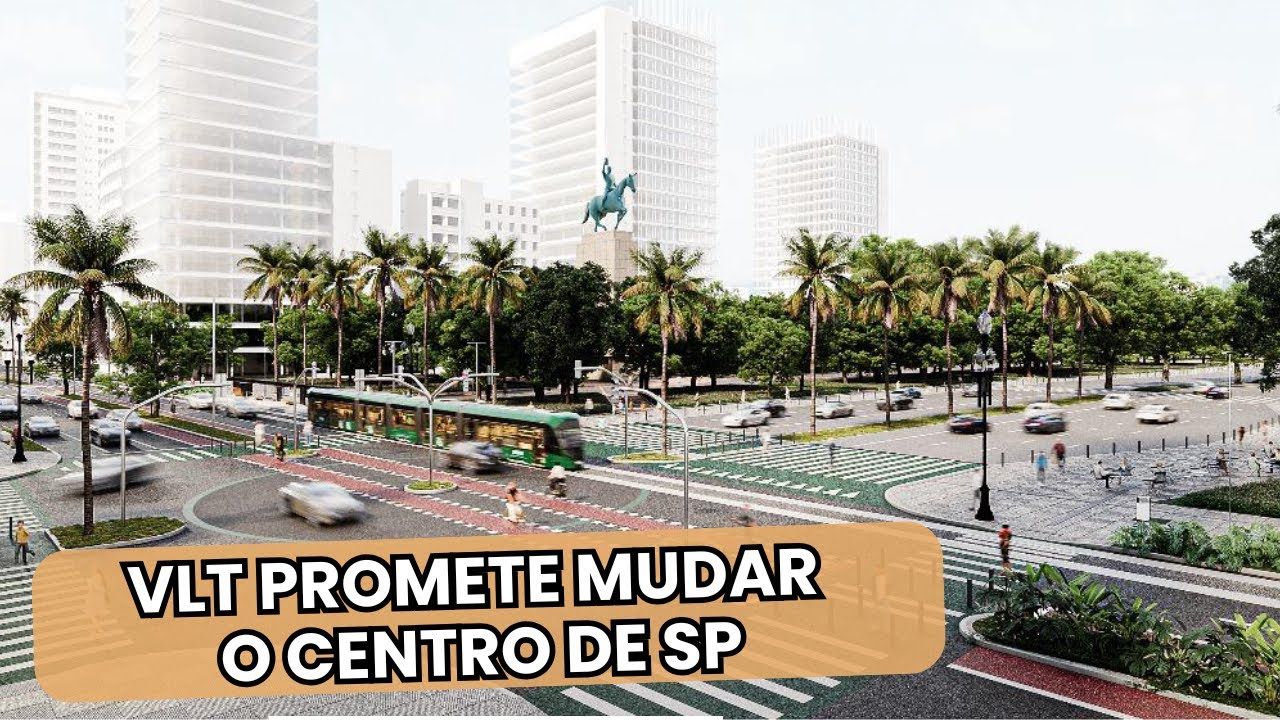
São Paulo Prepares VLT in The Historical Center with Investment of R$ 1.2 Billion to Integrate Metro, Buses and CPTM, Revitalize The Center of São Paulo and Attract Up to 200,000 New Residents to The Region.
When we talk about mobility in major capitals, Rio de Janeiro and São Paulo almost always appear in the same sentence. On one hand, Rio has already reaped the urban effects of its VLT in the central area. On the other, São Paulo prepares VLT in the historical center as part of a larger strategy to reorganize transport, recover public spaces, and bring life back to the city’s oldest streets.
The project is not just another modern tram line designed on a map.
São Paulo prepares VLT with an estimated investment of R$ 1.2 billion, funded in partnership with BNDES, to connect nine metro stations, five bus terminals and two CPTM stations, alter the design of sidewalks, create green spaces, lawns between the tracks and, mainly, attract around 200,000 new residents to the center by the end of the decade.
-
Petrobras sends a message to Brazilian truck drivers after fuel collapse and reveals plan to have 100% domestic diesel.

-
Mothers and daughters come together, create an ‘express’ beauty salon and turn the idea into a network with 21 units, revenue of R$ 16.7 million and 12,000 subscribers.

-
End of the 6×1 schedule: how the reduction of hours can affect service companies, industry, and agribusiness.

-
Brazil Ignores Trump’s threats to BRICS, Buys 42 tons of gold and reduces the Dollar’s share by 6.45% in international reserves.

The bet is clear: use urban mobility and requalification as a lever to transform the heart of the country’s largest city.
Why São Paulo Prepares VLT in The Historical Center
The starting point is simple and ambitious at the same time. São Paulo prepares VLT in the historical center because the neighborhood brings together exactly what any city thinking about smart mobility needs to combine: a large supply of jobs, a huge concentration of metro, bus, and train lines, in addition to many underutilized buildings that could return to being housing.
The project is part of the current administration’s target plan and was included in the National Urban Mobility Study, developed by BNDES in partnership with the Ministry of Cities. This study already indicates an investment of R$ 1.2 billion for the VLT system in São Paulo and suggests that construction could start within this decade, as long as the bidding is indeed launched in the current term.
More than just placing vehicles on tracks, the city hall wants a structuring urban project. The idea is to use the VLT in the historical center to reorganize flows, improve public space, bring housing closer to employment, and reduce the dependence on long trips from the outskirts to the center during peak hours.
What Will The Route of The VLT in The Historical Center Be Like

In the presentations made by SP Urbanism, the general design already appears with a relatively clear concept. The first line of the VLT in the historical center is expected to have a circular shape, traveling through the central area in two directions, clockwise and counterclockwise, following the so-called central roundabout.
The route is still under analysis, but the proposal includes iconic streets such as Rua Direita, Viaduto do Chá, the surrounding area of Theatro Municipal, and Rua da Cantareira.
The choice of traditional streets is not casual. The intention is for the VLT in São Paulo to pass exactly where the city was born, where pedestrian flow is intense, and where there is greater potential for urban transformation.
A second line of VLT in São Paulo is expected to connect the historical center to Bom Retiro, weaving together areas that already have significant pedestrian traffic, strong commerce, and a vast connection with other modes of transport. The complete design may still change throughout the studies, but the repeated concept is always the same: take advantage of existing infrastructure, order traffic, and favor pedestrians.
Integration with Metro, Buses, CPTM and Pedestrians
One of the central arguments to explain why São Paulo prepares VLT is the capacity of this system to function as “glue” between the existing modes.
According to SP Urbanism itself, the VLT in São Paulo is expected to connect directly with nine metro stations, five bus terminals, and two CPTM stations, forming a true ring of passenger redistribution in the center.
In practice, this means that those who today need to take more than one bus to get from one metro station to another will be able to cover this stretch on the VLT, in just a few minutes, with level boarding, low floors, and greater comfort. In addition, the project openly discusses “good relationship with pedestrians”, which includes:
- Wider and continuous sidewalks
- Green areas and lawns between the tracks
- Less aggressive competition for space between cars, buses, and people
This type of solution is typical of urban mobility projects in São Paulo that seek to reduce the priority of private cars in the center, bringing the city closer to international references in medium-capacity transport.
Revitalization of The Center of São Paulo and The Return of Residents
Mobility is the most visible piece, but it is not the only one. São Paulo prepares VLT as part of a larger agenda for the revitalization of the center of São Paulo.
The city hall talks about attracting up to 200,000 new residents to the region, betting that with quality transport, comfortable sidewalks, active commerce, and increased safety, the center can also become a strong residential neighborhood.
Today, what can be seen on the busiest lines of the metro and CPTM is a reflection of unbalanced urban planning. People live far away, work in the center, and spend hours a day squeezed into trains and buses.
By encouraging housing closer to employment, the idea is to reduce these forced displacements, relieve the pressure on existing systems, and improve the quality of life for those who use public transport daily.
In this context, the VLT in the historical center serves as a permanent invitation for people to circulate, consume, occupy squares, frequent shops, and feel comfortable living in the region. The experience of other cities shows that when transport is quiet, predictable, and integrated, the surroundings become more valuable, and the revitalization of the center of São Paulo ceases to be just a speech.
VLT in São Paulo as a Medium-Capacity Solution
Another important point is to understand the place of the VLT in São Paulo within the transportation hierarchy. The VLT is classified as a medium-capacity system. It transports more people than a regular bus corridor but fewer than a heavy metro line.
In exchange, it can be implemented with less intervention than a subway line and with much more positive urban impact than a simple bus reinforcement.
The city hall highlights typical characteristics of this type of system:
- Low floor, which facilitates boarding for elderly people, wheelchair users, and users with reduced mobility
- Silent operation, allowing circulation in dense areas without deteriorating the sound environment
- Regularity and reliability of schedule, an attribute that historically makes passengers trust rail systems more than regular bus lines
For these reasons, the VLT in São Paulo is seen as an instrument of transformation not only of transport but of the very perception that São Paulo residents have of the center.
Technologies Studied for The VLT in The Historical Center
Although the route of the VLT in the historical center is more advanced than the technological definition, some possibilities are already mentioned in technical presentations. The city hall mentions:
- Traditional electric VLT, powered by overhead lines or more modern ground feeding solutions
- Hydrogen VLT, using fuel cell technology to further reduce local emissions
- Digital Urban Tram (DUT), a system that operates without physical tracks, guided by sensors and markings on the road, but offering an experience similar to that of a VLT
The bidding notice should bring the minimum requirements, such as electric traction and capacity to overcome slopes of up to 6 percent, in addition to curves with a minimum radius of 25 meters.
The estimated fleet is 36 trains, but the final model may be at the discretion of the winning company, as long as it complies with the parameters set by the public authority.
The most important thing, however, is that any chosen solution needs to align with the larger proposal for urban mobility in São Paulo for the center: less local pollution, less noise, more comfort, and better integration with what already exists.
Challenges to Bring the VLT in São Paulo to Life
Even with the BNDES study, estimated investment, and public presentations, there is still a considerable way to go before seeing the VLT actually circulating.
São Paulo prepares VLT within a scenario of pressured public finances, competing priorities, and the need for fine coordination among various departments and companies.
Among the challenges are:
- Complete the economic-financial viability studies
- Structure the concession or partnership model that will operate the system
- Articulate the track construction with the revitalization of the center of São Paulo, such as sidewalk renovations, tree planting, and drainage networks
- Minimize the impact of construction on commerce and on those who already live and work in the region
Despite this, the fact that the project appears in the target plan, is included in the national mobility study, and already has a reference value of R$ 1.2 billion linked to BNDES indicates that the VLT in São Paulo has moved from the phase of generic idea to a phase of concrete structuring.
Urban Mobility in São Paulo and The Symbolic Role of The VLT
In the end, it is not just a new mode of transport. When São Paulo prepares VLT for the historical center, the city sends a message about the kind of future it wants to build for its mobility. A future where urban mobility in São Paulo means:
- Prioritizing pedestrians, public transport users, or cyclists
- Reconnect housing and employment, avoiding gigantic displacements
- Using road space to create places for social interaction, not just flows of cars
If the plan works, the combination of VLT in the historical center, VLT in São Paulo integrated with metro, buses, and CPTM, and the revitalization of the center of São Paulo could become a milestone similar to what the metro represented in past decades.
And here is the question to close the article and open the comments.
Would you live in the center if the VLT in São Paulo really comes to fruition and transforms the region, or do you think the city still needs to change much beyond transportation for that to happen?




-

-

-

4 pessoas reagiram a isso.