





 Portuguese
  English
  Spanish
  7 min of reading
  0 comments


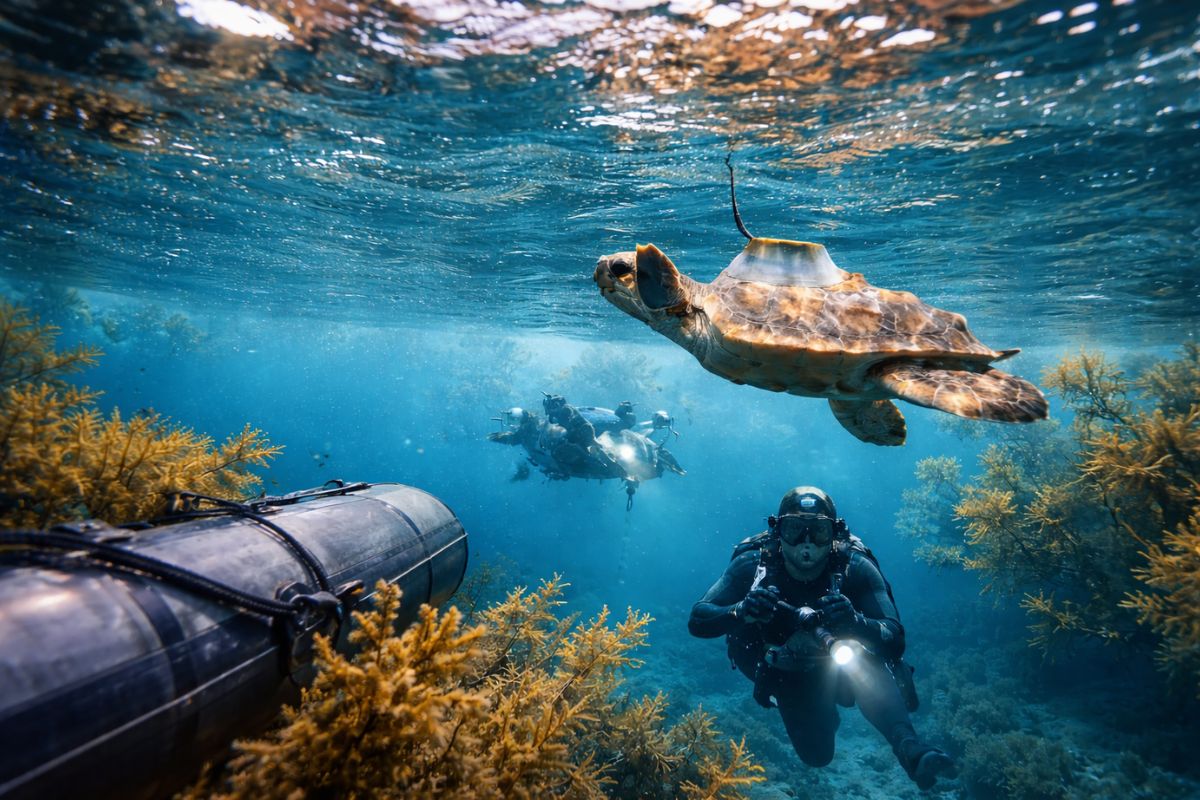
With New Digital Tools, Scientists Monitor Endangered Species in Isolated and Dangerous Habitats, Collecting Real-Time Data on Distribution, Health, Behavior and Ocean Use. Unmanned Vehicles, Acoustic Recordings, Telemetry and Artificial Intelligence Allow Tracking Whales, Turtles and Seals, Guiding Protection and Recovery.
The race to protect endangered species in the ocean has fully entered the technological age, with satellites, drones, unmanned vehicles, acoustic sensors, smart tags and artificial intelligence being used to see what was previously invisible in remote, deep, cold or too dangerous areas for traditional expeditions.
With real-time monitoring and long-term research, these resources are changing the way we understand how endangered species respond to environmental and anthropogenic impacts, enabling quicker decisions for conservation, recovery and risk reduction such as collisions with vessels, accidental capture in fisheries, and habitat loss.
Long-Term Monitoring in Places Where Almost No One Can Reach

One of the most important gains from this technological package is the ability to study animals and ecosystems in isolated habitats that are difficult and dangerous to access, with efficiency and continuity.
-
In a flooded well, archaeologists found a 1,700-year-old Roman egg that still contains clear and yolk intact inside the very thin shell.

-
Something is happening around the Earth: Inside the huge explosion of fireballs in 2026

-
A hot air bubble coming from Argentina expands over Brazil, causing thermometers to exceed 38 degrees with a thermal sensation of 40 degrees in late March, affecting 6 states at once.

-
The radish leaf that almost everyone throws away has more polyphenols, flavonoids, and fiber than the consumed root, and a 2025 study showed that the leaf contains compounds that protect the intestine, combat inflammation, and may inhibit the growth of cancer cells.


Instead of relying solely on short observation windows in the field, teams can maintain surveillance for long periods, accumulating data series that reveal invisible patterns in snapshot surveys.
This type of remote monitoring allows tracking the distribution of populations and understanding how they use habitat, recording seasonal changes, movements and critical feeding and breeding areas. For endangered species, this means reducing uncertainties about where they are and when they are most vulnerable.
Unmanned Vehicles: Machines That Have Become the Eyes and Ears of the Ocean

Unmanned vehicles are being used to collect essential data on endangered species and other protected species with greater precision and less risk.
These systems help measure population status, movement, health, habitat and behavior, revealing how animals interact with the ecosystem and with threats such as vessels and fishing gear.
Among the platforms being tested are unmanned surface vehicles, such as the DriX. They can be employed to understand the abundance and distribution of plankton, a factor that directly influences where marine mammals seek food.
This is crucial because many events of concentration of whales, dolphins and porpoises are associated with areas where food accumulates.
By expanding data collection in conditions and environments inaccessible to traditional aerial and maritime surveys, these machines broaden the reach of science to regions that were previously without information for long periods.
Drones: Measure, Count, Observe and Tag Without Touching the Animal
Unmanned aerial systems, known as drones, have become key tools for monitoring animals without direct contact, reducing stress and decreasing the need for repeated vessel approaches.
In practice, drones are used to:
- Count and measure animals individually
- Estimate group size
- Monitor birth rates and pup births
- Observe body condition
Additionally, drones can deploy suction-cup tags on cetaceans, such as whales, dolphins and porpoises. Among the species mentioned in this type of monitoring are the North Atlantic right whale and the Rice’s whale, both endangered.
These tags collect data on dive patterns, vocalization rates, habitat use and other behaviors of each individual.
The result is a much more detailed picture of the biological and ecological factors that determine the conservation status of a population.
Drones also play a direct role in rescues. They help teams assess entangled or injured whales, allowing for a safer and quicker visual assessment and minimizing the animal’s stress by reducing the number of vessel approaches.
Thermal Imaging in the Arctic: Seals Shining on the Ice

In the Arctic, drones equipped with thermal imaging systems are used to monitor populations of ice seals. The logic is simple and powerful: the warmed bodies of seals resting on large ice floes appear brightly, standing out against the cold surrounding environment.
This solves a practical problem. Access to the ice floes can be difficult for the small inflatable boats used by researchers to approach seals.
With Arctic conditions continuously changing, the use of drones to monitor abundance, health, and behavior of these seals becomes essential for conservation and recovery efforts, especially when the scenario demands speed and precision.
Acoustic Recordings: “Listening” to the Ocean Where the Eye Cannot Reach
Sound is the primary form of communication for many marine animals, as well as being used to find food, locate mates and avoid predators.
For this reason, acoustic recording has become one of the most strategic technologies for monitoring endangered species.
Science uses passive acoustic monitoring technology to “listen” to the ocean for long periods and over large distances. Among the tools used are:
- Bottom-mounted recording devices
- Hydrophone arrays towed by ships
- Drifting recorders
- Acoustic recording tags
- Near real-time monitoring by gliders and acoustic buoys
With these tools, researchers study behavior, movements and distribution of animals using unique frequency and sound patterns produced by different species underwater.
The major advantage is covering gaps that seasonal aerial and maritime surveys leave behind. In adverse conditions, or when animals are diving, traditional methods may not record sightings. Acoustic monitoring, on the other hand, can operate year-round.
This is especially useful for hard-to-study species, like beaked whales, which dive to great depths, or small but widely distributed populations like the North Atlantic right whale.
From Data to Alert: Reduced Speed Zones to Protect Whales
Acoustic data does not remain solely in the scientific field. They can guide protection measures in real time.
When North Atlantic right whale vocalizations are detected in real time, a Reduced Speed Zone for Right Whales is activated, encouraging mariners to reduce vessel speed in the area.
This type of response transforms information into immediate action, reducing risks for endangered species in one of the most difficult threats to control in the ocean: vessel traffic.
Additionally, detections of whale and dolphin vocalizations in the North Atlantic are loaded onto a passive acoustic map of cetaceans, an interactive public data tool that allows understanding when and where large whales occur along the U.S. east coast.
Animal Telemetry: Tags That Have Become “Diaries” of the Body and the Environment
Animal telemetry utilizes tags attached to animals to track movements and collect data on location, physiology, behavior and environment.
These tags can use GPS, acoustic recorders, and video. Data is stored and transmitted via radio, satellite or acoustic signal.
With technological advancements, more durable tags can store data for several years, especially useful for long-lived species.
There are also miniature tags applicable to smaller animals, such as young sea turtles and seabirds.
There is a specific effort to improve satellite sensors and measure more detailed physiological data. Among examples are stomach temperature to monitor prey intake, and environmental data such as water temperature and salinity.
Satellites Following Migrators: The Route of Pacific Leatherback Turtles
Satellite tags are especially useful for monitoring highly migratory species that are difficult to track by ship or plane.
One cited example is using tags to collect data on location, temperature, and dive depth of Pacific leatherback turtles, an endangered species.
These turtles migrate long distances. Tracking allows understanding seasonal distribution and how much time they spend on the surface or at greater depths in the water column. This knowledge helps reduce the risk of harmful interactions, such as accidental capture in commercial fisheries, a constant threat to endangered species.
Acoustic Tags and the Change in Distribution Over Time
Another type of tag, with acoustic transmitters, emits unique signals every few seconds. These signals are detected by nearby receivers and record the location as the animal swims.
This method is valuable for tracking movements of long-lived species and identifying if geographical distribution is changing due to environmental conditions, recovery, or habitat loss.
One cited example involves the small-toothed sawfish: despite having extended from Texas to North Carolina, it is now found almost exclusively in Florida waters.
Artificial Intelligence and New Technological Frontiers to Reduce Extinction Risk
In 2023, a program focused on Advanced Sampling and Technology for Reducing and Recovering Extinction Risk was launched. The proposal is to accelerate technological advances that help conserve endangered species and their habitats.
The approach combines artificial intelligence and machine learning, advanced statistical methods, advanced sampling and “omics,” as well as unmanned systems, acoustics, imagery, and other technologies. The goal is to improve conservation management and also reduce regulatory burdens, with more informed and efficient decisions.
Why This Technological Race Changes Conservation in Practice
When science can observe animals without touching them, listen to the ocean year-round, track migrations via satellite, measure body condition with drones, and detect presence through acoustic patterns, the result is a leap in capacity.
Conservation ceases to rely solely on sporadic expeditions and begins to operate with continuous data, helping to understand how populations respond to environmental and anthropogenic threats and how to adjust protection and recovery strategies more precisely.
Besides the direct environmental impact, there is an economic argument associated with sustainable marine ecosystems, which enhance competitiveness and economy, linking the survival of endangered species to management and ocean use decisions.
Do you think this technological race to protect endangered species will manage to arrive in time to halt extinction at sea, or is the ocean already changing too fast?







-

-

-

3 pessoas reagiram a isso.