





 Portuguese
  English
  Spanish
  4 min of reading
  0 comments


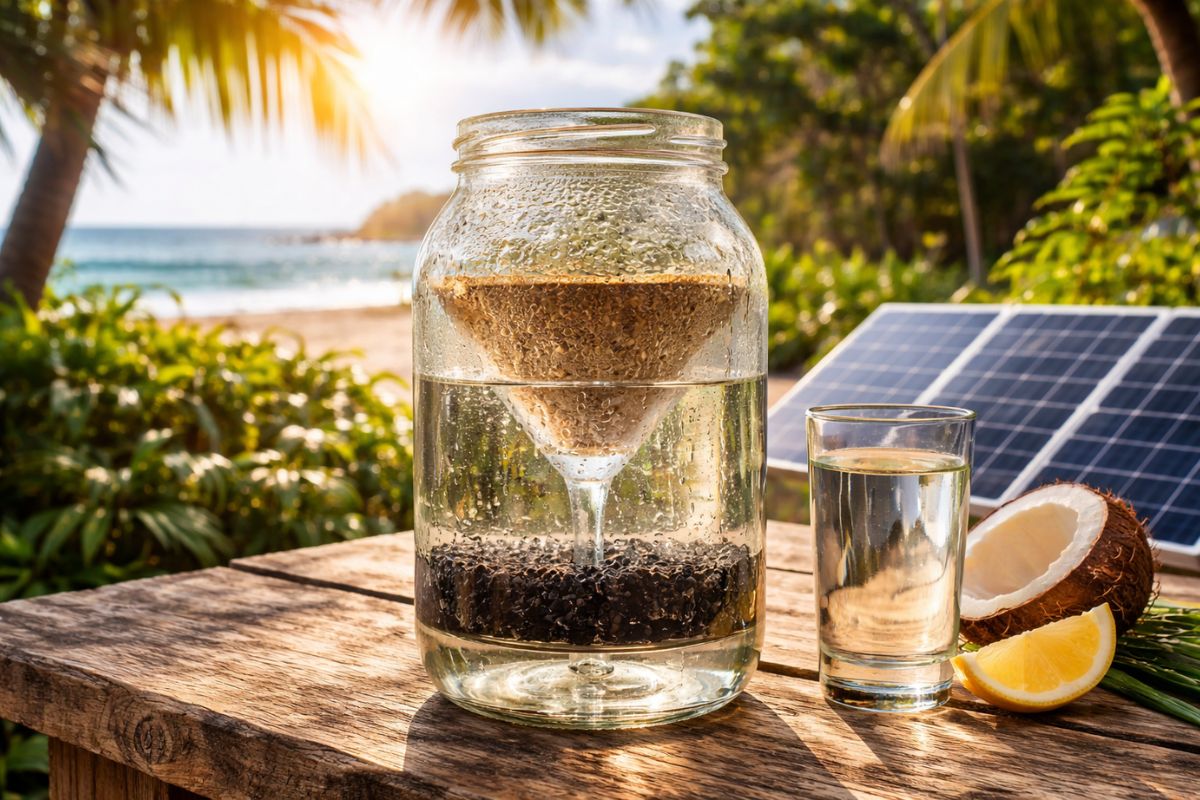
The hydrogel filter developed by the University of Texas transforms contaminated and even salty water into potable water using only passive solar energy without requiring electricity, batteries, or infrastructure and can be assembled in common household containers with biodegradable organic materials and virtually no cost.
Scientists at the University of Texas at Austin have developed a filter made from organic materials that can transform contaminated water and even seawater into potable water using exclusively sunlight. According to the portal Olhar Digital, the system does not require electricity, does not use chemicals, and has a production cost of almost zero; it works with hydrogels produced from natural biomass that act as molecular sponges, capturing impurities while solar heat causes evaporation. The clean vapor is condensed and collected as potable water ready for consumption.
The simplicity of the process is what makes the discovery potentially transformative. While traditional desalination plants cost millions and rely on electricity and heavy infrastructure, this filter can be assembled in common household containers and works anywhere there is sunlight. For the hundreds of millions of people worldwide who lack access to potable water, a portable, inexpensive system that operates without electricity can mean the difference between illness and health or between life and death.
How the solar filter transforms contaminated water into potable water

The process works in three stages. In the first, the organic filter absorbs sunlight and converts that energy into heat, initiating the evaporation of impure water.
-
No more worrying about age: scientists discover a way to reprogram your cells to keep your bones as strong as iron for a lifetime.

-
Artemis II makes historic flyby of the Moon, sets record for distance from Earth, captures the far side, and witnesses a solar eclipse that no one on the planet could see.

-
NASA admits it may lose the space race: China has a crucial advantage to reach the Moon first and build a nuclear base before the United States.

-
Ford’s CEO calls China an existential threat while Stellantis, Mercedes, and Volkswagen rush to adopt Chinese technology in their own cars, and what is happening now could determine who survives in the future of the global automotive industry.

In the second, natural polymer molecules present in the hydrogel retain salts, heavy metals, and contaminants, allowing only clean vapor to pass. In the third, the vapor is cooled and collected in a separate container, resulting in potable water that meets international drinking water standards.
What differentiates this method from other solar purification systems is the filter material. Hydrogels are produced from organic compounds abundant in nature, keeping costs low and production scalable.
Tests have indicated that the filter can remove heavy sediments, pathogenic bacteria, microplastics, and even traces of industrial pollutants—a range of contaminants that simple conventional filtration systems cannot eliminate without the addition of chlorine or other chemicals.
Why this filter is more sustainable than any traditional potable water method
Conventional water treatment methods rely on chlorine, synthetic plastic membranes, and electricity—all with significant environmental costs.
The organic solar filter operates entirely on passive renewable energy and uses regenerative biomass, meaning that at the end of its life cycle, the material can be disposed of without causing environmental impact. The cycle is completely organic: from production to disposal, nothing harms the environment.
The comparison with traditional methods is revealing. Conventional systems use electricity or fossil fuel as a source, generate chemical waste, and have high maintenance costs. The organic solar treatment uses only the sun as energy, has zero environmental impact because it is biodegradable, and has virtually no maintenance cost.
To produce potable water at scale, the only infrastructure needed is a container, the hydrogel filter, and access to sunlight—three elements available at virtually any point on the planet.
Where this potable water technology can make the most difference
The portability of the system is what makes it especially relevant for isolated communities, conflict zones, and regions with poor or nonexistent water infrastructure.
The filter does not require complex technical training to operate; anyone can assemble and use the system by following basic instructions. This eliminates dependence on specialized technicians and allows for large-scale implementation without the bottlenecks that typically hinder sanitation projects in developing countries.
The democratization of access to potable water has direct consequences for public health. Waterborne diseases caused by consuming contaminated water still kill hundreds of thousands of people each year, mostly children in countries with poor infrastructure.
A filter that transforms seawater or river water into potable water without operational costs and without dependence on the electrical grid can drastically reduce these deaths, especially in regions of Sub-Saharan Africa, Southeast Asia, and rural areas of Latin America where clean water simply does not reach.
What is needed for this potable water technology to reach those in need
Science is ready—the filter works, tests prove its effectiveness, and the resulting water meets international drinking water standards.
The challenge now is to scale production and get the technology to the populations that need potable water the most, which depends on investment in manufacturing, distribution logistics, and public sanitation policies. The ease of replicating the filter designs allows governments to implement programs quickly, but political will and funding are needed.
With ongoing support from research institutions and eventual interest from international organizations, this potable water production system has the potential to become standard in programs aimed at mitigating the global water crisis.
The technology exists. The cost is almost zero. The energy required is the same as that which lights any sunny day. What is needed is to take this solution from the University of Texas laboratory to the hands of those in need, and that is a human decision, not a technical one.
Do you think this technology can solve the potable water crisis in Brazil and the world? Should it be a public policy priority? Let us know in the comments.









Seja o primeiro a reagir!