





 Portuguese
  English
  Spanish
  5 min of reading
  0 comments


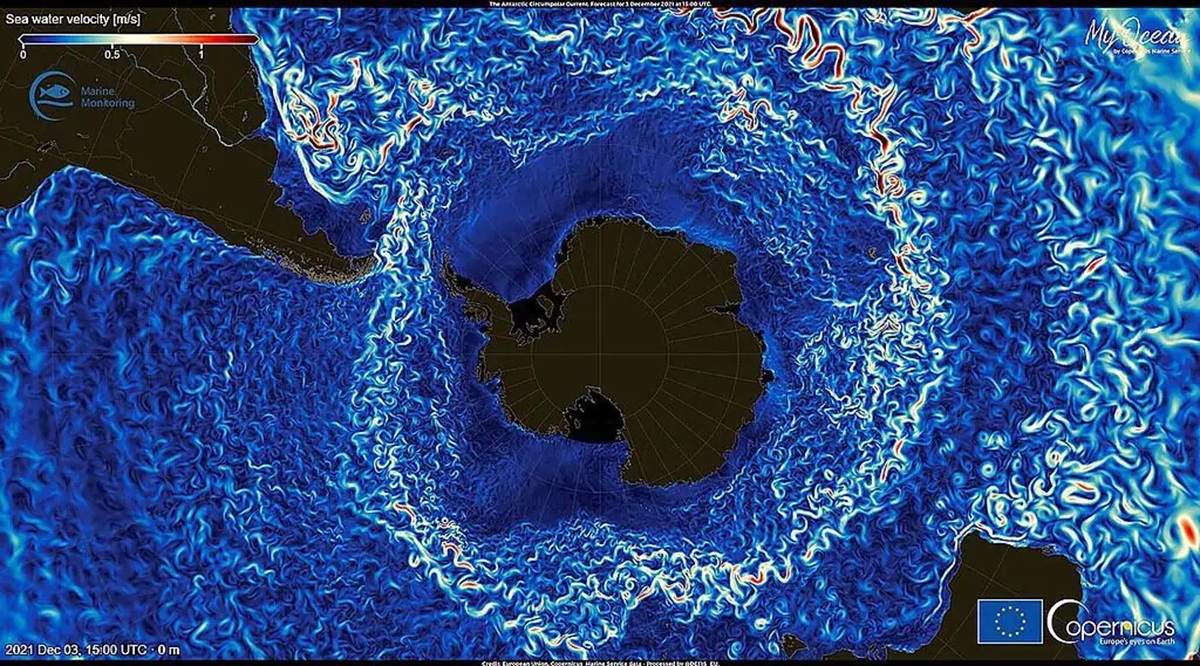
Study reconstructed the Earth 33.5 million years ago and indicated that the most powerful ocean current on the planet only formed fully when Australia aligned with the western winds, altering ocean circulation, increasing carbon absorption, and helping to cool Antarctica
The origin of the most powerful ocean current on the planet began to be clarified by a new virtual reconstruction that points to a decisive factor beyond the opening of maritime passages around Antarctica. The study indicates that the Antarctic Circumpolar Current only gained strength when Australia moved north enough to align with the western winds, a condition that allowed the complete development of the flow responsible for transporting one hundred times more water than all the rivers in the world combined.
The Antarctic Circumpolar Current is described as the largest ocean current on the planet and acts as a system that helps maintain the South Pole in permanent cold.
The new simulation challenges the idea that the deep cooling of the region began automatically when South America and Australia separated from Antarctica due to tectonic plate movement.
-
The new TCL smartphone arrives with a battery that lasts up to 7 days and screen technology that simulates paper, promising to reduce eye strain during daily use; check the price and availability of the NXTPAPER 70 Pro.

-
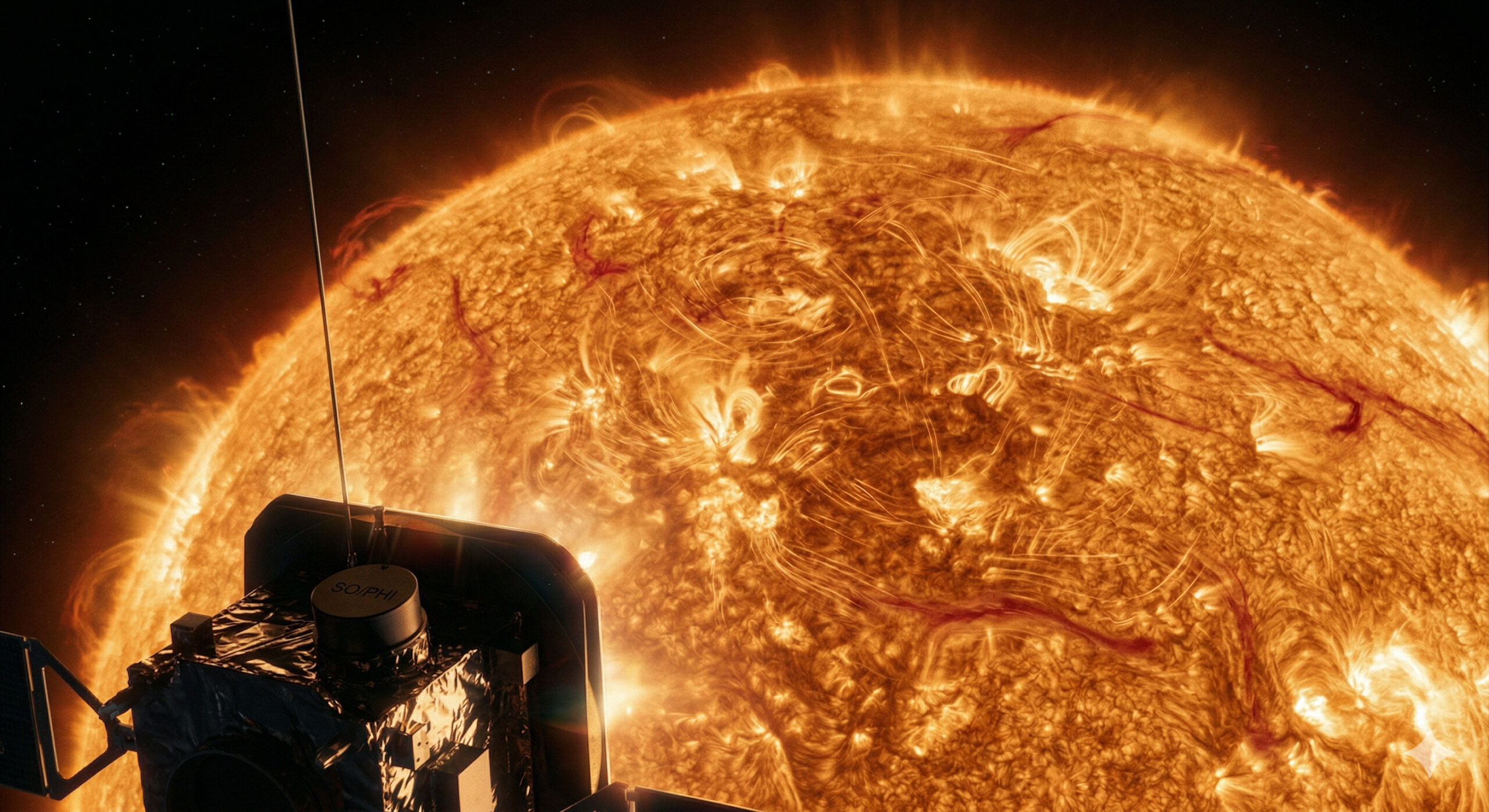
For the first time in history, a probe photographed the Sun’s pole outside the orbital plane of the solar system and discovered that the star’s magnetic field is disorganized, a revelation that forces scientists to rethink the models used to predict solar storms capable of knocking out satellites, GPS, and electrical grids on Earth.
-
A law that no one knows requires oil companies to invest billions in technology in Brazil, and the result is autonomous robots, AI that predicts failures, and cameras that see danger before humans do on offshore platforms.
-
End of glue: this new laser uses the paper’s own composition to bond layers without external glue and could solve one of the most hidden problems of packaging recycling.

Instead, the results show that the newly opened ocean passages remained inactive for a long period.
The effective activation of the current only occurred when Australia’s position began to coincide with the band of prevailing western winds, which propelled circulation around the Antarctic continent.
Climatic transition and opening of passages
The reconstruction focuses on a period of about 34 million years ago, when the Earth was undergoing a significant change between the Eocene and the Oligocene. The former was marked by high concentrations of greenhouse gases and little presence of permanent ice, while the latter consolidated a colder scenario.
During this period, the slow movement of tectonic plates expanded and deepened the water connections between Antarctica, South America, and Australia. The two central passages in this process were the Drake Passage and the Tasman Strait, considered essential elements for the reorganization of marine circulation in the southern part of the planet.
There was an expectation that the simple opening of these gaps had unlocked the Antarctic Ocean and initiated a lasting freeze. Geological evidence, however, showed a different picture, with the circumpolar current still slow and incomplete even after the separation of the seas.
To address this contradiction, researchers turned to a high-resolution climate model fed with data that reproduces the geography of the Earth 33.5 million years ago. The work also incorporated a detailed model of the Antarctic ice sheet in its initial phase, based on a study published in the journal Science in 2024.
Co-author Gerrit Lohmann, a modeler of the Earth system at the Alfred Wegener Institute, stated that the study published in PNAS shows for the first time the utility of coupled simulations of relatively high resolution to investigate the climate of the distant past. For him, despite the computational demands, this type of approach offers new perspectives on the interaction between ice, atmosphere, land surface, and ocean.
The decisive role of wind in the ocean current
The simulations pointed to a component that had already been suggested in previous works but now appears more clearly: the wind. At the beginning of the process, the western winds were blowing too far north to push water through the newly formed Tasman Passage, which prevented the formation of a continuous ocean current around Antarctica.
Hanna Knahl, a climate modeler and lead author of the study, stated that the simulations clearly confirm the importance of this atmospheric alignment. She said that the current could only develop fully when Australia moved away from Antarctica and the strong western winds began to blow directly through the Tasman Passage.
Before this continental repositioning, the behavior of the waters was irregular. Instead of forming a continuous circuit, the initial circulation fragmented, with intense flows in the Atlantic and Indian sectors and a diversion to the north after passing through the Tasman Strait.
In this scenario, the Pacific sector remained relatively calm and strongly stratified. The absence of continuity around Antarctica helps explain why the circumpolar current did not emerge immediately after the opening of the maritime passages.
When the continents migrated to positions that favored the meeting between the ocean passages and the prevailing western winds, the current gained strength. This repositioning allowed circulation to organize on a full scale and began to act as a decisive mechanism in the thermal isolation of Antarctica.
Effects on climate and carbon
With the strengthening of the Antarctic Circumpolar Current, the possibility of thermal isolation of the Antarctic continent increased. The authors also argue that the change in circulation may have increased carbon absorption by the oceans, with broader effects on the Earth’s climate.
Johann Klages, a geoscientist and co-author of the study, stated that the formation of the current strongly boosted carbon absorption by the ocean. For him, the resulting reduction in greenhouse gas concentrations in the atmosphere had the potential to initiate the colder climate of the so-called Cenozoic Ice Age, still marked by permanently ice-covered polar caps and alternation between warm and cold periods.
The study also highlights the atmospheric context of that moment. At the beginning of the Oligocene Glacial Maximum, carbon dioxide was around 600 parts per million, after falling from approximately 1,000 ppm at the end of the Eocene.
This scenario is treated as an important reference for understanding climatic states of the Earth with high CO2 concentrations. The goal is not to directly reproduce the past in the present but to refine models capable of interpreting more accurately how major changes in ocean circulation and atmospheric composition affect the climate system.
Knahl stated that predicting possible future climates requires analyzing the past with simulations and data that allow understanding the Earth in warmer and more CO2-rich states than the current ones. At the same time, she emphasized that the climate of the past cannot be projected directly into the future and that the circumpolar current in its infancy influenced the climate very differently from the fully developed Antarctic Circumpolar Current.
The researchers believe that the Earth’s climate is governed by highly sensitive variables that are currently changing at record speed. In this context, accurately defining the historical conditions that shaped the current world is a central part of the effort to interpret recent transformations in the Southern Ocean and the functioning of an ocean current that helped reconfigure the planet.





Seja o primeiro a reagir!