





 Portuguese
  English
  Spanish
  4 min of reading
  0 comments


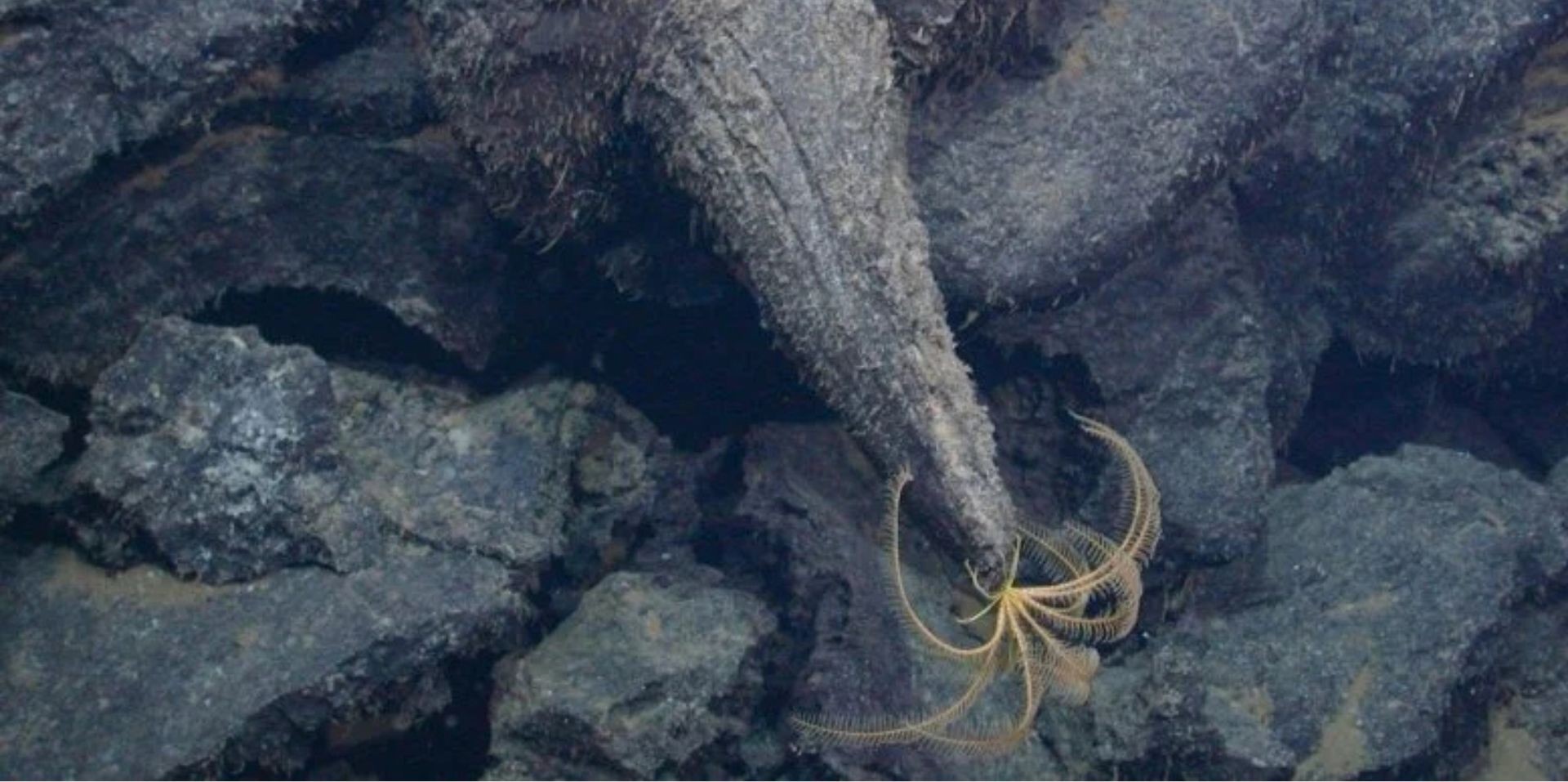
The submarine technology reveals secrets of millennial eruptions in the Northeast Pacific. The use of autonomous robots and remotely operated vehicles allowed MBARI scientists to map with unprecedented precision the 130-meter-thick lava flows on the Axial Seamount.
MBARI scientists discovered gigantic lava fields originating from an active submarine volcano located on the Juan de Fuca Ridge, in the northeast Pacific Ocean. Investigations revealed that massive lava flows and the collapse of lava lakes on the Axial Seamount are redefining the technical understanding of how underwater eruptions reshape the ocean floor.
The Axial Seamount is located along a ridge that extends for about 500 kilometers (310 miles) near the coasts of Oregon and Washington. This active submarine volcano has recorded several eruptions since its original discovery in the 1980s, becoming a focal point for geological studies. Continuous monitoring is vital, as these eruptions pose serious geological risks and can generate tsunamis that directly threaten nearby coastal areas.
Detailed mapping of the distal rift zones
The latest study, published in the journal Geochemistry, Geophysics, Geosystems, utilized cutting-edge technology to detail the hard-to-access underwater terrain. The teams from the Seafloor Mapping Laboratory and the Submarine Volcanism Team employed autonomous underwater vehicles (AUVs) to map the terrain accurately. Additionally, remotely operated vehicles (ROVs) were used for sample collection and direct observations of the active submarine volcano.
-
Geologists finally solve the great 150-year mystery of the formation of the incredible rocks and fossils of the Green River Formation!
-
Scientists develop a new water filter capable of capturing even the smallest particles of dangerous forever chemicals that no one could catch!

-
Scientists have found a new “neighbor” in space: meet the Earth-sized planet that could be the key to uncovering whether life exists and how atmospheres survive on alien worlds.
-
A new technology attached to the helmet can detect motorcycle accidents in seconds, assess the severity, and send the location to emergency services; meet Quin, a small smart device.


The data obtained revealed three exceptionally large lava flow fields located along the distal rift zones of the seamount. Each of these areas covers between 65 and 100 square kilometers (25 to 39 square miles), featuring impressive thicknesses reaching up to 130 meters (427 feet). The detailed mapping allowed for the identification that these structures are much more extensive than those observed in smaller and more frequent eruptions at the summit of the volcano.
Within these vast fields, researchers identified a complex network of deep and interconnected lava lakes. These structures are considered unique by the scientific team, as they have no clear equivalents on land or in other known regions of the seafloor. The discovery of these lakes provides unprecedented insights into the development of large-scale underwater geological formations.
The process of expansion and collapse of the structures
The formation of these complex geological features occurs through a physical process known as inflation. After the reduction of the forward movement of lava, the molten material continues to rise and spread within the structure, exerting enormous pressure. This mechanism causes the surface of the flow to bulge outward, overflow, and fracture as the internal liquid rock seeks new pathways.
When the solidified crust gives way due to instability, deep craters arise from the collapse of the roofs of these lava lakes. Some of these lakes in the active submarine volcano remained in a liquid state for prolonged periods beneath the hardened surface. The final drainage of the liquid rock only occurred when critical structural ruptures allowed the material to leak out.
This phenomenon of expansion, thickening, and subsequent retraction demonstrates the constant dynamics of reshaping the ocean floor. The pressure from the internal magma is the main engine that generates the deformations and cavities observed by the MBARI mapping teams. The collapse of the structures is a fundamental step in the final architecture of the seabed in that specific region of the ridge.
Connections between eruptions and the magma chamber
The collected evidence suggests that the large eruptions observed were fed extremely quickly. This magma supply was driven by dikes directly connected to the magma chamber located at the top of the active submarine volcano. The speed and volume of this flow explain the magnitude of the lava fields found in the distal zones of the volcanic structure.
The most recent event identified by scientists in these lava fields occurred approximately 1,200 years ago. According to the collected data, this massive eruption may have coincided with a dramatic collapse of the caldera located at the top of the Axial Seamount. This correlation indicates that significant structural changes at the summit can trigger voluminous flows that travel long distances across the ocean floor.
Even older lava fields analyzed in the region appear to have followed very similar formation processes to those observed in the event 1,200 years ago. These findings reinforce the direct link between the cyclical structural collapses of the caldera and the creation of extensive lava fields. The ongoing study of the active submarine volcano remains essential to understanding how these submerged giants shape the Earth’s crust and influence coastal safety.
Click here to check the study.






Seja o primeiro a reagir!