





 Portuguese
  English
  Spanish
  5 min of reading
  0 comments


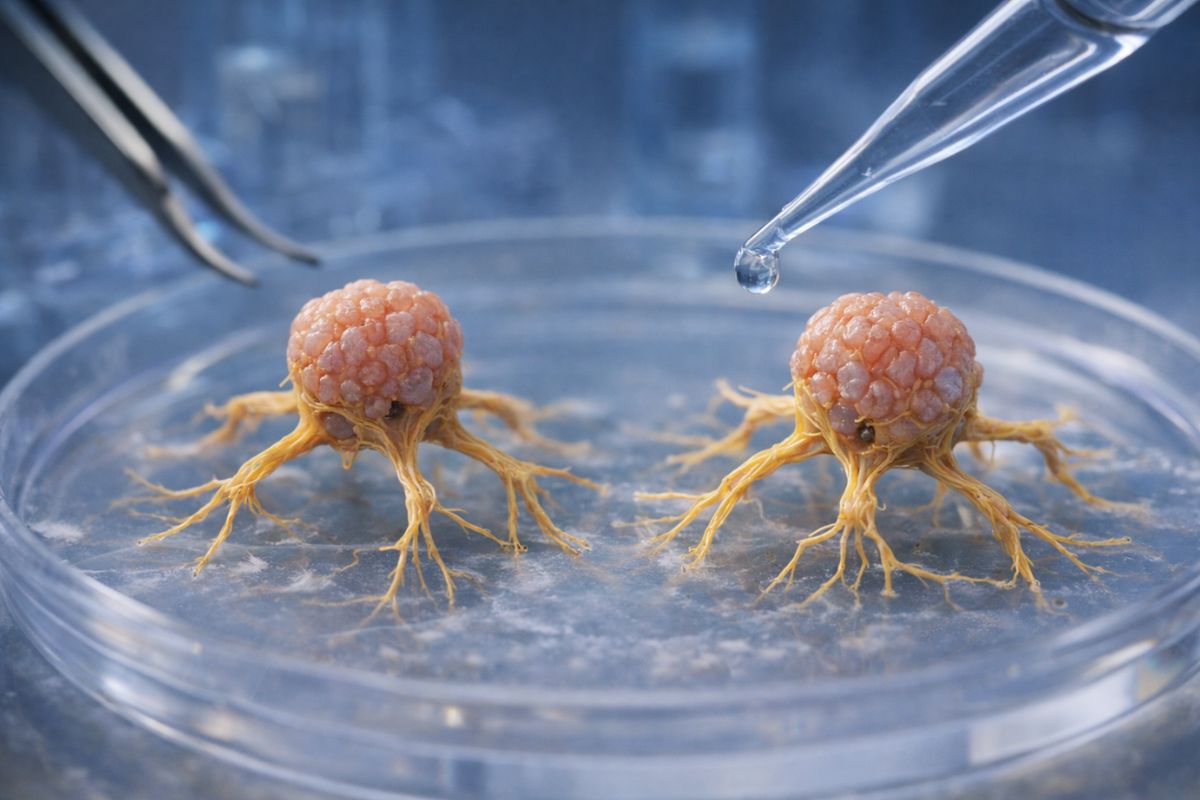
Neurobots are robots built with living frog cells that develop their own nervous system and move autonomously, an evolution of the xenobots created by biologist Michael Levin from Tufts University, and the next step is to build versions with human cells
Scientists have created robots made entirely of living frog cells that possess their own nervous system, swim on their own, explore the environment, and self-organize without any genetic engineering. Called neurobots, these artificial organisms represent the evolution of xenobots first described in 2020 and were published in the journal Advanced Science as the most advanced work of biologist Michael Levin from Tufts University and his collaborators.
According to Spectrum, what makes neurobots different from any other bioengineering project is that they do not imitate life: they are life. Instead of building biology-inspired robots, Michael Levin’s team built robots from biology, using living cells that mature, form nerve connections, and produce behaviors that do not exist anywhere in the natural world. And the team’s next step is even more ambitious: to add human neural cells to these living machines.
From xenobots to neurobots: how living cell robots gained a nervous system
The xenobots, created in 2020, were the first generation of robots built with living frog cells by Michael Levin’s lab.
-
Students create a solar-powered ambulance that operates without a plug, without fuel, and still keeps medical equipment running in remote areas.
-
French “ghost” submarine lost in World War II reappears after more than 80 years on the seabed near the coast of Spain.

-
A simple stitch in wood with nylon thread can reduce adhesives, speed up production, and make sheets up to 4 times stronger and 14 times more difficult to break.
-
The gigantic steel shell built to contain Chernobyl for a century has been pierced by a drone, exposing a critical system and creating a hole that could cost over 500 million euros to repair.


Built with a single type of structural cell, they could already propel themselves in water using cilia, survive for days without nutrients, and even self-replicate, spontaneously collecting loose stem cells from the environment.
Despite these impressive capabilities, the xenobots had a fundamental limitation: their behavior was essentially mechanical.
Their movements were driven by anatomy and physics, not by anything resembling internal control.
Neurobots fill this gap by incorporating neurons that mature from partially differentiated stem cells and form branched connections throughout the organism, creating circuits that transmit electrochemical signals from cell to cell.
Neurobots swim, explore, and respond to the environment in unprecedented ways
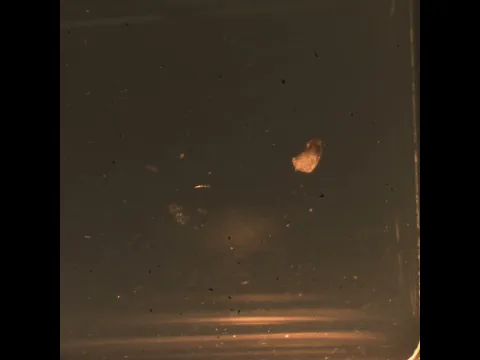

The difference between xenobots and neurobots is visible in behavior. Neurobots spend less time idle and more time exploring the environment, they follow winding and spiraling paths instead of simple trajectories, and respond differently to neuroactive drugs, demonstrating that the integrated nervous system truly influences their actions.
Under the microscope, these robots appear as irregular and translucent clusters of tissue, but coordinated movement reveals an emerging order.
Neurobots connect the electrical activity of neurons to observable physical movement, something no other laboratory model of living cells can do.
Unlike brain organoids or lab-on-a-chip technologies, neurobots move, swim, and interact with their surroundings, producing activity patterns that Michael Levin’s team is just beginning to decipher.
Living cells that self-organize without genetic engineering
One of the most surprising aspects of neurobots is that they form on their own.
When living cells are removed from their normal developmental context and cultured in simple saline conditions, they spontaneously self-organize into structures that move and act in ways that were not programmed.
There is no genetic manipulation involved. Carlos Gershenson, a computer scientist at Binghamton University who studies artificial life, explained that these robots are made with natural living cells, but organized by scientists in a way that nature would never produce.
Michael Levin questions where form and function come from when they are not the result of evolution or genetic engineering, and considers neurobots a model system to investigate exactly that question.
The next step: neurobots with human cells
Michael Levin’s team has already created a variation called “antrobots,” built with clusters of human lung cells instead of frog tissue.
The plan now is to add human neural cells to the antrobots, extending the structure of neurobots to a fully human context.
The idea is that these living machines can be conditioned and trained to perform specific tasks. Josh Bongard, a computer scientist and robotics expert at the University of Vermont, said that the hope is that it will be possible to teach these living cell robots to do what is desired, just like training a dog to sniff out explosives.
With additional enhancements, neurobots could be used in applications ranging from precise tissue repair to environmental cleanup, expanding the scope of what the original xenobots have already demonstrated to be possible.
Practical applications are already starting with first-generation xenobots
While neurobots are still in the research phase, first-generation xenobots are already being developed for commercial use.
Fauna Systems, a startup co-founded by Michael Levin and Josh Bongard, is initially focused on environmental sensing, planning to use xenobots in aquaculture, wastewater monitoring, and pollutant detection.
The logic is that these living cell robots can integrate multiple environmental signals simultaneously.
If the xenobots encounter a combination of stress factors such as heavy metals, changes in pH, and traces of agricultural runoff, their changes in movement can provide a real-time signal that something is wrong in the ecosystem.
The concept is inspired by cities in Poland that already use freshwater mussels as sentinels of water quality, but with potentially superior sensitivity and specificity.
Are we ready for robots made of human cells?
Michael Levin’s neurobots represent a leap beyond engineering: they are robots made of living cells that develop a nervous system, self-organize, and explore the environment without genetic programming.
With xenobots already moving towards commercial applications and neurobots with human cells on the horizon, the boundary between machine and living organism has never been so thin.
What do you think about robots built with human cells? Is this the future of medicine and the environment, or are we crossing a dangerous line? Leave your opinion in the comments.








Seja o primeiro a reagir!