






 Portuguese
  Spanish


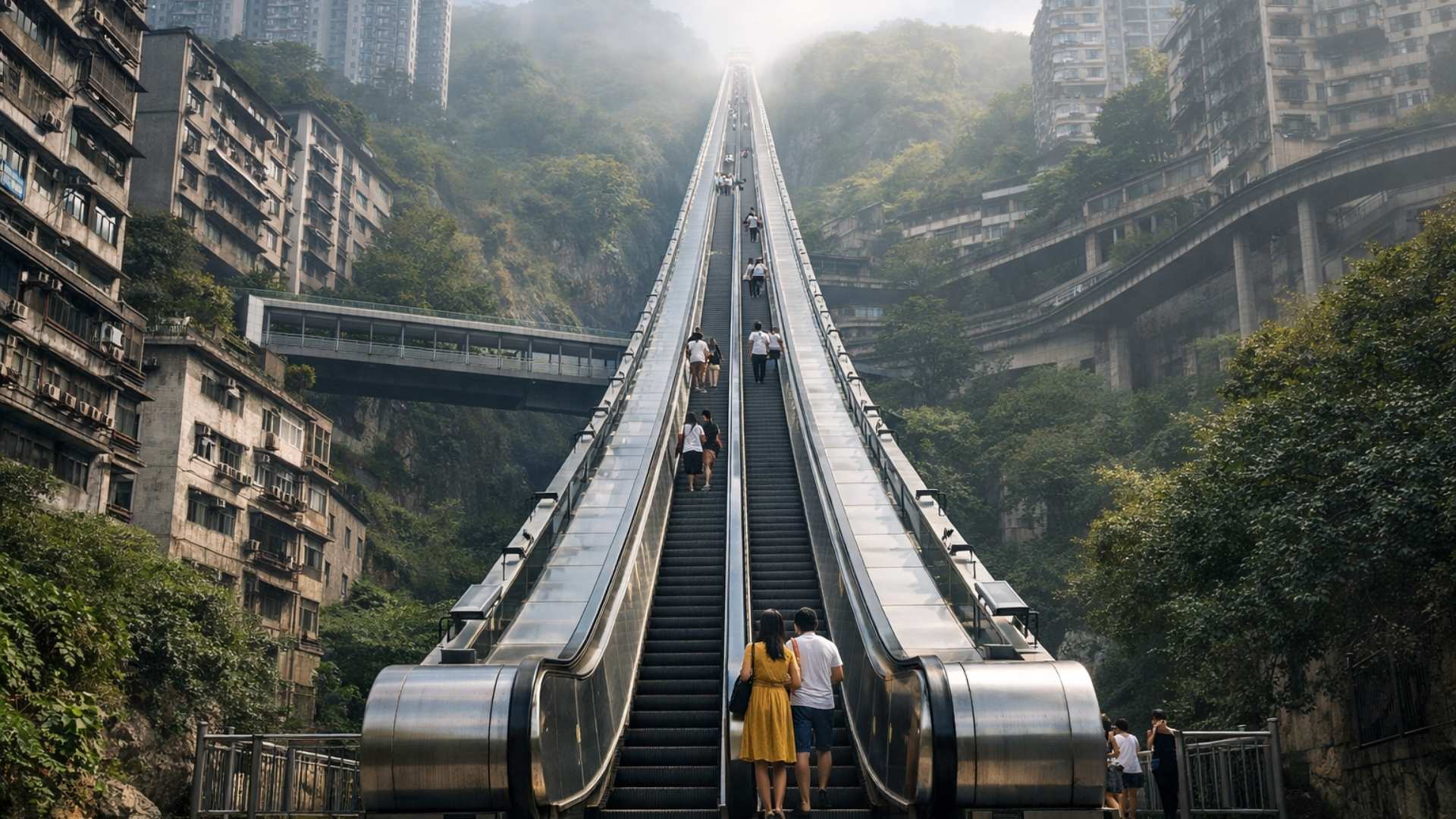


Structure transforms movement into a continuous vertical crossing, shortens paths in a city marked by extreme height differences, and reinforces how mobility works can also become points of interest for residents and visitors.
The Chinese city of Chongqing now features the largest urban escalator ever built, with a length of 905 meters and a height difference of over 240 meters, shortening a journey that previously took more than an hour on foot to about 20 minutes.
Designed to tackle the complex topography of the region, the structure connects different urban levels and directly addresses the historical mobility challenges in steep areas, common in one of the densest and most verticalized cities in the country.
Escalator in Chongqing changes urban mobility
Situated in a mountainous region, Chongqing is characterized by sloped streets, buildings at different heights, and urban connections that often require long walks, which motivated the adoption of vertical solutions integrated into the transportation system.
-
How to Prevent Brown Recluse Spider Bites: Common Hiding Spots and Free Tips to Reduce Risks

-
Natto: The Unusual Japanese Superfood Gaining Popularity on Social Media and Driving Record Exports
-
Brazilian Mayor Goes Undercover as Homeless for 24 Hours to Assess Public Services

-
15-Year-Old Entrepreneur Malu Lira Publishes 20 Children’s Books on Financial Education, Earns $500,000, and Expands Her Project to the Amazon Rainforest




In this context, the so-called Wushan Goddess Escalator emerges as a practical alternative for residents and visitors, allowing them to overcome a height difference equivalent to an approximately 80-story building without intense physical effort.
Before the inauguration, traveling between the points connected by the structure required extensive routes via staircases or winding paths, making the journey tiring and, in some cases, limiting access for the elderly or people with reduced mobility.
Integrated system combines stairs, elevators, and walkways
Despite the emphasis on the escalator’s length, the project is not limited to a single piece of equipment, but rather to a complete mobility system that includes elevators, walkways, and suspended bridges interconnected along the route.
This integration allows for continuous movement without significant interruptions, creating an efficient vertical corridor that connects different areas of the city and reduces the time spent on daily commutes.
At the same time, the project was designed to adapt to the existing urban environment, avoiding interventions that would compromise local circulation or cause major changes in the dynamics of the neighborhoods served.
Tourist infrastructure increases interest in the work
In addition to its practical function, the escalator has begun to attract visitors interested in the experience of traversing one of the largest systems of its kind in the world, especially as it offers privileged views of the surrounding landscape.
During the journey, it is possible to observe natural areas and sections associated with the Three Gorges region, transforming a previously exhausting commute into a contemplative activity, combining urban mobility with tourism.
This type of approach aligns with a growing trend in China to transform infrastructure works into tourist attractions, adding economic value and expanding the use of spaces beyond their original function.
8D city reinforces vertical solutions in China
Chongqing is often described as an “8D city”, a term used to illustrate its organization across multiple levels, where streets, buildings, and transportation systems coexist at different heights and urban layers.
In this scenario, solutions such as large escalators, public elevators, and elevated walkways become essential to ensure the mobility of the population, especially in areas where horizontal expansion is limited by the terrain.
The new structure fits into this already established urban model, reinforcing the importance of investments in infrastructure that consider local geographical characteristics and the real mobility needs of the population.
Natural landscape and environmental impact enter the debate
The project also aimed to preserve the natural landscape of the region, with a design that avoids blocking views and attempts to integrate into the environment, reducing the visual impact on areas of tourist and environmental interest.
Still, initiatives of this scale often generate discussions about potential environmental effects and about the transformation of the relationship between physical effort and access to natural areas, especially in places previously only reachable by trails.
These debates gain relevance as infrastructure works begin to also play a tourist role, influencing how visitors and residents interact with urban space and the surrounding environment.
The escalator in Chongqing exemplifies how engineering and urban planning can redefine mobility in cities with complex geography, while also introducing new dynamics of use and circulation in areas previously considered difficult to access.






