





 Portuguese
  English
  Spanish
  6 min of reading
  0 comments


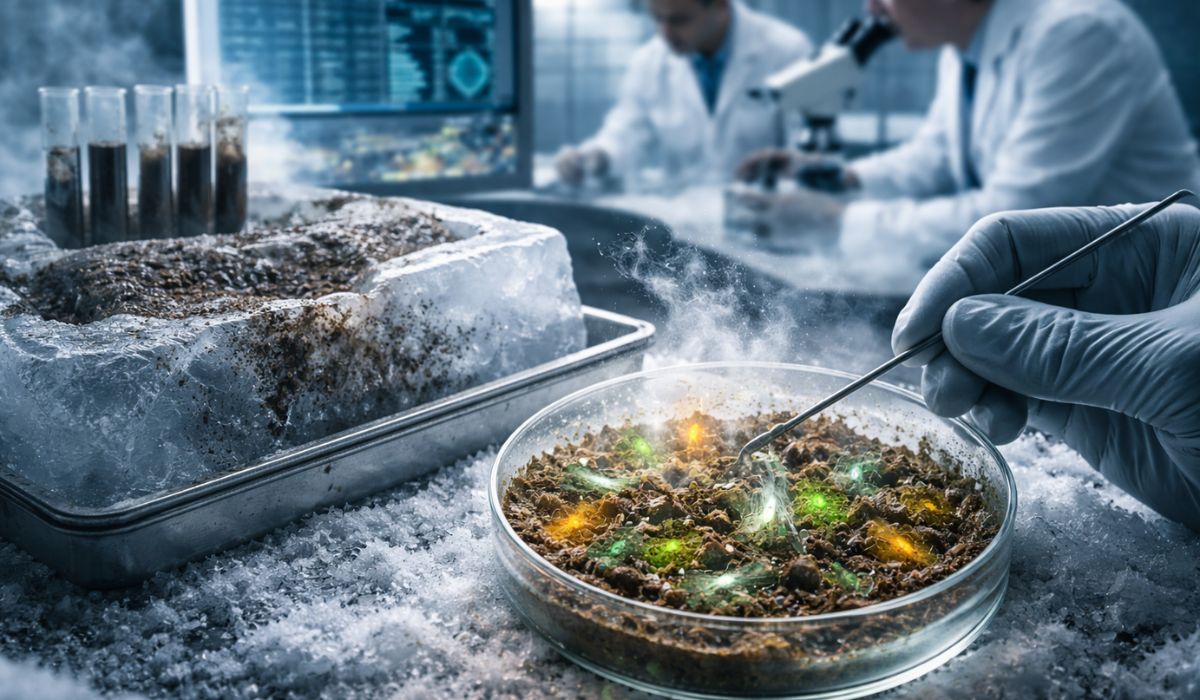
Study with microorganisms preserved in Alaska permafrost details how these forms of life resume activity after thawing and reignite the scientific debate about ancient carbon, natural emissions, and the effects of warming in the Arctic.
Ancient microbes resume activity in Alaska permafrost
Microorganisms that remained preserved in Alaska permafrost for up to about 40,000 years resumed activity after being thawed in the laboratory by a team from the University of Colorado Boulder.
According to the study, the organisms were not dead: after an initial period of low activity, they began to grow, reorganize their communities, and consume organic matter from the soil, a process that can result in the release of carbon dioxide and methane, two greenhouse gases.
The results were published in September 2025 in the Journal of Geophysical Research: Biogeosciences.
-
China is erecting a mega project in Tibet worth $167 billion and 60 GW that could become the largest individual source of energy in the world and, at the same time, one of the biggest geopolitical bombs in Asia.
-
Alone in space, a wandering planet without a star is consuming 6 billion tons per second, setting a record that challenges astronomy and reignites the debate on how planets and stars actually form.

-
Humanoid robots have already arrived in hospitals and are pushing wheelchairs, arranging beds, and interacting with patients. This advancement marks the shift of artificial intelligence from the digital world to direct physical care for human beings.

-
5 mysteries of the Moon that the Artemis missions could finally solve
The work draws attention from the scientific community because permafrost, the name given to soil that remains frozen for at least two consecutive years, is one of the largest carbon reserves on the planet.
In areas of the far north, this soil holds organic remains accumulated over millennia.
When the ice melts, microorganisms can resume metabolizing this material and transform part of it into gases that escape into the atmosphere.
Data from NSIDC and NOAA indicate that permafrost soils in the Northern Hemisphere store about twice the carbon currently present in the atmosphere.
Therefore, research on microbial activity in these areas is considered relevant for understanding potential effects of thawing on the climate.
Where the samples were collected in Alaska
The analyzed samples came from the Permafrost Tunnel Research Facility, maintained by the U.S. Army Corps of Engineers in the Fox area, about 16 miles from Fairbanks, Alaska.
The facility is used by researchers because it exposes ancient and preserved layers of frozen soil, with fossils, organic matter, and microorganisms kept in conditions that are difficult to reproduce on the surface.
Contrary to what was stated in the original text, the tunnel is not “107 meters below the ground”.
The official description states that the structure is about 110 meters long, is approximately 15 meters below the surface, and includes an additional sloped gallery that descends another 45 meters.
This configuration allows access to different layers of permafrost and analysis of materials of varying ages, including deposits formed in the Pleistocene.
It was in this environment that the team led by Tristan Caro collected permafrost samples ranging from a few thousand to tens of thousands of years old.
Subsequently, the scientists added water and incubated the material at temperatures of 4°C and 12°C, ranges chosen to simulate conditions associated with warmer periods in Alaska.
To monitor the resumption of biological activity, the group used water enriched with deuterium, which allowed them to observe how microorganisms incorporated this heavy hydrogen into their cell membranes.
What happened after thawing in the laboratory
The first signs of resumption occurred slowly.
According to the announcement from the University of Colorado Boulder and the summary of the article, microbial growth was very low at the beginning of the experiment, especially in the first 30 days after thawing.
In some cases, the renewal observed was equivalent to about one cell in every 100,000 per day, a rate significantly lower than that seen in bacterial colonies grown in laboratory conditions.
However, as the months progressed, this situation changed.
About six months after the start of the experiment, the analyzed communities showed greater biological activity and the formation of biofilms visible to the naked eye.
These biofilms are structures produced by microorganisms that begin to live in an aggregated manner, sharing resources and forming a protective matrix.
In the study, the appearance of these structures was treated as an indication that dormancy had been interrupted and that part of the community was again functional.
Instead of an immediate return, the experiment indicated a gradual process.
In a statement released by the university, Caro stated that the samples were far from dead and remained capable of sustaining robust life, capable of decomposing organic matter and releasing carbon dioxide.
The statement was presented by the researchers as a sign that deep freezing can preserve biological viability for extended periods, as long as environmental conditions allow for the resumption of metabolism.
Permafrost, carbon, and release of greenhouse gases
The central point of the research, according to the authors, is not just the survival of these ancient organisms.
The most relevant aspect is what happens when they resume acting on the carbon trapped in the soil.
By degrading organic remains preserved in permafrost, these microorganisms can produce carbon dioxide and methane, amplifying a concern already known in climate science: the risk that thawing will turn large frozen areas into liquid sources of emissions.
NOAA describes this mechanism as a climate feedback.
In this process, warming favors thawing; thawing exposes previously frozen organic matter; microorganisms begin to consume it and release greenhouse gases; these gases, in turn, contribute to intensifying warming.
The new research does not measure this effect on a planetary scale nor quantify how much of the deep reserves will be effectively mobilized in the coming decades, but it provides experimental evidence that very ancient microorganisms can resume activity when subjected to prolonged warming conditions.
Another point highlighted by the authors is that higher temperature alone did not seem to decisively accelerate the resumption of growth.
According to Caro, the most important factor may be the duration of the warm period, not just isolated peaks of heat.
In the team’s assessment, this suggests that longer summers in the Arctic may give microorganisms enough time to come out of dormancy and act more intensively in the thawed soil.
Warming Arctic and the advancement of research
The Arctic region is treated by researchers as one of the most sensitive areas to climate change.
NOAA reports that the Arctic is warming approximately three times faster than the global average.
Observational studies published in the journal Communications Earth & Environment indicate that, in certain historical series, this pace has reached nearly four times the planet’s average.
This context helps explain why the thawing of permafrost has come to occupy a central position in research on natural emissions.
In addition to Alaska, permafrost extends over large areas of the northern planet, such as Siberia, Canada, and Greenland.
The material examined by the team from the University of Colorado Boulder represents only a fraction of this system, as the author himself noted by highlighting that the group studied a very small portion of the permafrost existing in the world.
Still, the experiment adds a relevant piece of data to the scientific debate: ancient and deep layers, previously treated in many studies as relatively stable, may harbor microbial communities capable of resuming metabolic functions when the ice recedes.
The results do not allow definitive projections about the speed at which this process will occur in natural environments, as laboratory conditions do not fully reproduce the complexity of Arctic ecosystems.
Even so, the study reinforces, according to the authors, the need to more accurately monitor the biological behavior of permafrost in a scenario of longer warm seasons and progressive thawing of soil in the far north.






Seja o primeiro a reagir!