





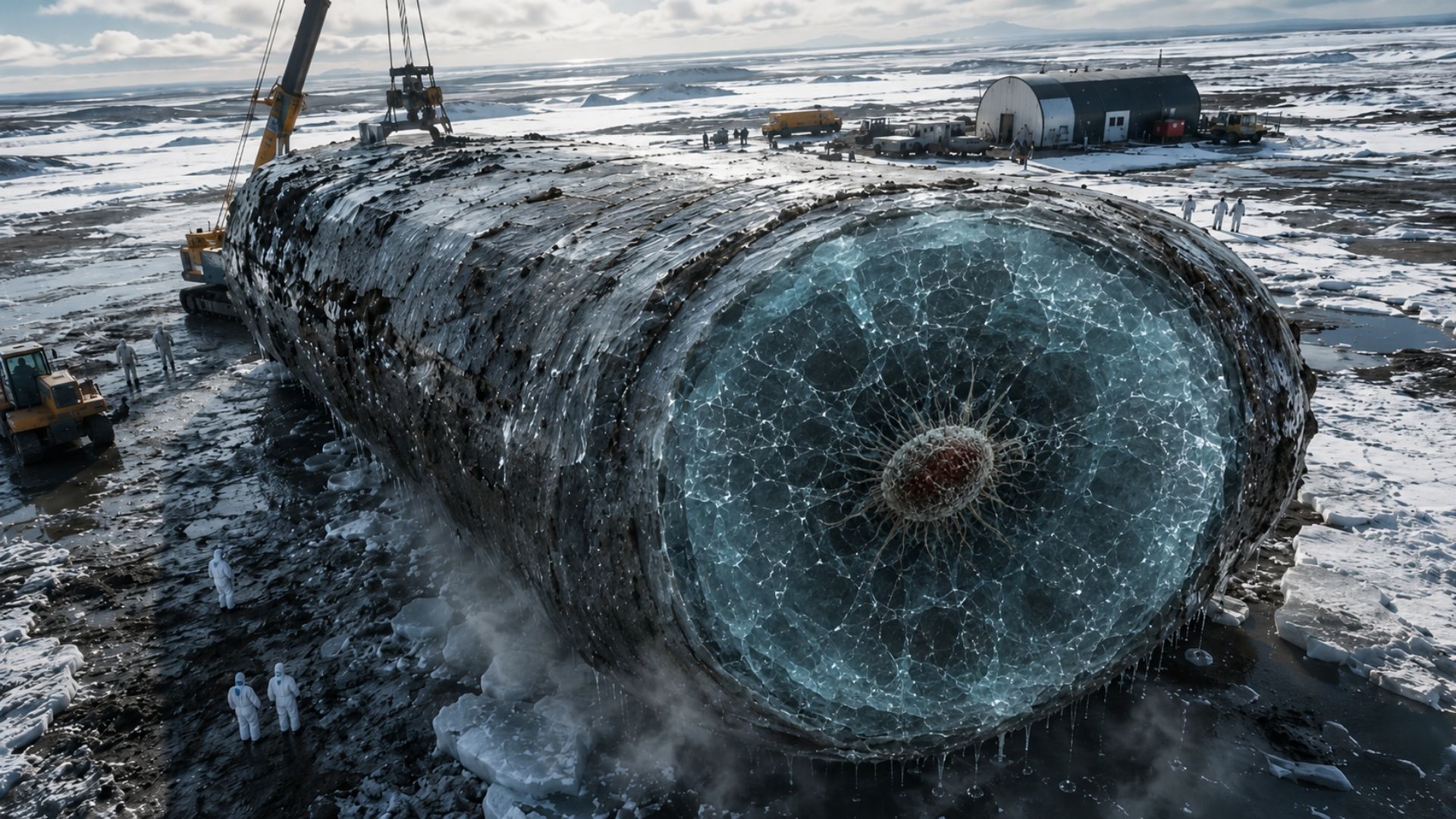

Buried in the frozen soil of Siberia since the Pleistocene, a giant virus named Pithovirus sibericum began to multiply again in the laboratory after being frozen in ice for more than 30,000 years. It is harmless to humans and animals, but what researchers saw afterward is much more concerning.
A sample of frozen soil taken from the autonomous region of Chukotka, in the far northeast of Siberia, contained a passenger that no one expected to find in working condition. Researchers from the Information Génomique et Structurale laboratory (CNRS/AMU), in partnership with teams from Biologie à Grande Echelle (CEA/INSERM/Université Joseph Fourier), Génoscope (CEA/CNRS), and the Russian Academy of Sciences, identified a giant virus over 30,000 years old, named Pithovirus sibericum. The study was published on the website of the Proceedings of the National Academy of Sciences of the United States in the week of March 3, 2014, and the particle described is 1.5 micrometers long by 0.5 micrometers wide, disproportionate dimensions for anything bearing the name of a virus.
What turned the discovery into a global topic was not just its age. After all this time immobilized in the permafrost, the virus was still capable of infecting and multiplying within amoebas, the cells it uses as hosts. For humans and animals, researchers are categorical: it is harmless. The concern came from another calculation. If a virus survived 30,000 years of freezing without losing its ability to infect, the Arctic ice ceases to be just a landscape and becomes a repository of still functional biological material, precisely at a time when global warming and the race for minerals and energy are beginning to disturb these layers.
An amphora-shaped virus that crossed the Pleistocene
The estimated age of Pithovirus sibericum places it in a very specific period of the planet’s history. More than 30,000 years means Upper Pleistocene, a time contemporary with the extinction of the Neanderthal man, as recorded by the French study itself. While the last Neanderthals were disappearing from Europe, that viral particle was already sealed in the Siberian subsoil, and there it remained for layers and layers of geological time.
-
Up to six weeks in advance come into the storm forecast horizon with a project that will analyze everything from large climate patterns to cloud processes and could help utilities, insurers, and communities prepare more in advance for severe weather conditions.

-
A giant of almost 5 tons abandoned by SpaceX is traveling through space at 8,700 km/h and will crash onto the Moon, causing an explosion equivalent to 3 tons of TNT, creating a new crater, and launching debris that could be observed from Earth.

-
Refrigerator with days numbered: Xiaomi creates a smart 621-liter version that works with Alexa, makes only 35 dB of noise, freezes 14 kg in 24 hours, and arrives with a surprising price in Europe

-
Harvesting 6.62 million tons and declining by 16% in the 2025 season, Brazil’s wheat production shrank contrary to the record grain harvest, in a cycle where the country remained dependent on imports.


The name is not decorative. Pithos, in Greek, is the large clay jar used for storage, and the particle has exactly that shape, an elongated body with an opening at one end. It was this shape that confused the researchers at first. The appearance pointed to an ancient relative of the Pandoravirus, and the genetic analysis debunked the entire hypothesis. The amphora shape, it was later discovered, is not the signature of just one family.
It is worth noting what the discovery means in terms of method. It was not an expedition in search of ancient viruses with a ready hypothesis. The team was studying frozen soil samples from Chukotka and found something that did not fit into any of the known categories, which is quite different from confirming a prior suspicion.
What makes a virus be called giant
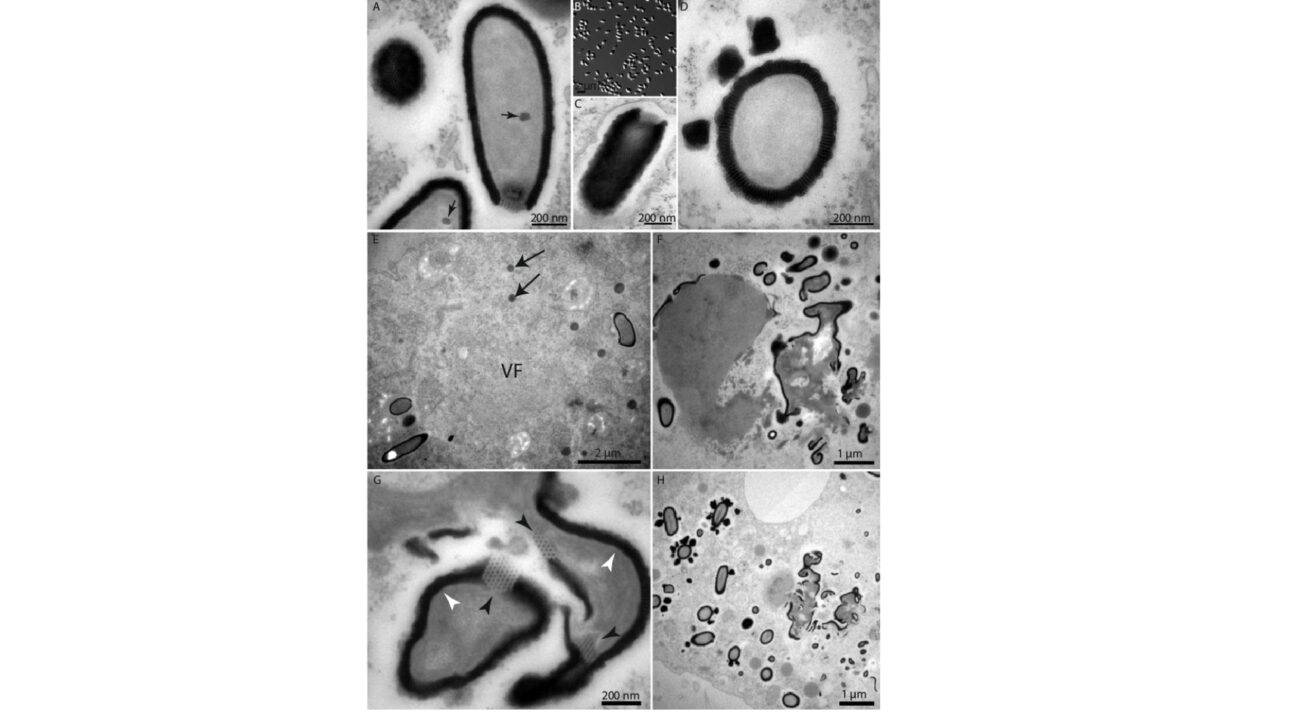
The definition is more concrete than it seems. A giant virus, in this literature, is one that exceeds 0.5 micrometers in diameter, which makes them the only viruses visible under a common optical microscope. All others only appear in electron microscopy. For comparison, a micrometer is one-thousandth of a millimeter, and the Pithovirus, at 1.5 micrometers long, is larger than many bacteria that any biology student observes in class.
The particle size is only half of the oddity. The other half is in the genetic content. Common viruses, like the flu or AIDS virus, carry around ten genes, enough to invade a cell and hijack its machinery. A giant virus operates on another scale: its genome is comparable in size to many bacteria, and sometimes larger. It is this imbalance between what a virus should be and what these particles actually carry that has been puzzling microbiology since 2003.
It was in that year that the Mimivirus appeared and opened the Megaviridae family. Years later came the Pandoraviridae. Until the arrival of the Pithovirus, researchers worked with the idea that these two families accounted for the diversity of known giant viruses. All of them, by the way, have in common the host: they infect amoebas, such as Acanthamoeba, unicellular organisms that live in soil and water.
Genome analysis dismantled the first hypothesis
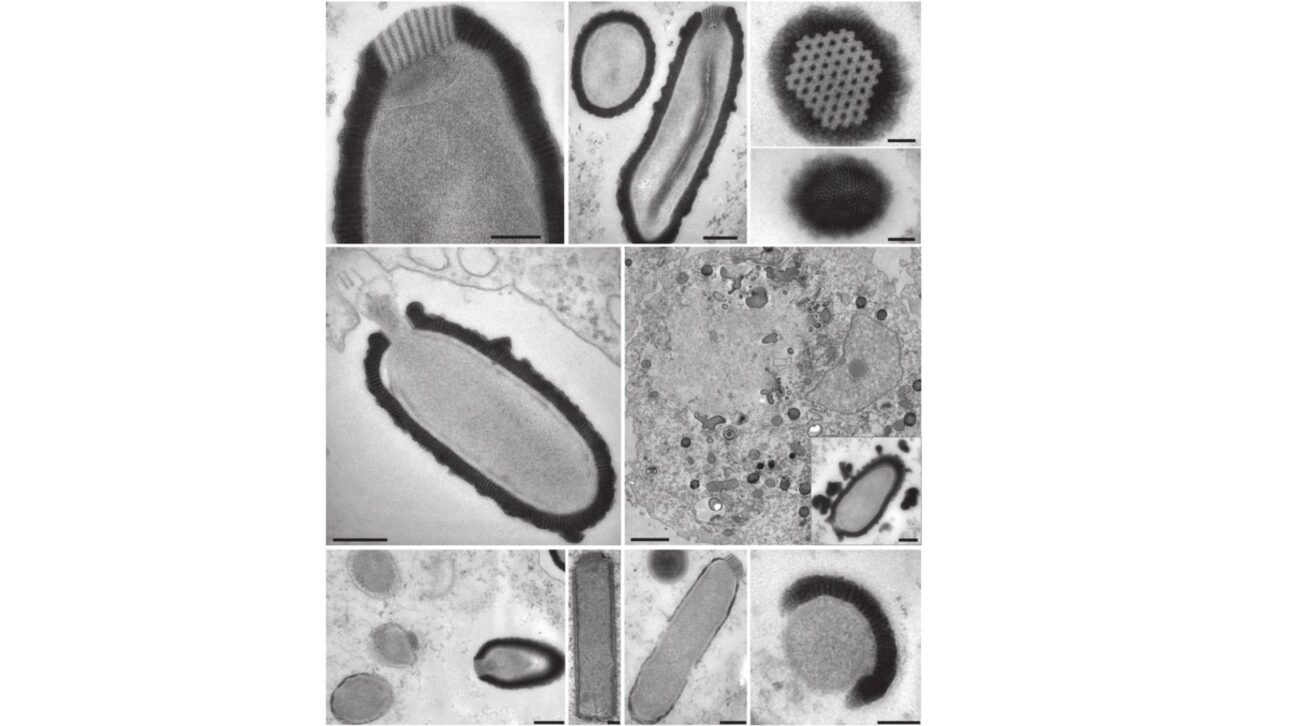
When the sequencing was completed, the result contradicted the visual impression. There is no genetic relationship between the Pithovirus and the Pandoravirus, despite the similarity in shape and size. And the most visible difference is in the number of genes: the Pithovirus genome has about 500, while the Pandoravirus genome reaches 2,500. It’s a large genome by viral standards, but five times smaller than the apparent cousin.
The protein comparison closed the argument. The researchers analyzed the proteome of the particle, that is, the set of proteins that compose it, and found hundreds of them. Of these hundreds, only one or two also exist in the Pandoravirus particle. Two structures practically identical on the outside and almost nothing in common on the inside: this is the picture that emerged from the French laboratory.
For those who follow taxonomy, the lesson is known and still holds true. External form does not define kinship. The same design can arise more than once in unrelated lineages, and in the microscopic world, where visual clues are scarce, betting on appearance is a recipe for classification error.
Multiplication occurs outside the amoeba’s nucleus
The second fundamental difference appeared when observing how each virus reproduces within the infected cell. The Pandoravirus relies on various functions that only exist in the amoeba’s nucleus to replicate. Meanwhile, the Pithovirus carries out almost the entire process in the cytoplasm, outside the nucleus, a typical behavior of large DNA viruses from the Megaviridae family.
Here appears the paradox that the authors highlight. The Pithovirus has a smaller genome than the Pandoravirus and yet seems to depend less on the amoeba’s cellular machinery to propagate. In other words, it carries fewer instructions and needs to borrow less. The degree of autonomy of a giant virus in relation to the host does not match the size of its genome, and the size of the genome also does not match the size of the particle that carries it.
These are three variables that intuition usually ties together, and the study shows them as separate: physical dimension, number of genes, and functional independence. Each follows its own path. This complicates any attempt to organize giant viruses by a single scale and explains why each new finding in this field tends to disrupt the previous classification instead of completing it.
A third family changes the map of giant viruses
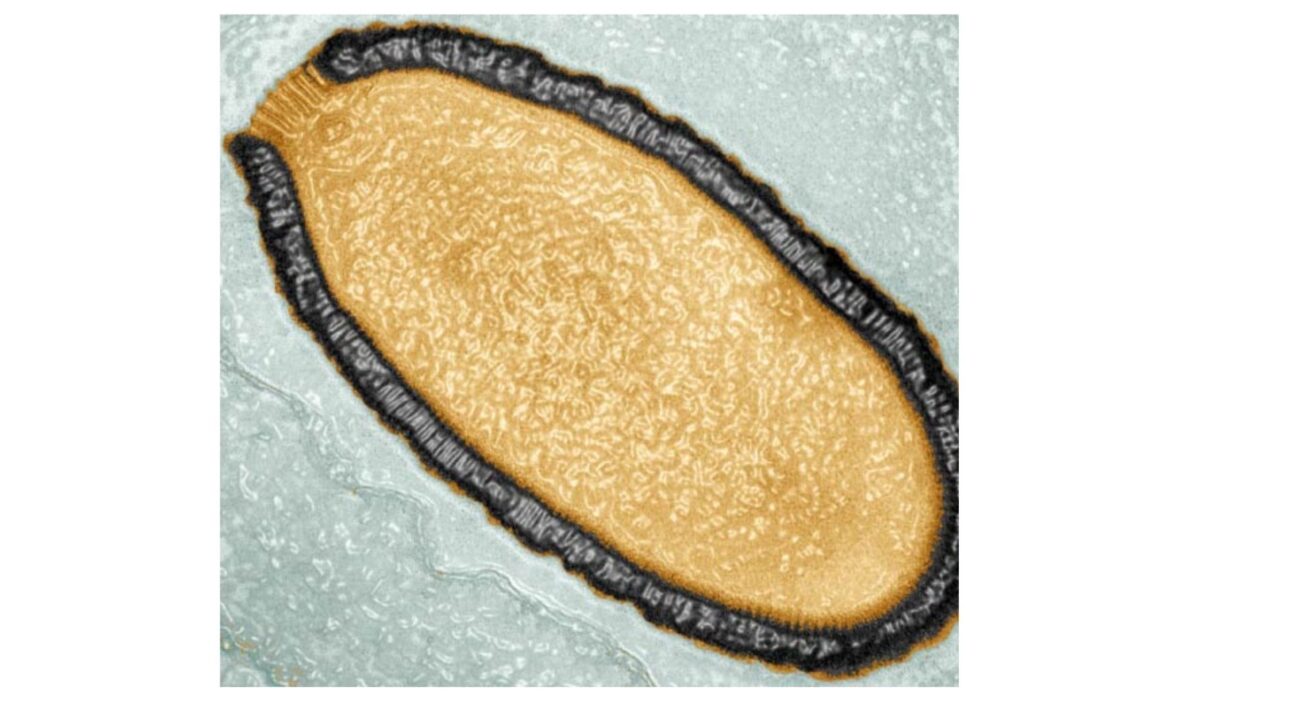
Bringing together genome, proteome, and replication mechanism, the conclusion of the work is that the Pithovirus has almost nothing in common with the giant viruses characterized until then. It is not an exotic member of an existing family. It is the first representative of a new family, which raises to three the number of distinct giant virus families known at that time.
The chronological detail matters. The discovery came shortly after that of the Pandoravirus, and two new families in quick succession suggest something that researchers put directly: amphora-shaped viruses might be as diverse as icosahedral viruses, that polyhedron shape that dominates the most known and widespread examples. If the hypothesis is correct, what has been found so far is the tip of a catalog that has barely begun to be opened.
The final reading that the study proposes is about method, not shock. Each new environment explored returns organisms that do not fit into existing categories, demonstrating how much the understanding of microscopic biodiversity is still incomplete. Frozen soil in Siberia was, until 2014, one of those little-explored places.
Permafrost functions as a biological archive
Permafrost is the layer of permanently frozen soil in arctic regions. It is not snow, it is not surface ice, it is earth that never thaws and therefore preserves whatever is inside it in stable temperature conditions for thousands of years. What the Pithovirus demonstrated is that this preservation also extends to viral particles in an infectious condition.
The study is explicit on this point: viruses can survive in permafrost for almost geological periods, over 30,000 years, a range that corresponds to the Late Pleistocene. It is not survival in the sense of identifiable remains or fragments of degraded genetic material. It is functional survival, with the capacity to infect and replicate preserved after millennia of freezing.
The difference between the two things is enormous for those who study risk. Finding ancient DNA in sediment has been routine in paleogenomics for decades and poses no threat. Finding a particle capable of resuming the infection cycle as soon as conditions allow is another category of finding, and it was this that appeared in the Chukotka sample.
Why the discovery became a public health issue
The most cited part of the work does not talk about taxonomy. The authors point out relevant public health risk implications linked to the exploration of mineral and energy resources in circumpolar regions, an activity that tends to grow as global warming makes these areas more accessible. Mining and drilling in the Arctic mean removing, heating, and disturbing precisely the layers that were sealed.
The following sentence from the study is even more direct. The resurgence of viruses considered eradicated, such as smallpox, whose replication process is similar to that of the Pithovirus, is no longer science fiction. It is not about stating that this will happen, but rather recognizing that the hypothesis has moved from the realm of imagination to the realm of things that need to be calculated. The probability of this type of scenario, the authors argue, needs to be estimated realistically.
It is worth clearly separating the two ends of the reasoning to avoid distorting what was said. The similarity cited between smallpox and the Pithovirus is in the replication mechanism, not in kinship or danger. The Pithovirus does not infect humans. What its case proves is the principle: a virus with this type of multiplication strategy can survive millennia in ice without disintegrating.
What the study does not claim
No part of the work suggests that Pithovirus sibericum poses a threat to people. The research states the opposite, more than once: it is harmless to humans and animals. Its targets are amoebas, and it was in amoeba culture that researchers observed the complete cycle of infection and multiplication.
There is also no mention in the study of an outbreak, contagion, or immediate risk. The concern raised is statistical and long-term, about what else might be stored in the permafrost, and not about this specific virus. The confusion between the two is the most common error in the coverage of this type of discovery, and it arises from combining two true pieces of information that are in different paragraphs of the same text.
The distinction matters because it completely changes the type of response the discovery demands. A dangerous virus circulating would require epidemiological surveillance. A reservoir of unknown viruses being opened by economic activity requires inventory, research, and risk assessment before the machines arrive.
The researchers’ response was to go after the rest
The Information Génomique et Structurale laboratory did not stop at the description of the new family. With support from the France-Génomique infrastructure, created under the French national program Investments for the Future, the team was already, at the time of publication, conducting a metagenomic study of the permafrost.
Metagenomics is the approach that allows sequencing all the genetic material present in an environmental sample without needing to isolate and cultivate each organism separately. Applied to frozen soil, it functions as an inventory: instead of searching for one virus at a time, it maps what exists in that volume of earth. It is the attempt to answer the question that the Pithovirus left open, which is precisely to know the size of the collection before it starts to thaw.
The announcement came out in March 2014, and this is the snapshot of that moment. The discovery of Pithovirus sibericum did not close the subject of giant viruses, but rather showed that the list of known families grows every time someone looks at an environment that no one had thoroughly explored.
The ice preserved, and now it is returning
A 1.5-micrometer particle found in frozen Siberian soil reorganized an entire classification, created a third family of giant viruses, and posed a question that science prefers to answer with data rather than guesswork. It remained dormant for 30,000 years. It returned functioning.
And there lies the point that generates the most discussion: the Arctic is warming, and resource exploration is advancing into it. Do you think the world should map what exists in the permafrost before allowing mining and drilling in these areas, or is this an exaggerated concern about something that has remained undisturbed for thousands of years? Comment below on what you would do if you were in the decision-maker’s place.


