





 Portuguese
  English
  Spanish
  3 min of reading
  0 comments


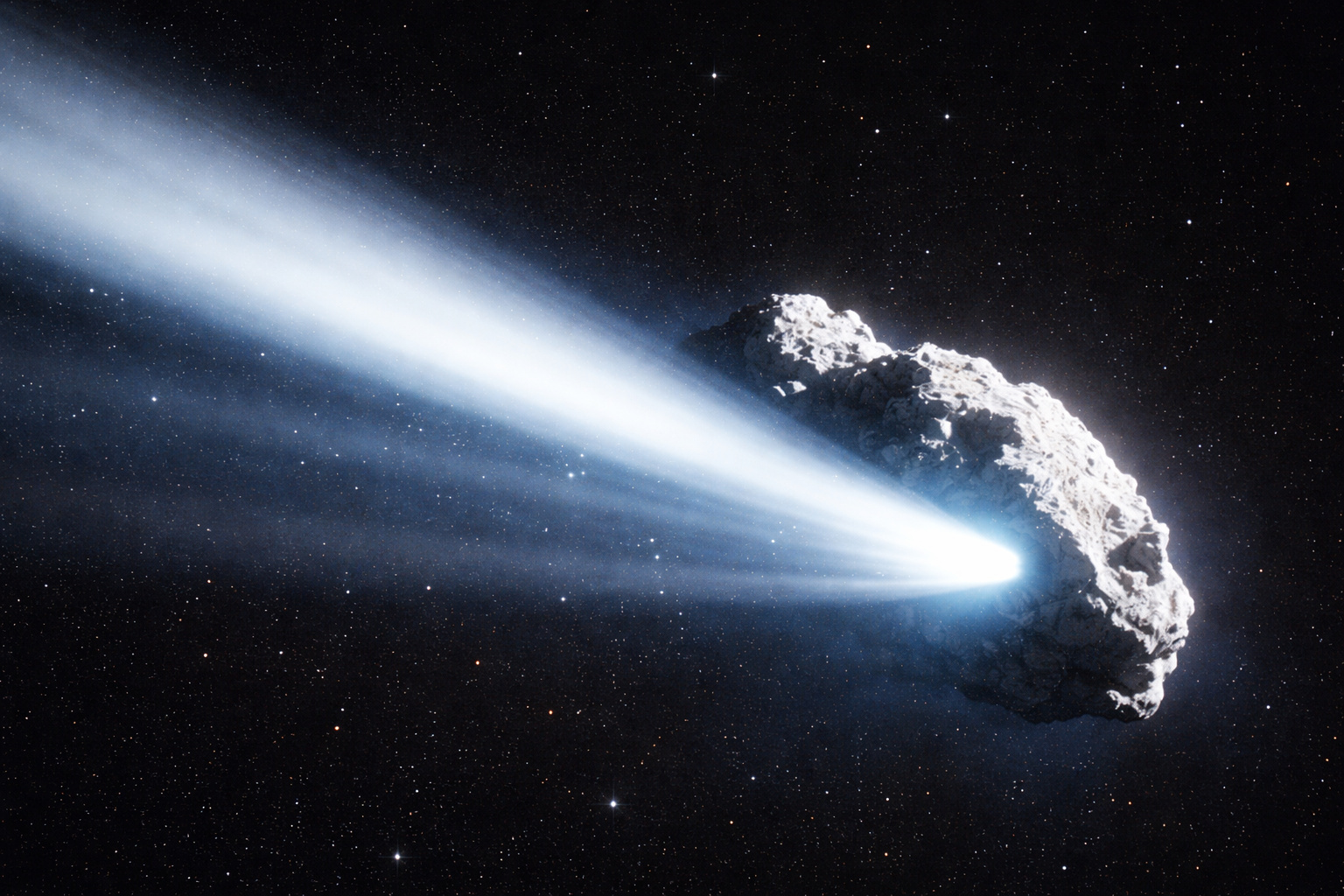
NASA captured for the first time the comet that began to release gases and changed rotation surprising scientists and reveals that objects in space can undergo rapid changes near Earth
A group of scientists warns that a comet may have completely changed the way it spins in space and this could lead to its destruction in a short time. It was captured for the first time by NASA and the situation draws attention because it shows that space objects can change quickly.
This type of event raises questions about the behavior of bodies that pass close to Earth, as such changes can happen without warning. The case involves the comet called 41P, which exhibited a rare transformation.
Comet began to spin in reverse and surprised scientists
The investigation was published by the Astronomical Journal, an international scientific journal specializing in astronomy. The study showed that the comet 41P may have reversed its rotation, something never seen before.
-
These living root bridges and ladders are over 700 years old and help indigenous people survive in one of the rainiest regions in the world.

-
From sertanejo star to international investor: Ana Castela invests millions in a mansion in the USA, creates a themed accommodation in Orlando, and shows that the “boiadeira” also wants to grow away from the stage.

-
The 10 most stunning motorhomes in the world: a $3 million trailer with a rooftop nightclub and garage for a Ferrari, “palaces on wheels” with Italian marble, private cinema, and five-star hotel luxury for billionaires.

-
Trump wanted to spend $400 million on the White House, but the courts prohibited the million-dollar construction.

Between April and December 2017, the comet began to spin in the opposite direction. This happened because it started to release gases, which acted as a push in space.

This push made the comet decelerate, stop, and then spin in reverse, which caught the attention of the scientific community.
Gases acted like a motor and changed everything
The heat from the Sun hit the comet and caused part of the ice to turn into gas. This gas was released forcefully and acted as if it were a small engine.
This effect caused the comet to first lose speed until it stopped. After that, it began to spin again, but now in the opposite direction.
Astronomical Journal, an international scientific journal specializing in astronomy, detailed that this process may explain all the changes observed in space.
Rotation accelerated and may lead the comet to destruction
After the reversal, the comet began to spin faster and faster. In December 2017, it was completing a rotation in about 14 hours, much faster than before.
This increase can be dangerous. If it continues like this, the very force of the spin may overcome the comet’s gravity.
When that happens, it may simply break into several pieces.


Small comets can disappear faster than one might think
The comet 41P is about 1 kilometer in size, considered small in space. This makes it more vulnerable to this type of change.
Objects of this size can accelerate very quickly and end up disappearing in a short time. This helps explain why there are few small comets.
This behavior shows that not everything in space is as stable as it seems.
Scientists still don’t know when this will happen
There is a possibility that the comet will disintegrate in a few decades. The exact time cannot yet be defined because the gas release may change.
Even so, the trend indicates that the process is already underway and may advance rapidly. This type of event serves as a warning about how space can change unexpectedly.
Phenomenon shows that not everything in space lasts forever
The idea that everything in space is eternal is not entirely true. Some objects can disappear in a relatively short period.
The case of comet 41P shows that internal changes can lead to the complete destruction of a space body. This reinforces the importance of observing and studying these phenomena, especially those that pass close to Earth.
What do you think of this discovery? Leave your comment and share with those who enjoy curiosities about space.







Seja o primeiro a reagir!