





 Portuguese
  English
  Spanish
  6 min of reading
  2 comments


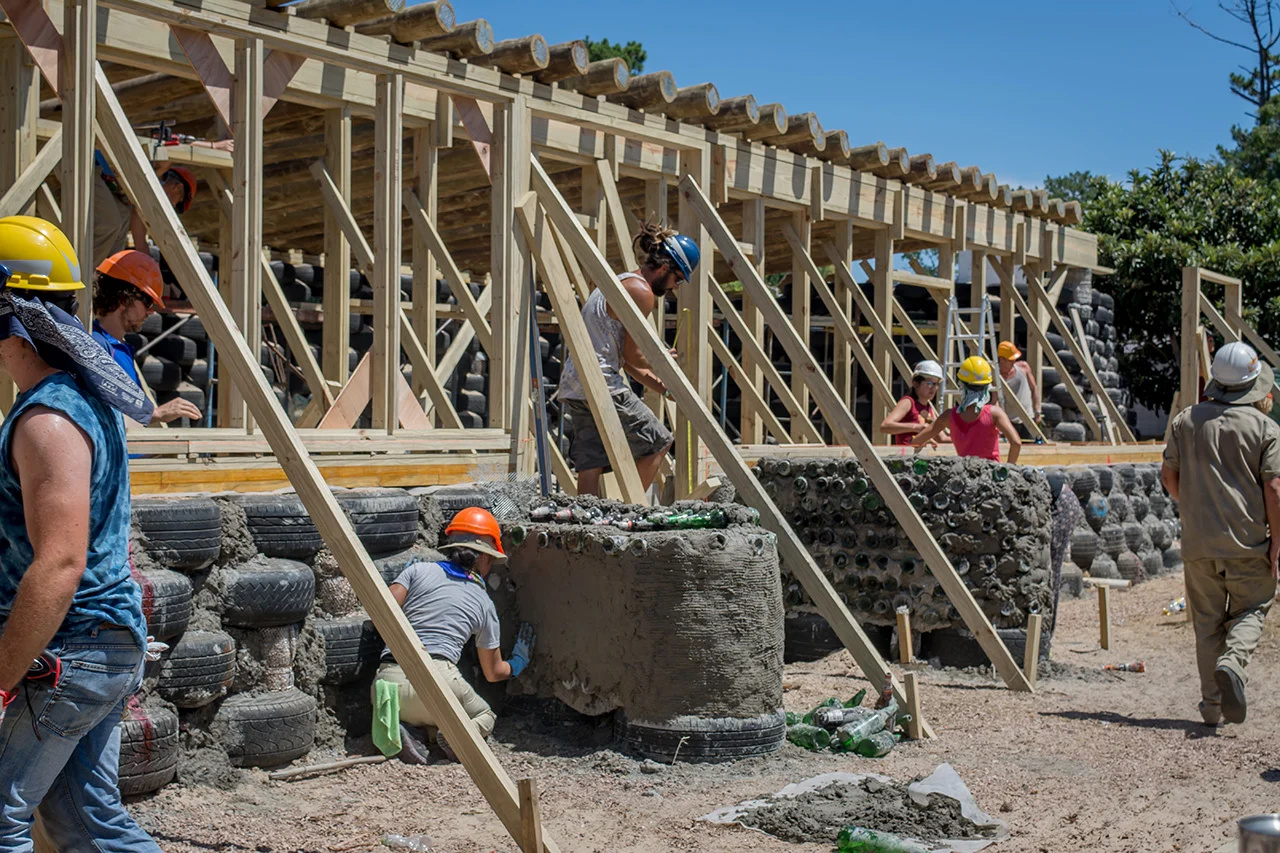


Volunteers From 30 Countries Built In Uruguay The First Self-Sufficient Public School In Latin America, Made With Tyres, Bottles, And Earth, Turning Waste Into Sustainable Architecture.
In January 2016, people from 30 different countries arrived in Jaureguiberry, a small coastal community in Uruguay. They were not engineers hired by a construction company. They were volunteers — students, architects, curious individuals, and local residents who came to learn a construction method that uses as raw material what the rest of the world discards: old tyres, glass bottles, aluminum cans, and the very earth of the ground. Seven weeks later, the first self-sufficient public school in Latin America was standing.
The Waste That Turned Into Walls
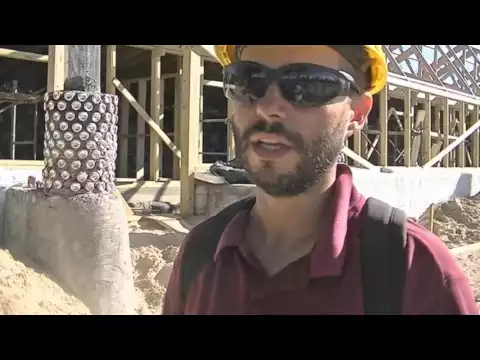
The technique used in the construction is called Earthship Biotecture and was developed by American architect Michael Reynolds since the 1970s in the New Mexico desert. The central idea is so simple that it seems improvised: take discarded tyres, fill them with damp earth with a sledgehammer until they are completely compacted, and stack them in layers to form the structural walls of the building.
Each filled tyre weighs about 130 kilograms and functions as a high thermal mass brick. Stacked and filled, they form walls that absorb heat during the day and release it slowly at night, regulating the internal temperature without the need for air conditioning, heaters, or any climate control systems.
-
The lack of welders, electricians, and operators becomes a structural threat in 2025, with the construction industry and manufacturing already suffering from delays, cost pressures, and labor shortages in Brazil.
-
Brazil and Paraguay are just 46 meters away from a historic union on the bioceanic bridge that promises to revolutionize trade between the Atlantic and the Pacific.

-
With 55 km over the sea, a cost of US$ 20 billion, and enough steel to build 60 Eiffel Towers, China’s largest project has connected Hong Kong, Zhuhai, and Macau in a colossal bridge that defies the logic of engineering.

-
A trick with joint compound transforms a Styrofoam ceiling into a plaster-like ceiling: leveled panels, wires and mesh at the joints, sand, paint, and change the environment while spending little today.


The result, tested in hundreds of constructions around the world over five decades, is an internal temperature that remains stable around 22°C regardless of the external climate.
The internal walls complete the system. Glass bottles are fitted in mortar to form translucent panels that let in natural light while creating a decorative effect. Aluminum cans are inserted in the same way.

Cardboard is used as insulation in layers of the roof. In total, 60% of the materials used in the Jaureguiberry school were recycled: 2,000 tyres, 5,000 glass bottles, 8,000 aluminum cans, and 2,000 square meters of cardboard.
270 Square Meters Raised In Seven Weeks
The school occupies 270 square meters and houses three classrooms and two service wings, distributed along a glass-walled corridor facing north, the orientation that, in the southern hemisphere, maximizes sunlight capture during winter. This choice is not aesthetic.
It is the same logic an engineer applies when designing the position of windows in a conventional building, adapted to work without mechanical climate control systems.
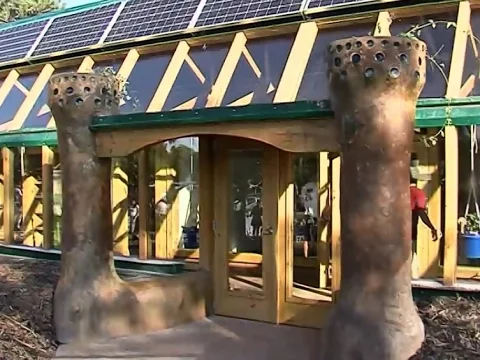

In summer, convective tubes installed in the structure capture fresh air from outside through the lower openings and expel hot air through the upper ones — cross circulation due to temperature difference, without fan, without motor.
In winter, these same tubes can be closed, and the glass-walled corridor functions as a greenhouse that warms the air before circulating it through the classrooms.
The construction was carried out by 150 to 200 volunteers from 30 nationalities, coordinated by the Uruguayan NGO TAGMA — whose name comes from Greek and means “something that comes together in an orderly way to form a unit” — in partnership with Reynolds’ team.
The project received formal authorization from the Uruguayan Council of Initial and Primary Education (CEIP) and was built between January and March 2016.
No Electricity Bills, No Water Bills, No Outside Dependencies
The Jaureguiberry school is not connected to the electrical grid. Electricity comes from photovoltaic panels and wind turbines installed in the building itself, stored in batteries. There is no energy bill to pay.
The water also does not come from the public network. Rainwater is collected from the roof, directed by gutters to a cistern with a capacity of 33,000 liters, and filtered before use.
This water supplies the sinks, feeds the garden, and, after treatment, is reused in the toilets’ cisterns. The water discarded by the toilets goes through natural treatment in wells made with truck tyres and through a wetland outside the building, without generating conventional effluent.
The north corridor houses an internal garden that produces food using treated gray water for irrigation. The school grows its own vegetables inside the classrooms — not as an optional pedagogical project, but as part of the system that makes the building function.
Fifty Years Of Waste Turning Into Homes
The story behind this method begins in the 1970s when Michael Reynolds, freshly graduated from Cincinnati University, faced two problems at the same time: the growing volume of tyres and packaging that the United States did not know how to discard, and the need to create low-cost housing for populations without access to the conventional market.

Reynolds spent decades testing materials in the desert of Taos, New Mexico, building an experimental community that now serves as a permanent laboratory.
In fifty years, he has built about 2,000 buildings in different countries, including emergency shelters in Haiti after the 2010 earthquake and a school in Easter Island with bottles and cans collected by the local residents themselves.
The school in Uruguay represented a specific step: the first time the method was applied in a public school approved by a national education system in Latin America. The Uruguayan government’s authorization was not symbolic. It involved technical verification of the structure, validation of the water and energy systems, and approval for continuous use by children from the community. Currently, the school serves 45 students from the Jaureguiberry area, a community of about 500 inhabitants.
What The Technique Demands And What It Does Not Solve
The Earthship method is not universal. Compacting tyres with a sledgehammer is physically demanding and slow — each tyre can take 20 to 30 minutes to be filled correctly.
The number of available volunteers was decisive for the school to be completed in seven weeks. In smaller projects, the construction time is much longer per person.

The technique works especially well in climates with large thermal variations between day and night, where the thermal mass of the walls has more work to do. In humid tropical climates, like much of Brazil, the thermal behavior is different and requires adaptations in the design.
Reynolds acknowledges the need for regional adjustment and recommends that each project be adapted to local climate conditions, including solar orientation, rainfall regime, and average ground temperature.
Used tyres also raise questions regarding their chemical composition. Research indicates that tyres compacted with earth and coated with mortar do not release toxic substances under normal conditions, but the technical debate still exists and varies according to the type of tyre and coating used.
The Bill That No Longer Exists
The total cost of the Jaureguiberry school was 300,000 dollars — an amount that includes the transportation and accommodation of Reynolds’ team, traditional materials that make up the 40% non-recycled part of the construction, and all the energy and water collection infrastructure.
Divided by the 270 square meters, it represents a cost per square meter comparable to conventional construction of a similar standard.
The difference lies in what happens after delivery. A conventional school of the same size would pay monthly bills for electricity, treated water, and maintenance of climate control systems. The Jaureguiberry school does not pay any of these bills.
The monthly operating cost is close to zero — and this calculation completely changes the long-term economic equation for communities that do not have reliable urban infrastructure.

The material that turned into walls would still be waste if it weren’t for the project. The 2,000 tyres used in the construction — which represent just a fraction of the billions that the world discards every year without destination — are now inside a building where children from a community of 500 inhabitants learn. And the school has not paid a single electricity bill since it opened its doors.









A ideia é de um arquiteto e vocês fazem uma machete dessa. Vcs foram totalmente desrespeitosos com a classe, que já sofre por não ter trabalho suficiente já que o povo insiste em fazer o ra sozinho e nem sabe pra quê serve um arquiteto. Desserviço. Nunca mais acesso um link sequer de vocês.
Falta de respeito para com os arquitetos. Como se o custo de projeto arquitetônico e acompanhamento de obra, que gira em 3%, no máximo, fosse tal que coibisse a execução de alguma obra. E por tratar-se claramente de obra feita em mutirão, entidades e profissionais teriam participado de bom grado, gratuitamente. Não reconhecem aí na Petróleo e Gás a importância de técnicos habilitados? Não valorizam a contribuição de engenheiros e arquitetos na melhor resolução de problemas? Pensaram que; se houvesse arquitetos cooperando no mutirão, poderiam criar soluções mais inteligentes, econômicas e racionais? **** e constrangedor o texto já na primeira frase. Terá tudo um profissional habilitado por detrás dele? Parece que não. E o inacreditável nisto tudo; tudo decorreu do trabalho de um arquiteto, desde o desenvolvimento da tecnologia, até conclusão da obra. Inacreditável.