





 Portuguese
  English
  Spanish
  6 min of reading
  22 comments


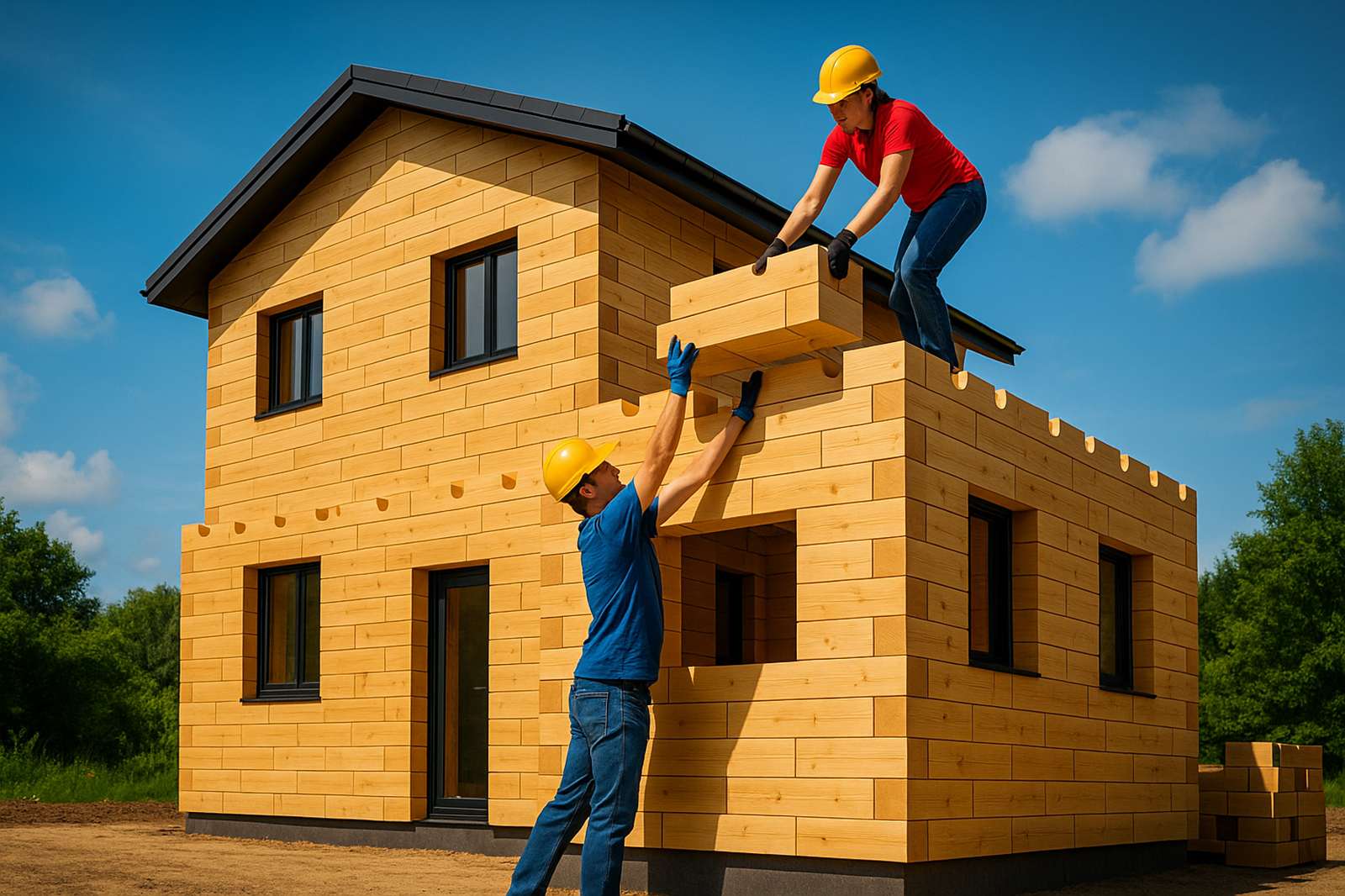


A Technique Created By A Belgian Architect Allows You To Build A Complete House From Wood Blocks That Fit Together Without Cement, Without A Large Team, And With Clean Assembly From Start To Finish
In just five days, two people built a two-story house using wood blocks that fit together like Lego pieces, without cement, without the noise of a concrete mixer, and without a team of bricklayers.
The scene might seem like an exaggeration from a viral video, but it summarizes a real trend in construction: modular systems of prefabricated blocks that promise to reduce timelines, waste, and costs.
The most well-known model today in the international market is Gablok, created by a Belgian architect specifically to simplify traditional construction and make it more sustainable.
-
With over 14 million baskets of earth moved, an ancient North American metropolis built a monumental pyramid of 30 meters and established a city with 20,000 inhabitants nearly a thousand years ago.

-
A 1,900-year-old treasure emerges from a Roman house destroyed by fire and sealed since antiquity in Romania, with coins and metals fused among the ashes.
-
The Brazilian colonial city that stopped in time and shares territory with a rocket launch base.

-
79-year-old woman challenges limits, visits 193 countries in the world after 56 years of planning and reveals the behind-the-scenes of a global journey that few have managed to accomplish.


What The System Is And How It Was Born

The system was developed by Belgian architect Gabriel Lakatos, who has over two decades of experience in traditional construction.
Frustrated by project delays, material waste, and difficult-to-control costs, he designed a method based on interlocking wooden blocks that assemble like building toys. The idea began developing in 2018 and received international patent shortly after.
The company created to explore the technology was named Gablok and started providing complete kits for self-construction mainly in Belgium and other European countries.
The principle is always the same: the client sends the project, the company adapts the plan for the block module, cuts all the pieces in the factory, and delivers a numbered kit, accompanied by an assembly plan.
What The Blocks Are Made Of

The blocks are not solid common wood. The system combines OSB panels – a structural panel made of pressed wood chips – with a core of expanded polystyrene (EPS) with graphite additive that improves thermal performance.
Each block is light enough to be carried by one person, weighing around 7 to 9 kilograms, depending on the model. This allows for stacking, testing fits, disassembling, and redoing sections without extreme physical effort or the use of cranes.
The set includes straight blocks, corner pieces, locking components, lintels for doors and windows, and specific elements for slabs and upper floors.
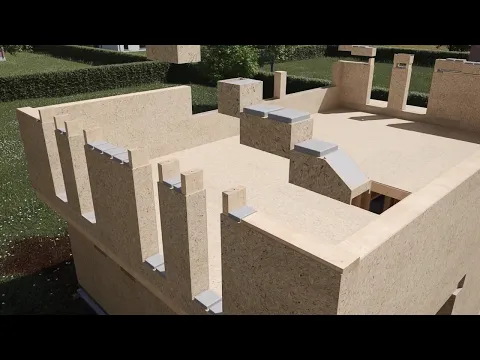
The geometry is designed so that the blocks fit together precisely, eliminating the need for mortar between the rows. The EPS insulation, in addition to providing thermal comfort, also plays a role in the fitting since part of the material slides to create the “tooth” that holds one block to another.

What The Step By Step Of The Construction Is Like
Despite the appearance of a “giant Lego,” construction doesn’t start with the blocks. First, it is necessary to execute the foundation – usually a slab or beam system approved by an engineer, according to local regulations. Only after the base is ready does the block kit come into play.
The company provides a detailed assembly plan, like an instruction manual. From there, two or three people with simple tools like a level, ladder, and screwdriver can quickly raise the external and internal walls. Reports from constructions indicate that the “shell” of a house of about 100 square meters can be erected in five to six days of work.
Once the walls are assembled, traditional steps follow: roof structure, tiles, frames, electrical and plumbing installations, and internal and external coverings. The system saves a lot of time in the masonry and wall structure phase, but does not completely eliminate the need for other construction trades.

Thermal Performance And Comfort
One of the system’s strong points is insulation. According to technical data from the company and independent studies, a wall built with the blocks achieves a U-value of around 0.15 W/m²K, which indicates low heat loss. In many European countries, the standard requirement for walls is around 0.24 W/m²K, which means the system goes beyond the regulatory minimum and approaches the performance of nearly passive houses.
In practice, this means less need for heating in winter and reduced energy consumption over the house’s lifetime. In hot regions, good insulation also helps to reduce external heat gain, keeping the interior more stable and decreasing the load on air conditioning when used.
Regarding acoustic comfort, studies cited in articles about modular construction indicate that lightweight wood systems with insulating fill can reduce noise with performance comparable to or better than well-executed conventional walls, provided the sealing details and finishing layer are respected.

Sustainability And Waste Reduction
Another central argument is environmental impact. Since the blocks are cut and assembled in a factory, the system arrives at the construction site with practically the exact number of pieces, reducing the volume of excess, debris, and transport of loose materials.
The OSB is made from reforested wood and utilizes chips and fibers, which increases the yield of raw material. The EPS with graphite, in turn, requires low water and energy consumption in its manufacturing process and is fully recyclable.
Academic reviews on modular construction suggest that systems similar to Gablok can reduce carbon emissions associated with the construction phase by about 30 percent compared to conventional masonry and concrete construction, mainly due to lower mass and efficient transport and assembly.
Costs And Time Savings
The final cost per square meter varies widely depending on the country, type of foundation, finish level, and standards for doors and windows.
Market estimates in Europe indicate that the system can be up to about 30 percent cheaper than equivalent traditional construction, especially when the client participates in assembling the walls and reduces labor costs.
Additionally, as there is no curing time for concrete walls or waiting for plaster drying during this structural phase, the timeline shortens and the risk of delays decreases. The possibility of ordering doors and windows early, with defined measurements, also helps avoid “gaps in the construction schedule” while waiting for frames.

Limitations, Challenges, And Frequently Asked Questions
Despite the promises, the system is not a magic solution. It is still necessary to properly design and execute the foundation, ensure moisture protection at the junction between the base and the blocks, and comply with fire safety standards and structural performance of each country.
To function well in very humid climates, such as various tropical regions, the construction details of vapor barriers, facade ventilation, and choice of external coverings become important.
Company information highlights that the walls are designed to manage moisture with specific layers, but this performance depends on proper execution and technical supervision.
Another limitation is the need to adapt the architectural design to the block module. Not every conventional floor plan converts directly to the system without adjustments to dimensions and openings. Therefore, the company usually participates in the compatibility stage, generating a “Gablok layout” of the house before cutting the pieces.
Finally, even though it is designed for self-construction, the system does not eliminate the need for professionals. Engineers and architects are responsible for structural calculations, city hall approvals, and compliance with technical standards. The “do it yourself” part is mainly focused on the assembly of the wall structure.
Prospects For Use In Other Countries
Today, block manufacturing is concentrated in Belgium, focusing on the European market and international expansion plans.
This means that adoption in countries outside this axis depends on partnerships, technology licensing, and adaptation to local regulations regarding thermal performance, acoustics, fire resistance, and wood durability.
Nevertheless, the concept helps anticipate a broader trend in construction: increasingly industrialized structures, with less improvisation on site, reduced waste, and much of the project intelligence concentrated in the prefabrication phase.
Interlocking wood block systems like Gablok show that the idea of “building a house like Lego” is no longer just a marketing metaphor, but a scenario that is beginning to gain scale.








Bacana e o custo
Muito boa ideia. Sustentável.
Muito interessante!!!
Não foi citado o valor (ainda que atual) , e, sobre a durabilidade de “uma casa dessas”, revestimento “de gesso”…?