





 Portuguese
  English
  Spanish
  2 min of reading


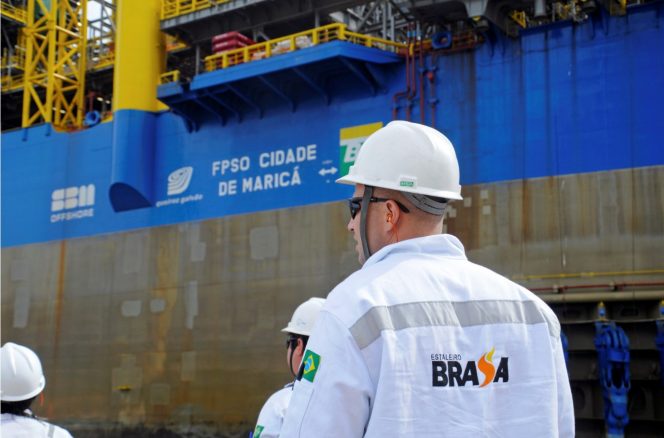
The World’s Largest FPSO Supplier, SBM Offshore, Will Close Its Brasa Shipyard in Brazil, Where It Integrates the Modules and Hulls of Its FPSO Units, with a Loss of US $ 20 Million. Additionally, SBM Also Experienced a US $ 25 Million Reduction in Its Floating Production Unit Business.
SBM Offshore stated that, despite Brazil being its primary market, with several opportunities being actively pursued, the waiting time for opportunities in construction activities, combined with uncertainty regarding the evolution of local content regulations, led to the decision to keep Brasa inactive for at least two years.
The 65,000 m² Brasa yard, established in 2012, is located in Niterói, Rio de Janeiro, Brazil. It Was Responsible for the Construction of Topsides Integration in SBM’s FPSOs Cidade de Ilhabela, Cidade de Marica, and Cidade de Saquarema.
The company said on Thursday: “SBM Offshore, together with its joint venture partner, has decided to take steps to continue with the Brasa yard for at least the next two years. This decision will require the write-off of the investment in the completion of the joint venture (50% stake) to a residual accounting value of zero, resulting in a reduction in the recoverable amount of approximately US $ 20 million.
-
Government unlocks R$ 554 million for a highway that has been requested for decades and accelerates the duplication of BR.

-
Without bricks, without cement, and without endless construction: the cardboard house that is assembled in modules and can be moved.

-
Billions of barrels on the equatorial margin could lead Amapá to double its oil production in Brazil — the state aims to enter the route of companies in the Campos Basin, attract investments, and boost jobs and businesses in the oil and gas sector.

-
Without bricks, without cement, and without endless construction: the cardboard house that is assembled in modules and can be moved.

No Demand for FPUs
Aside from Brazil, SBM Offshore has taken a write-down on the recoverable amount in its Floating Production Unit business focused on the delivery of semi-submersible platforms and Tension Leg Platforms.
SBM stated: “Although the company continues to seek opportunities in the Floating Production Unit (FPU) market, customer activity visibility in this segment remains moderate. As a result, the goodwill related to the acquisition of Houston-based subsidiaries has been entirely impaired, resulting in a reduction in the recoverable amount of approximately US $ 25 million.
“The establishment of a global resource pool for engineering, announced in February, has facilitated the deployment of Houston-based resources to other product lines, including FPSOs,” said SBM.
In addition to the Brasa and FPU business lines, SBM Offshore expressed optimism on Thursday regarding future FPSO demand, also raising its updated underlying directional EBITDA guidance for 2018 from “around” to “above” US $ 750 million.
SBM Offshore’s CEO, Bruno Chabas, said: “The market recovery is accelerating based on industry fundamentals. Investment is needed to ensure future production and deepwater projects cfavorably rank in client project portfolios. SBM Offshore is uniquely positioned to benefit from the current recovery.”
The directional revenue guidance for the year is maintained at around US $ 1.7 billion, with approximately US $ 1.3 billion from Lease and Operate and around US $ 400 million from Turnkey. Year-to-date, SBM Offshore has generated revenue of US $ 1.247 billion, stable (-1%) compared to the same period last year.









Seja o primeiro a reagir!