





 Portuguese
  English
  Spanish
  5 min of reading
  0 comments


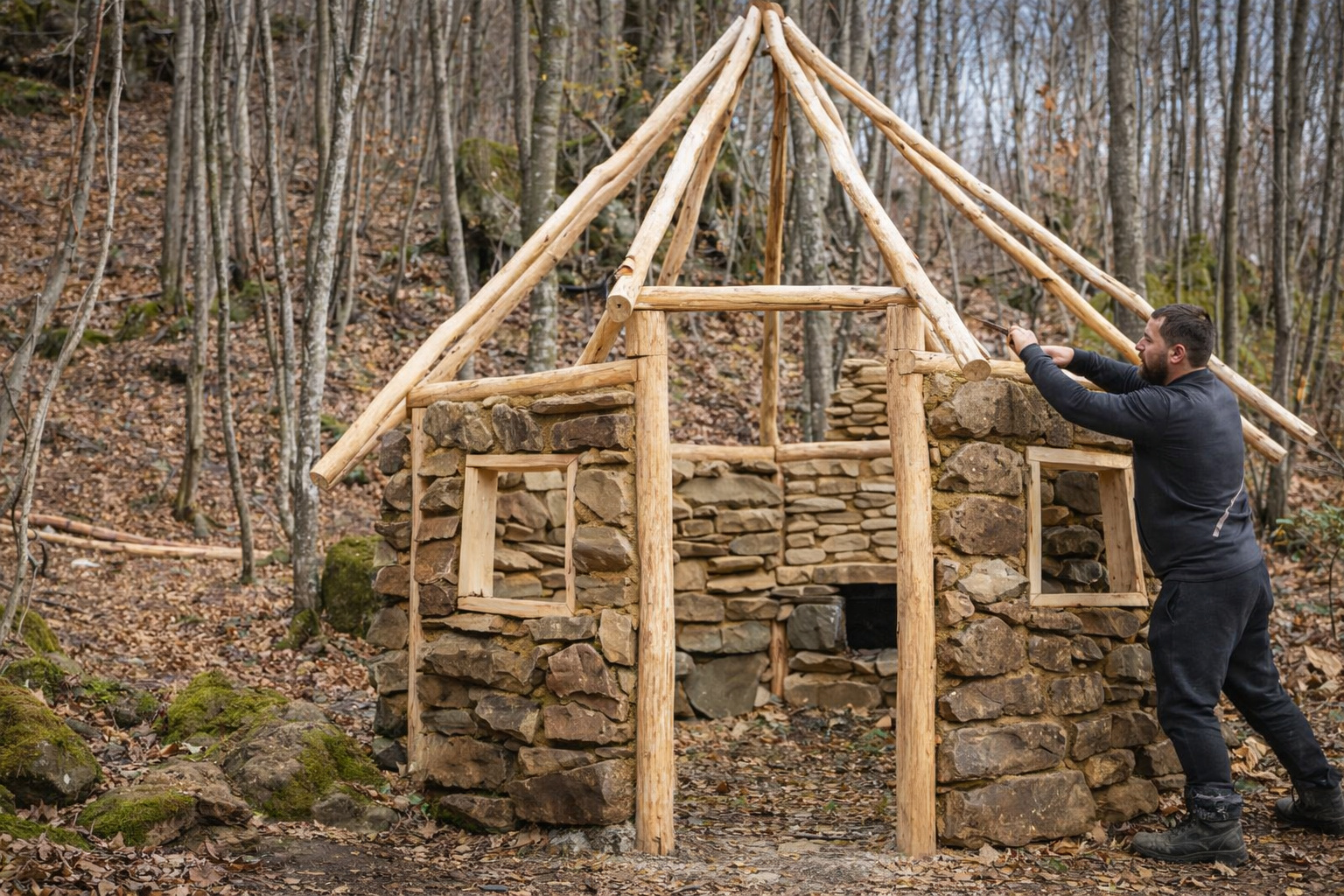
With Shovel, Axe, and Wood Gathered From the Surroundings, Worker Builds Circular House of Stone, Wood, and Conical Straw Roof Using Only Manual Labor and Creative Construction
Everything is impressive. A plot covered with dry leaves and loose stones begins to change shape as a man works alone in the midst of the vegetation. No machines, no electricity, and using only hand tools, he transforms the space into a circular house with a conical straw roof.
The process happens step by step. First comes the excavation of the soil, then the assembly of a stone base, the installation of vertical logs, and finally the sloped structure of the roof. Each phase depends on physical strength, repetitive movements, and careful fitting of the natural materials.

The result draws attention because it shows a simple and efficient building solution. Stone, wood, and straw form a complete shelter, assembled only with basic tools and a method that prioritizes direct use of the natural resources available on site.
-
These living root bridges and ladders are over 700 years old and help indigenous people survive in one of the rainiest regions in the world.

-
From sertanejo star to international investor: Ana Castela invests millions in a mansion in the USA, creates a themed accommodation in Orlando, and shows that the “boiadeira” also wants to grow away from the stage.

-
The 10 most stunning motorhomes in the world: a $3 million trailer with a rooftop nightclub and garage for a Ferrari, “palaces on wheels” with Italian marble, private cinema, and five-star hotel luxury for billionaires.

-
Trump wanted to spend $400 million on the White House, but the courts prohibited the million-dollar construction.


Manual Excavation of the Land Defines the Circular Shape of the Construction and Creates the Foundation of the Shelter
The first step happens directly on the forest floor. With a metal shovel, the worker removes layers of soil mixed with fine roots and dry leaves. The soil begins to form a circular depression that marks exactly where the house will be built.
The execution requires constant repetition. The shovel enters the soil, lifts the earth, and deposits the material beside the hole. Over time, the bottom of the excavation becomes flatter, and the circular outline becomes increasingly defined.
This preparation creates a stable base for the rest of the structure. The uneven land loses natural protrusions and begins to receive larger stone blocks that start to form the first ring of the construction.
Heavy Stones Form a Strong Foundation That Supports the Entire Wall of the House
Once the soil is prepared, large stones begin to appear around the excavated circle. Each block is manually lifted and placed at the edge of the excavation, creating a continuous base that follows the round shape of the house.
The assembly requires constant attention to fitting. The rocks are rotated until a stable position is found, and small fragments of stone or compacted earth are used to fill gaps between the blocks.

This ring of stones creates a heavy foundation that supports the weight of the upper walls. The base also slightly elevates the construction from the ground, creating a clear boundary between the interior of the shelter and the natural terrain.
Wooden Logs Form the Vertical Structure That Defines the Shape of the House
With the foundation ready, straight wooden logs are positioned vertically around the stone circle. The bases of these posts are secured between the blocks while the top remains free to receive the roof beams.
The installation requires raising each log and adjusting its position until it is aligned with the others. An axe and a saw come into play during the work to trim ends and improve the fitting of the wooden pieces.
The vertical structure begins to reveal the volume of the construction. The posts create the skeleton of the house and define the points where the stone wall will rise and where the roof will have support.
Stone Walls Grow Layer by Layer and Create a Solid Shelter
After the wooden structure is assembled, the work returns to the stones. Medium and large rocks are stacked between the vertical logs, forming thick walls that follow the circular contour of the base.

Each stone is placed carefully to avoid movement of the assembly. Small fragments are inserted between the larger pieces to stabilize the wall and maintain the alignment of the stacking.
As the rows increase in height, the shelter begins to take on a robust appearance. The stone walls start to envelop the wooden structure, creating a protected internal space.
Sloped Wooden Structure Creates the Conical Straw Roof That Defines the Shelter
With the walls completed, long wooden beams rest on top of the posts. These pieces slope towards the center of the construction, forming a radial structure that converges at the top.
Each beam serves as a support for the covering. The assembly creates a conical shape resembling that of a closed umbrella, with the bases distributed around the circular wall.
This arrangement completely transforms the appearance of the house. The shelter gains height in the center and a uniform slope towards the edges, creating the necessary support to receive the straw covering.
Layers of Straw Close the Roof and Complete the Protection of the House
The final step involves bundles of straw positioned over the wooden structure. The plant material is placed from the top down, covering the beams and forming a thick layer over the roof.
The work requires positioning each bundle carefully so that the covering follows the slope of the beams. The layers overlap until a continuous surface is formed around the conical roof.
Once the covering is completed, the shelter is finished. The circular house now has solid stone walls, a sturdy wooden structure, and a straw roof that covers the entire interior.

The construction draws attention because it shows that simple techniques can still produce efficient results. With shovel, axe, wood, stone, and straw, a single worker builds an entire house using only physical strength, organization, and constructive creativity.
This type of manual construction reveals an aspect that often goes unnoticed in modern engineering. Even without machines or complex equipment, the correct combination of natural materials can create stable and functional structures.
If you had to build a shelter using only natural materials, which technique would you use first? Share your thoughts in the comments.








-

-

-

-

-

-

44 pessoas reagiram a isso.