





 Portuguese
  English
  Spanish
  3 min of reading
  0 comments



The Autonomy and Income program combines digital and in-person education, offers financial benefits, and connects students to the job market
A new opportunity for professional qualification has been announced by the National Service for Industrial Learning, attracting national attention.
The program provides 15,000 spots in free technical courses, in addition to a monthly scholarship of R$ 700, which expands access to technology training.
This initiative occurs in partnership with Petrobras and is part of the Autonomy and Income program, which prepares young people for the job market.
-
MEC launches a free 180-hour online course on the AVAMEC platform with certification, immediate enrollment, and a duration of 45 to 200 days, teaching Genially, Google Sites, Wordwall, and the creation of videos and podcasts for teachers.
-
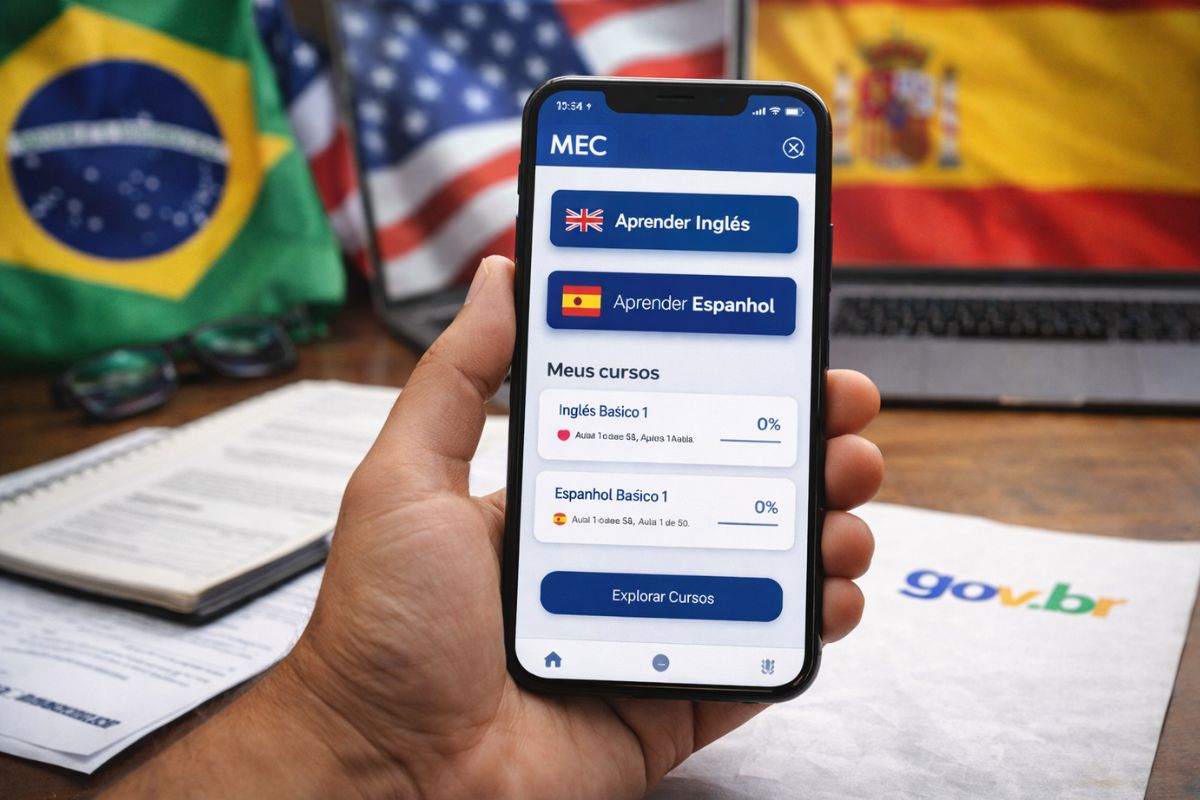
MEC launches free app with 800 English and Spanish lessons for any Brazilian: just have an account on gov.br and start from beginner to advanced.
-
USP opens 10,000 spots in a free online food education course: 110-hour training runs until August, targets public network employees in SP, and accepts registrations only until April 15.
-
Few people know, but SENAC has over 370 open slots for a free online technical course in Logistics, with national certification from SENAC RS and professional training in 13 months.
The proposal combines online and in-person education while simultaneously strengthening digital training on a national scale.
Program structure reveals progressive training in technology
Initially, the program was structured in two phases and, therefore, organizes learning progressively.
In the first stage, 10,000 candidates participate in the Digital Literacy course, conducted entirely online.
During this phase, students learn essential content, such as:
- Use of digital tools
- Safe navigation on the internet
- Organization of information
- Concepts of digital citizenship
- Introduction to logic and computational thinking
This stage creates a solid foundation for the technical evolution of participants.
In-person stage expands training in programming
Subsequently, students can compete for in-person spots in the Full Stack Programming course, which deepens technical knowledge.
In total, there are 420 spots distributed across states such as São Paulo, Rio de Janeiro, Bahia, Amapá, Rio Grande do Norte, Rio Grande do Sul, and Sergipe.
To do this, it is necessary to complete the online phase and reside in one of the selected cities.
Additionally, according to the schedule released by Senai, in-person classes begin in April, consolidating the transition to advanced training.
SIGN UP HERE!
Financial benefits ensure students’ retention
Participants in the in-person phase receive benefits that facilitate their continuation in the course.
Among them, the following stand out:
- Monthly scholarship of R$ 700
- Transportation assistance
- Food assistance
- Uniform
- Technical and pedagogical support
Thus, the program aims to reduce dropout rates and ensure the completion of training.
Participants in the online phase also receive benefits
On the other hand, even those who do not advance to the in-person stage still retain important benefits.
Upon completing the online course, participants receive:
- Certificate of completion
- Access to new free technology courses
Among the available options are:
- Internet of Things (IoT)
- 5G
- Computer networks
- Artificial Intelligence
- Mobile development
Thus, the program expands opportunities for continuous qualification.
Advanced training connects students to the job market
Subsequently, those who complete the Full Stack Programming course can advance to strategic specializations.
Among them, the following stand out:
- Artificial Intelligence
- Cloud computing
- Robotics
- Low Code
Additionally, the program includes participation in employment fairs and connections with partner companies.
Participation criteria prioritize social inclusion
According to Senai, the following can register:
- Young people between 17 and 22 years old
- Candidates from all over Brazil
Additionally, the program prioritizes:
- Women
- Black people
- Trans, transgender, and travesti people
Thus, the initiative expands access to technology in an inclusive manner.
Online registrations facilitate national access
Finally, registrations are open and must be made exclusively online, on the Autonomy and Income program website.
In this way, the digital process expands the initiative’s reach across all regions of the country.









Seja o primeiro a reagir!