





 Portuguese
  English
  Spanish
  4 min of reading
  0 comments


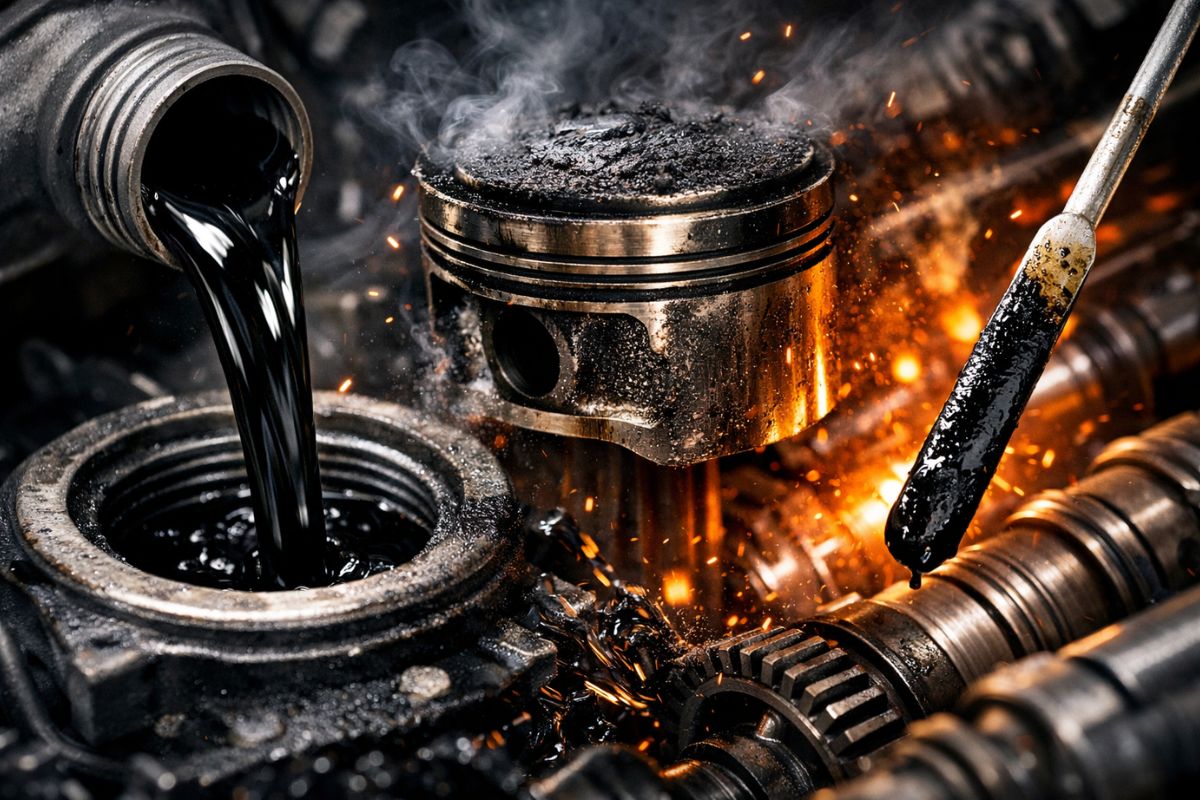
When the Oil Darkens Quickly, Many Interpret it as Immediate Mechanical Failure, but the Phenomenon Usually Indicates Active Engine Cleaning: Detergents Suspend Carbon Particles, Additives Combat Oxidation at High Temperatures, and the Lubricant Starts to Carry Residues That Cannot Securely Adhere Internally Continuously.
When the oil changes from golden to dark shortly after the change, the most common reaction is to think of an expensive defect. However, in most situations, the opposite happens: the lubricant has started to work on the most sensitive point of the engine, removing microscopic dirt and keeping the internal surfaces protected.
This behavior can appear in any car, but it stands out more in diesel engines, where soot occurs more quickly and changes color in a short time. In gasoline engines, the change is usually slower, sometimes over thousands of kilometers, without altering the logic of the process.
What Really Happens in the First Kilometers After the Change
Those who check the dipstick right after leaving the shop usually expect to find the same golden tone of the new product. When the oil appears darkened, the doubt arises: “Was bad lubricant used?” or “Is the engine compromised?”. In practice, isolated dark color is not a sentence of problem. It can just be the first sign that the additive package has kicked in and started sweeping the internal circuit.
-
The car stored for 38 years: when opening the barn door, what appears is breathtaking and looks like a scene from a movie!

-
Fiat works miracles in the Brazilian market, lowers the price of its 0 km hatch to R$ 69,990, reestablishes the model as the cheapest car in the country, and reignites the battle against Kwid and C3.

-
Chevette with cooking gas: How the gas cylinder ends up being used in cars clandestinely and why this makeshift solution can result in leaks, explosions, damaged engines, and seized vehicles.
-
Fiat launches the new 2027 Toro hybrid with 48V, 176 hp, an electric motor of 15.5 hp, a 0.85 kWh battery, up to 7% fuel savings, 8% fewer emissions, and possible exemption from IPVA.


This effect appears where the engine suffers the most: lubrication galleries, high-temperature areas, and continuous friction points between metal components. The lubricant circulates through these sections, capturing fine combustion particles and preventing this material from depositing in critical areas. In other words, darkening can be just the visible evidence of work that needed to happen.
Soot, Additives, and Heat: Why Does the Oil Darken So Quickly?
In combustion engines, part of the carbon generated is not completely burned and turns into microscopic soot. This soot, especially common in diesel, is carried by the oil and changes color in a short time. It is not the color that dirty the engine; it is the oil that removes dirt to prevent internal damage. This detail reverses the perception of many and reduces hasty interpretations.
Moreover, modern lubricant is not made solely of oily base. It contains detergent and dispersant additives, as well as antioxidant components, to enhance protection and stability. When these additives react with by-products of degradation, part of their efficiency is consumed over the useful life. At the same time, internal heat accelerates oxidation reactions, altering the appearance of the fluid. Therefore, darkening results from a combination: active cleaning + suspended contaminants + normal thermal stress of operation.
Dark Color Does Not Condemn the Oil, but Texture and Residues Can Raise an Alert
The right question is not just “Is the oil black?”, but “How is this oil behaving?”. A fluid that darkens and maintains adequate fluidity can be performing its function normally. However, when there is excessive thickening, pasty appearance, clumps, or visible metallic particles, the scenario changes and requires immediate technical attention. What truly concerns is loss of behavior, not just color change.
It also matters where and how the verification is done. Checking the level and appearance on the dipstick, with the correct checking procedure, helps avoid misinterpretation. Those who drive often in heavy traffic, short trips, or severe conditions may subject the set to greater stress and need to follow the maintenance interval with discipline. In these cases, professional reading in a reliable workshop prevents both unnecessary scares and dangerous negligence.
How Long Does the Interval Last and Why Following the Routine Prevents Loss
There is one point that resolves much of the anxiety: the oil has a defined service life by time and mileage, not by isolated color. The general recommendation is to change it annually or every 15,000 km, whichever comes first. This answers the “how much” in an objective and practical way. If the deadline is still within the expected, darkening alone does not turn the engine into an emergency.
The “where” of the decision also matters: it should not arise from hasty visual impression in the garage, but from the combination of the correct interval, usage history, and coherent technical evaluation. The “who” plays a strong role here: it is the owner, along with a qualified workshop, who defines the maintenance without falling into extremes, neither delaying beyond the limit nor changing early out of fear of color. The “why” becomes clear: keeping the lubricating film intact is what separates healthy operation from accelerated wear.
If the oil darkened shortly after the change, the more rational reading is this: it may be doing exactly the expected work, cleaning, suspending soot and dealing with intense heat without allowing contaminants to adhere to the internal parts of the engine. Valid concern exists, but it starts with the right signs, not the shock of color.
In your case, how many days or kilometers did it take for the oil to darken, and what guidance did the workshop give when you showed the dipstick: to maintain the standard interval or to anticipate the change due to some specific usage condition?









-

Uma pessoa reagiu a isso.