






 Portuguese
  Spanish


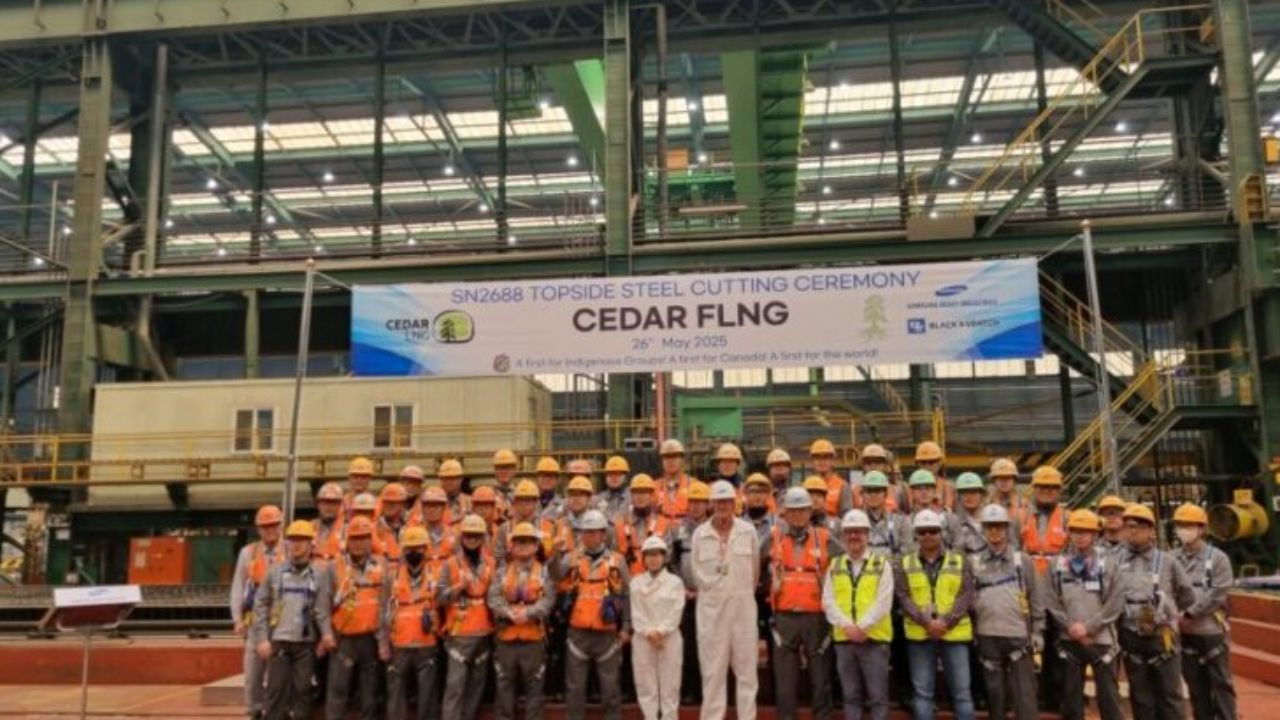

Steel Cutting Ceremony in South Korea Marks the Start of Construction of the Floating Liquefied Natural Gas (FLNG) Unit for the Cedar LNG Project Led by an Indigenous Nation.
The Samsung Heavy Industries (SHI) shipyard officially began the construction of a floating liquefied natural gas (FLNG) vessel intended for Canada. A steel cutting ceremony, held on May 26, 2025, in South Korea, marked the advancement of the US$ 4 billion Cedar LNG project. This project is being developed by Pembina Pipeline Corporation and the Haisla Nation, setting a new standard for Indigenous-led LNG exports.
The Start of FLNG Vessel Manufacturing
The ceremony represents a fundamental milestone for the Cedar LNG project. According to the developers, the event marks the beginning of the manufacturing of specific components of the vessel. Work will continue in parallel with the full development of the FLNG system project.
“This is an exciting moment for Cedar LNG as it represents the official start of construction of what will be an innovative, world-class floating LNG facility with low carbon emissions,” said Craig Day, Cedar LNG Projects Director.
-
This Massive 12-Meter, 21-Ton Underwater Drone Can Operate Autonomously for Up to Five Days

-
Global Shipping Faces Shortage of Certified Maritime Officers, Salaries in the U.S. Can Exceed $100,000 Annually

-
The FLIP: A 108-Meter Ocean Laboratory That Stood Vertically for 60 Years, Dismantled in 2023
-
North Korean Fiasco: Launch of the Largest Warship Ends in Sinking



Indigenous Leadership and Sustainability
The project is a symbol of a new era of Indigenous-led LNG exports to British Columbia, Canada, and the world. Once completed, the FLNG vessel will be transported from South Korea to its operational site in the traditional territory of the Haisla Nation.
“Seeing the floating LNG vessel begin to take shape is incredible,” said Chief Councillor Crystal Smith. She highlighted that the vessel will serve as a reminder of what is possible when Indigenous nations actively participate in managing their resources. The choice of a floating facility reflects the Haisla Nation’s values of sustainability and environmental protection, minimizing impacts on the region.
Capacity and Timelines of the FLNG Unit
The completion of the FLNG vessel is estimated for 2028. The Cedar LNG project’s entry into operation is expected by the end of the same year.
The facility will have the capacity to process 400 million standard cubic feet of natural gas per day. The annual LNG production will be 3.3 million tons, intended for international markets.
A Low-Emission FLNG for Asian Markets
With the green light received in June 2024, the Cedar LNG project will be powered by hydroelectric energy from the British Columbia grid. This will allow the production of LNG classified as ultra-low carbon. The LNG from the project is believed to have the potential to replace higher-emission energy sources in Asia.
The terminal’s location is strategic, offering one of the shortest shipping routes to key Asian markets. In March, a subsidiary of ExxonMobil in the Asia-Pacific closed a deal to purchase approximately 1.5 million tons per year of LNG from the facility.
Those Responsible for the Construction and Feasibility of the Project
Samsung Heavy Industries (SHI) and Black & Veatch were selected for the engineering, procurement and construction (EPC) contract for the FLNG unit. GTT will be responsible for the design of the vessel’s containment tank.
In addition to private investment, the project received support of up to 200 million Canadian dollars (approximately US$ 139.8 million) from the Canadian government in March, reinforcing its feasibility and national importance.


