





 Portuguese
  English
  Spanish
  5 min of reading
  0 comments


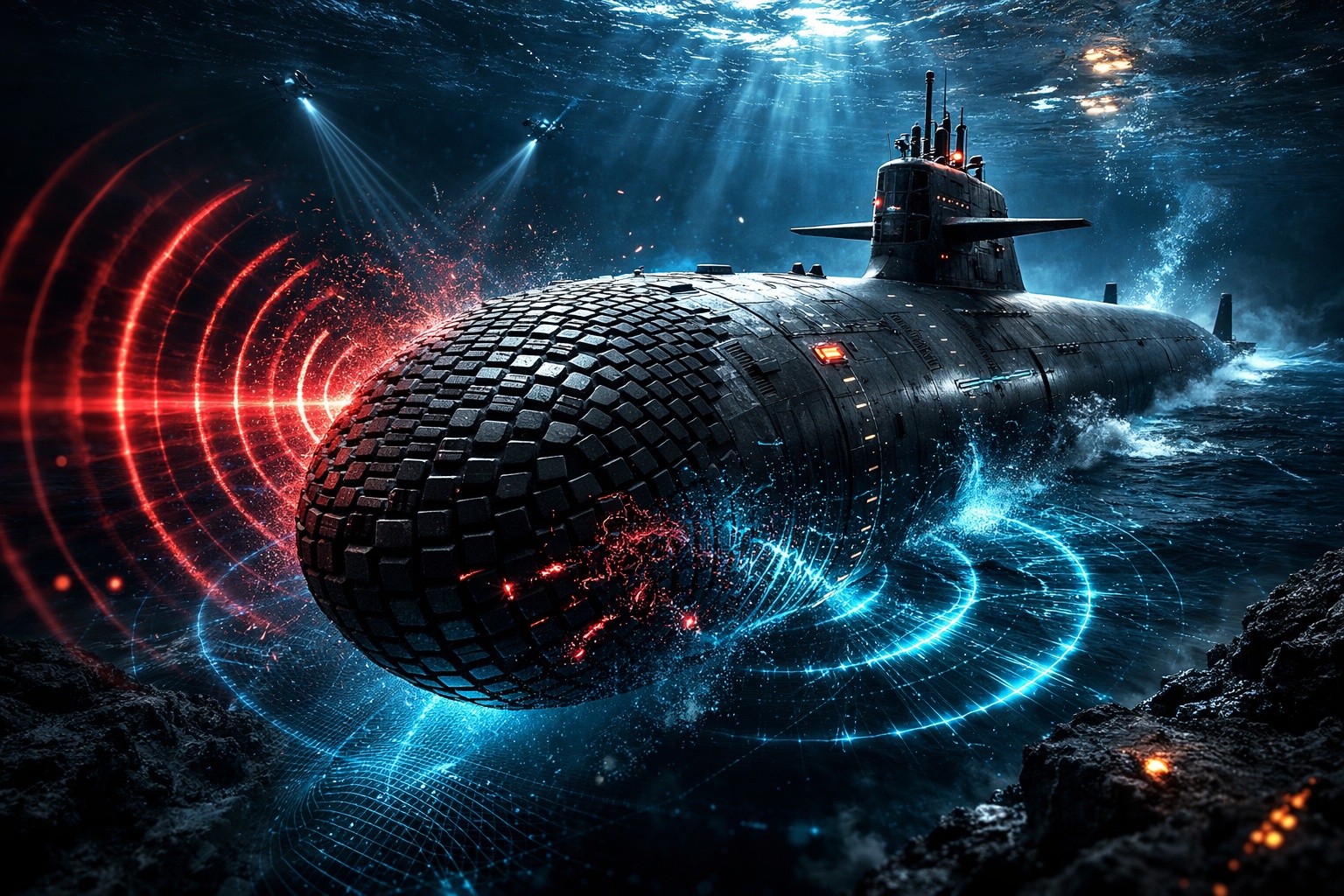
Anechoic Coatings Absorb Sonar Waves and Reduce the Acoustic Signature of Nuclear Submarines, Key Piece of Deterrence in the Seabed.
At the center of modern submarine warfare is an invisible struggle to the human eye: the battle for sound. Since World War II, detecting or not detecting a submarine largely depends on acoustic physics. In an environment where light rarely penetrates and radars do not work underwater, sound is the primary means of location.
It is in this scenario that anechoic coatings emerge — plates applied to the outer hull of military submarines with the function of absorbing and dispersing sound waves emitted by enemy sonars. The goal is simple in theory and complex in practice: to reduce echo and make detection more difficult.
This technology is now considered an essential part of strategic submarine stealth.
-
Something is happening around the Earth: Inside the huge explosion of fireballs in 2026

-
A hot air bubble coming from Argentina expands over Brazil, causing thermometers to exceed 38 degrees with a thermal sensation of 40 degrees in late March, affecting 6 states at once.

-
The radish leaf that almost everyone throws away has more polyphenols, flavonoids, and fiber than the consumed root, and a 2025 study showed that the leaf contains compounds that protect the intestine, combat inflammation, and may inhibit the growth of cancer cells.

-
A planet that seemed to defy the laws of physics has intrigued scientists for decades, until the James Webb revealed what is really affecting Saturn’s rotation.


How Sonar Detects a Submarine
Submarine detection occurs mainly through two methods:
- Active sonar, which emits sound waves and analyzes the reflected echo.
- Passive sonar, which only listens to noises produced by the target.
In active sonar, the principle is similar to that of an acoustic radar. A sound pulse is sent into the water and, upon hitting a solid object, part of the energy returns to the emitter. This return allows for the calculation of distance and position.
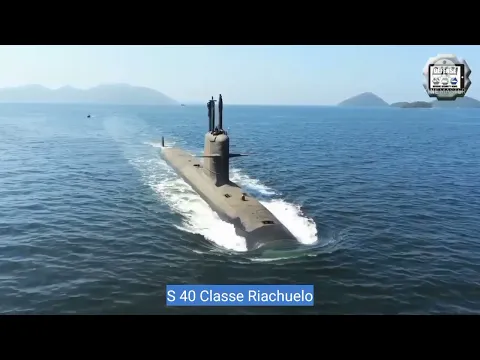

A traditional metal hull reflects a significant part of this sound energy, creating a detectable echo.
Anechoic coatings act exactly at this point: they reduce the reflection of the sound wave by absorbing part of the incident energy.
What Are Anechoic Plates
Anechoic plates are layers of synthetic rubber or special polymers attached to the outer hull of the submarine. They contain thousands of internal microscopic cavities designed to capture sound waves at different frequencies.
When a sonar wave hits the coated surface, part of the energy enters these cavities and is dissipated, turning into microscopic heat instead of returning as an echo.

This process does not eliminate reflection entirely but can significantly reduce it.
In addition to absorbing external waves, the coating also helps dampen internal vibrations, decreasing the noise generated by the submarine itself — a crucial factor against passive sonar.
Origin in World War II
The concept is not new. Nazi Germany developed an anti-sonar coating called Alberich during World War II, applied to some U-boats.
The intention was to reduce the effectiveness of Allied sonar, which was becoming increasingly efficient.
After the war, both the United States and the Soviet Union studied and refined the concept. During the Cold War, the issue became strategic.
Soviet submarines, known for being noisier than the Americans in the early decades of the conflict, began to receive thick coatings to counteract this acoustic disadvantage.
Technological Evolution During the Cold War
Throughout the 1970s and 1980s, the acoustic race between the U.S. and the USSR intensified. Surveillance systems like SOSUS, an American network of hydrophones installed on the Atlantic floor, were able to detect submarine noises at long distances.
Reducing acoustic signature became a strategic priority.

Ballistic missile-launching nuclear submarines, responsible for the so-called “second nuclear response,” needed to remain hidden to ensure retaliation capability.
The quieter the submarine, the greater the effectiveness of deterrence. Anechoic coatings began to be systematically applied to strategic submarines.
Application in Modern Submarines
Today, classes such as Virginia and Seawolf from the United States, and Borei and Yasen from Russia use advanced acoustic coatings.
These modern plates feature:
- Multilayer structures
- Cavities calibrated for different frequencies
- High pressure resistance
- Durability during long patrols
A nuclear submarine can operate at hundreds of meters depth, where hydrostatic pressure is dozens of times higher than atmospheric pressure. The coating must maintain structural integrity under these extreme conditions. Additionally, it must withstand constant hydrodynamic impact and the corrosion of saltwater.
It Is Not Total Invisibility
Despite its efficiency, the anechoic coating does not make the submarine invisible. Modern submarine warfare involves multiple layers of detection:
- Long-range low-frequency sonar
- Sensor networks on the sea floor
- Analysis of surface disturbances
- Magnetic systems
The coating is just one part of a larger set that includes:
- Engine isolation on cushioned mounts
- Propulsion designed to reduce cavitation
- Optimized hydrodynamic design
- Strict control of internal vibrations
The goal is to reduce the global acoustic signature of the ship. During the Cold War, there were reports of plates coming loose from Soviet submarines after long patrols.
When a plate detached, it created additional turbulence and, paradoxically, could increase detectable noise. With the advancement of materials and fastening methods, reliability has increased significantly.
Still, maintenance is constant. Submarines undergo periodic inspections to ensure that the coating is intact.
Why This Is Strategic
Strategic nuclear submarines carry intercontinental ballistic missiles.
Their primary function is to ensure retaliation capability in case the country suffers a nuclear attack. This capability depends on one essential factor: survival.
If a submarine can be easily located, its deterrence function loses credibility. The anechoic coating, therefore, is not just a technical detail. It is part of the architecture of global nuclear stability.
The Silent War
The struggle for acoustic superiority rarely makes headlines. It does not involve visible explosions or public displays of force.
It is a silent race, based on physics, materials engineering, and mathematical modeling. While sonars sweep oceans in search of minimal signatures, submarines continue to navigate under layers of acoustic absorption designed to reduce every possible echo.
It is an invisible battle occurring hundreds of meters below the surface, where sound decides who detects first.
And, in this environment, thousands of tiny microscopic cavities can make the difference between being heard or remaining invisible.







-

-

-

-

-

-

156 pessoas reagiram a isso.