





 Portuguese
  English
  Spanish
  2 min of reading
  0 comments


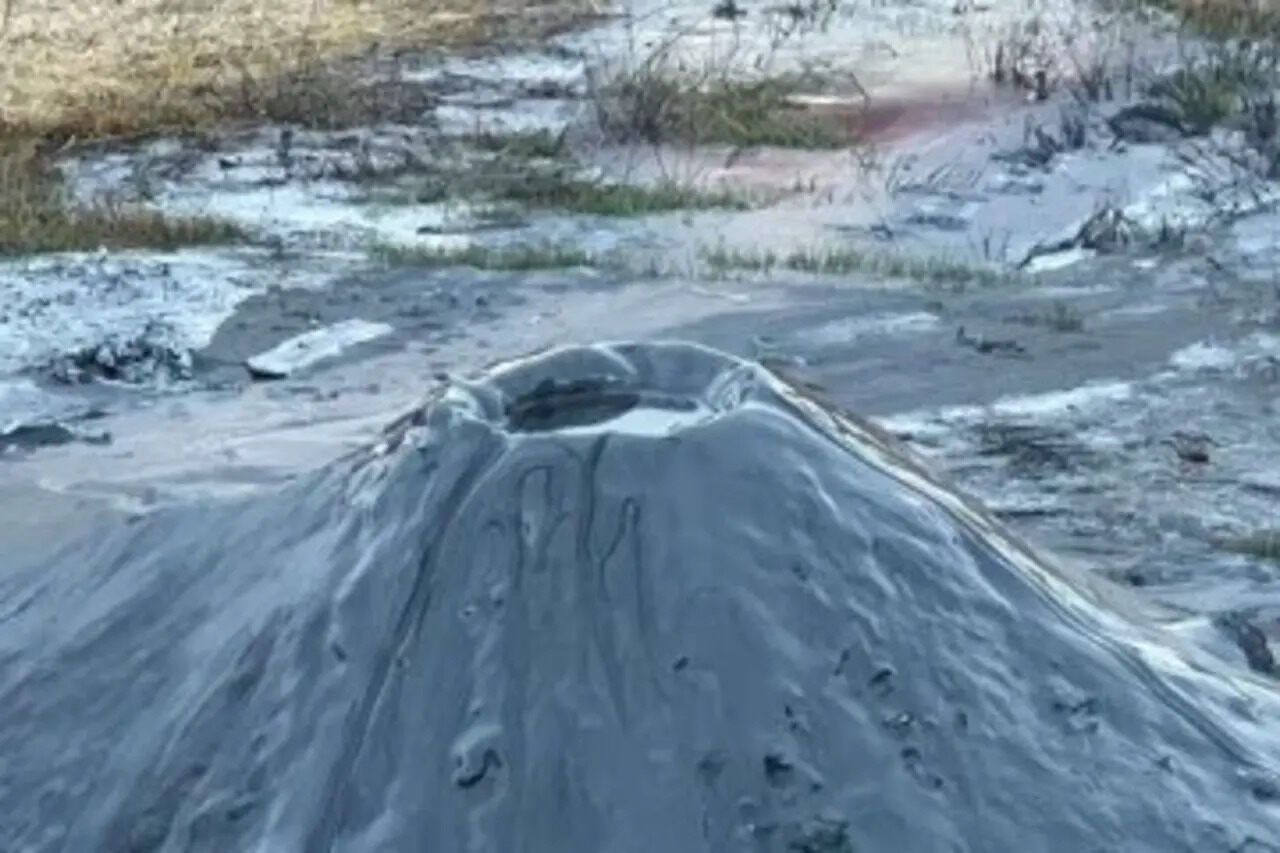
Residents of Cusco Observe Unusual Formation in the Ground; Conical Structure Emits Dark Mud, But Is Not Related to Active Volcanoes in Peru
An unusual phenomenon surprised residents of the mountainous region of Cusco, in southern Peru. A small gray mound, just 60 centimeters tall, appeared in the ground and began to expel a dark, muddy substance. The structure resembles a miniature volcano, with a conical shape and a crater on top, similar to large traditional volcanoes.
The discovery attracted attention not only for its appearance but also for the material oozing from the central hole. Over time, the mud solidified, forming a dark, hard crust.
Faced with the unusual scene, Arturo Mamani, a local community leader of Inca descent, nicknamed the formation “Eagle’s Eye.”
-
Motorola launched the Signature with a gold seal from DxOMark, tying with the iPhone 17 Pro in camera performance, Snapdragon 8 Gen 5 that surpassed 3 million in benchmarks, and a zoom that impresses even at night.

-
Satellites reveal beneath the Sahara a giant river buried for thousands of kilometers: study shows that the largest hot desert on the planet was once traversed by a river system comparable to the largest on Earth.

-
Scientists have captured something never seen in space: newly born stars are creating gigantic rings of light a thousand times larger than the distance between the Earth and the Sun, and this changes everything we knew about stellar birth.

-
Geologists find traces of a continent that disappeared 155 million years ago after separating from Australia and reveal that it did not sink, but broke into fragments scattered across Southeast Asia.

Despite the nickname and the appearance reminiscent of a classic volcano, experts clarified that the phenomenon is not related to volcanic activity.
Dr. Hernando Tavera, head of the Peruvian Geophysical Institute (IGP), linked to the Ministry of the Environment (MINAM), explained that it is a mud cone and not a true volcano.
According to Dr. Tavera, structures like this arise when underground gases, such as methane and carbon dioxide, rise to the surface and drag clay sediments mixed with water.
The result is the formation of a small conical mound with a central crater, similar to that of a volcano, but without the presence of magma.
“This type of phenomenon occurs naturally. The mud, water, and gases emerge from the underground, forming this structure,” explained the IGP representative.
He emphasized that the discovered cone is not related to active volcanoes in the south of the country and that its origin is completely different.
Even without eruption risks, the phenomenon requires attention. Dr. Tavera warned that the composition of the mud could have environmental impacts.
If it contains pollutant substances, there is a possibility of contaminating nearby water sources. Therefore, the IGP is closely monitoring the case.
The technical team continues to evaluate the formation. The goal is to better understand the behavior of the mud cone and its possible environmental implications.
The analyses aim to provide safe and scientific information to the local population and authorities.
With information from Correio Brasiliense.







-

Uma pessoa reagiu a isso.