






 Portuguese
  Spanish
  2 min of reading
  0 comments


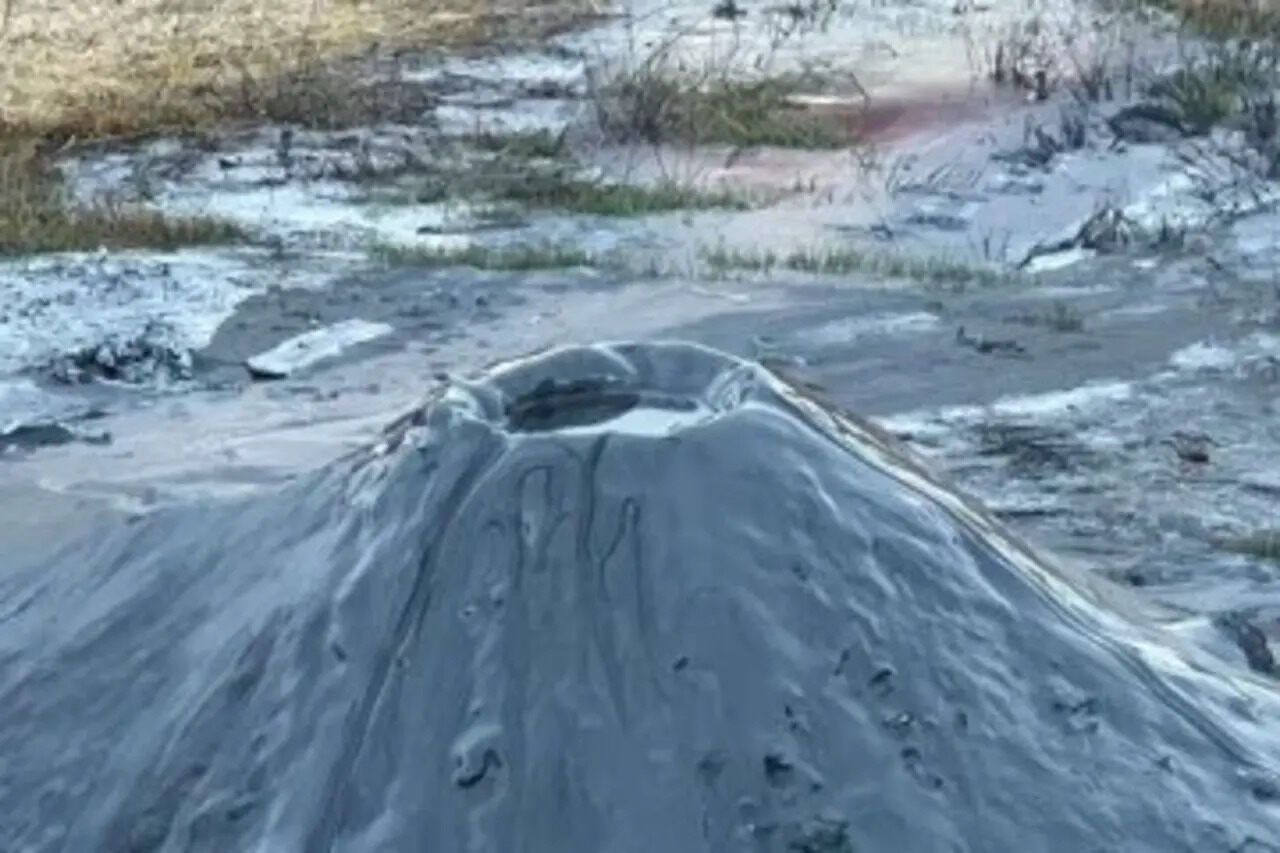
Residents of Cusco Observe Unusual Formation in the Ground; Conical Structure Emits Dark Mud, But Is Not Related to Active Volcanoes in Peru
An unusual phenomenon surprised residents of the mountainous region of Cusco, in southern Peru. A small gray mound, just 60 centimeters tall, appeared in the ground and began to expel a dark, muddy substance. The structure resembles a miniature volcano, with a conical shape and a crater on top, similar to large traditional volcanoes.
The discovery attracted attention not only for its appearance but also for the material oozing from the central hole. Over time, the mud solidified, forming a dark, hard crust.
Faced with the unusual scene, Arturo Mamani, a local community leader of Inca descent, nicknamed the formation “Eagle’s Eye.”
-
Chinese robots trained for two weeks to row a dragon boat at the Sichuan Festival in China, took full control when humans stopped rowing, and even made rice dumplings in one of the most unusual tests ever conducted with humanoids.

-
Public school students in Sergipe create an early autism screening kit for vulnerable communities without a doctor, in the year Brazil won 8 awards at the world’s largest science fair.
-
Engineering students create a low-cost 3D-printed wheelchair for dogs and help the paralyzed dog Bili, who was born without legs, walk again for R$ 448.
-
Man creates ingenious hack with pipes buried 2.4 meters deep and transforms snow into a tropical fruit greenhouse; system created by a retired mailman uses ground heat, produces oranges and lemons in Nebraska’s winter and has already turned into more than 700 kits sold.


Despite the nickname and the appearance reminiscent of a classic volcano, experts clarified that the phenomenon is not related to volcanic activity.
Dr. Hernando Tavera, head of the Peruvian Geophysical Institute (IGP), linked to the Ministry of the Environment (MINAM), explained that it is a mud cone and not a true volcano.
According to Dr. Tavera, structures like this arise when underground gases, such as methane and carbon dioxide, rise to the surface and drag clay sediments mixed with water.
The result is the formation of a small conical mound with a central crater, similar to that of a volcano, but without the presence of magma.
“This type of phenomenon occurs naturally. The mud, water, and gases emerge from the underground, forming this structure,” explained the IGP representative.
He emphasized that the discovered cone is not related to active volcanoes in the south of the country and that its origin is completely different.
Even without eruption risks, the phenomenon requires attention. Dr. Tavera warned that the composition of the mud could have environmental impacts.
If it contains pollutant substances, there is a possibility of contaminating nearby water sources. Therefore, the IGP is closely monitoring the case.
The technical team continues to evaluate the formation. The goal is to better understand the behavior of the mud cone and its possible environmental implications.
The analyses aim to provide safe and scientific information to the local population and authorities.
With information from Correio Brasiliense.




-

1 person reacted to this.